Viewing as
Teacher view: planning notes, the answers to every question, and the teacher copies of the files.
Maths · Similarity and congruence
Similarity in 3D solids
Use length, area and volume scale factors for similar solids, including cones, cylinders and frustums.
Teacher resources
The teacher copies: slides with the questions built in, the answers, and anything else attached to this lesson for whoever is teaching it.
- Similarity in 3D solids - Teacher Slides.pptx Teacher The lesson slides with the teacher's notes on each slide, and every question and mark scheme built in. Built from the lesson script on 30 September 2026. View
- Similarity in 3D solids - Teacher Notes.docx Teacher The complete notes with the teacher's notes and every model answer in full. Built from the lesson script on 30 September 2026. View
Student handouts
The same files the students see, to print or hand out.
- Similarity in 3D solids.pptx Built from the lesson script on 30 September 2026. View
- Similarity in 3D solids - Completed Notes.docx The full notes for the lesson, to revise from. Built from the lesson script on 30 September 2026. View
- Similarity in 3D solids - Exam Questions.docx Built from the lesson script on 30 September 2026. View
Warm-up
Answer each one, then check.
-
1
Work out \(2^3\).
Show answerHide answer
8
-
2
Work out \(1.5^3\).
Show answerHide answer
3.375
-
3
What is the area scale factor if \(k = 3\)?
Show answerHide answer
9
-
4
Work out \(\sqrt[3]{27}\).
Show answerHide answer
3
-
5
What is the formula for the volume of a cone?
Show answerHide answer
\(\dfrac{1}{3}\pi r^2 h\)
Learning Objectives
- 1Use length, area and volume scale factors.
- 2Find a volume, capacity or mass of a similar solid.
- 3Work out the length ratio from a volume ratio.
- 4Solve problems with similar cones, cylinders and frustums.
Similar Cubes
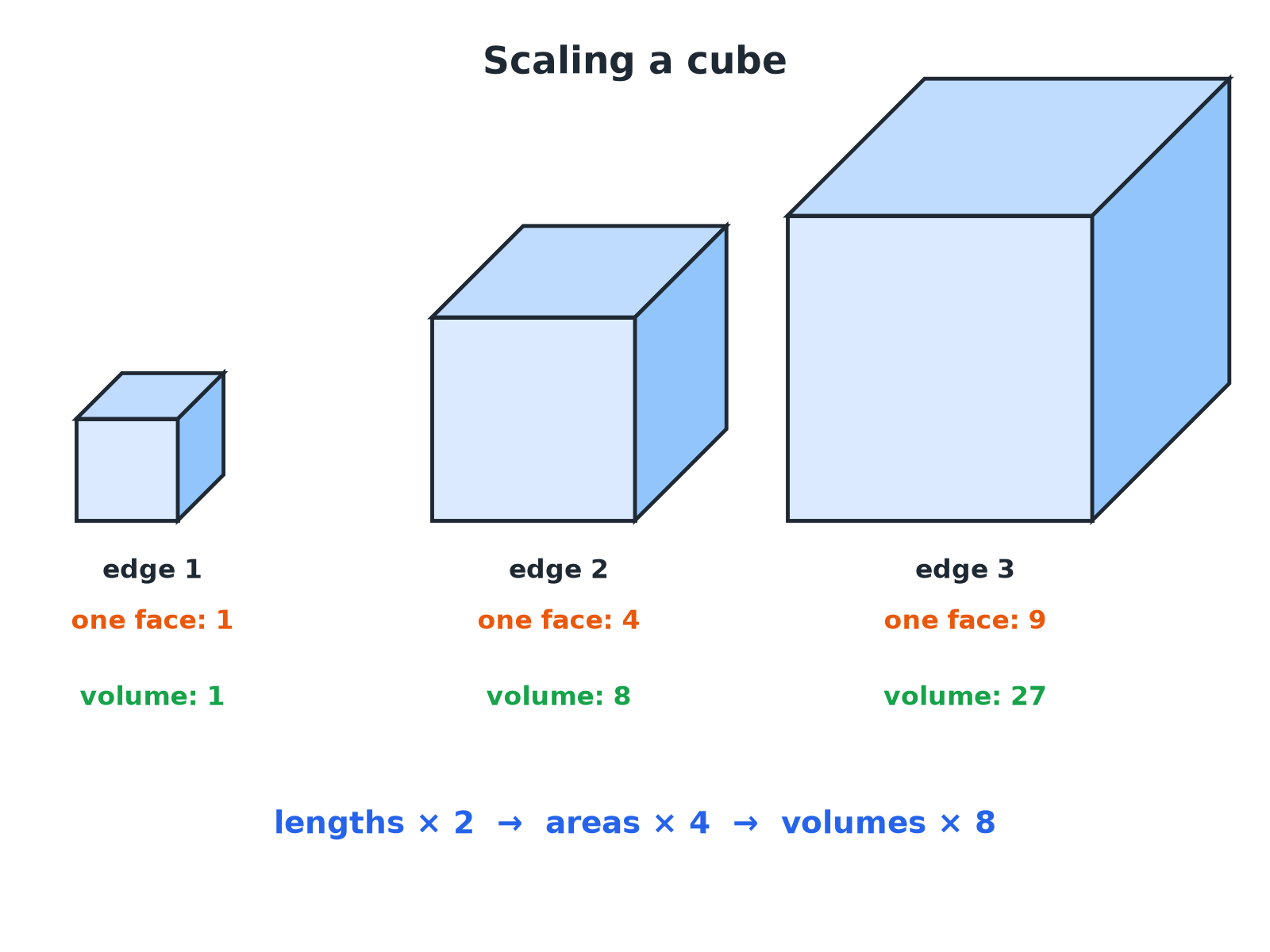
Doubling lengths multiplies areas by 4 and volumes by 8.
Scale Factors for Similar Solids
If the length scale factor is \(k\).
-
Lengths
Scale factor: \(k\). If \(k = 2\): 2
-
Areas (including surface area)
Scale factor: \(k^2\). If \(k = 2\): 4
-
Volumes (and capacity, mass)
Scale factor: \(k^3\). If \(k = 2\): 8
Volume of a Similar Cone
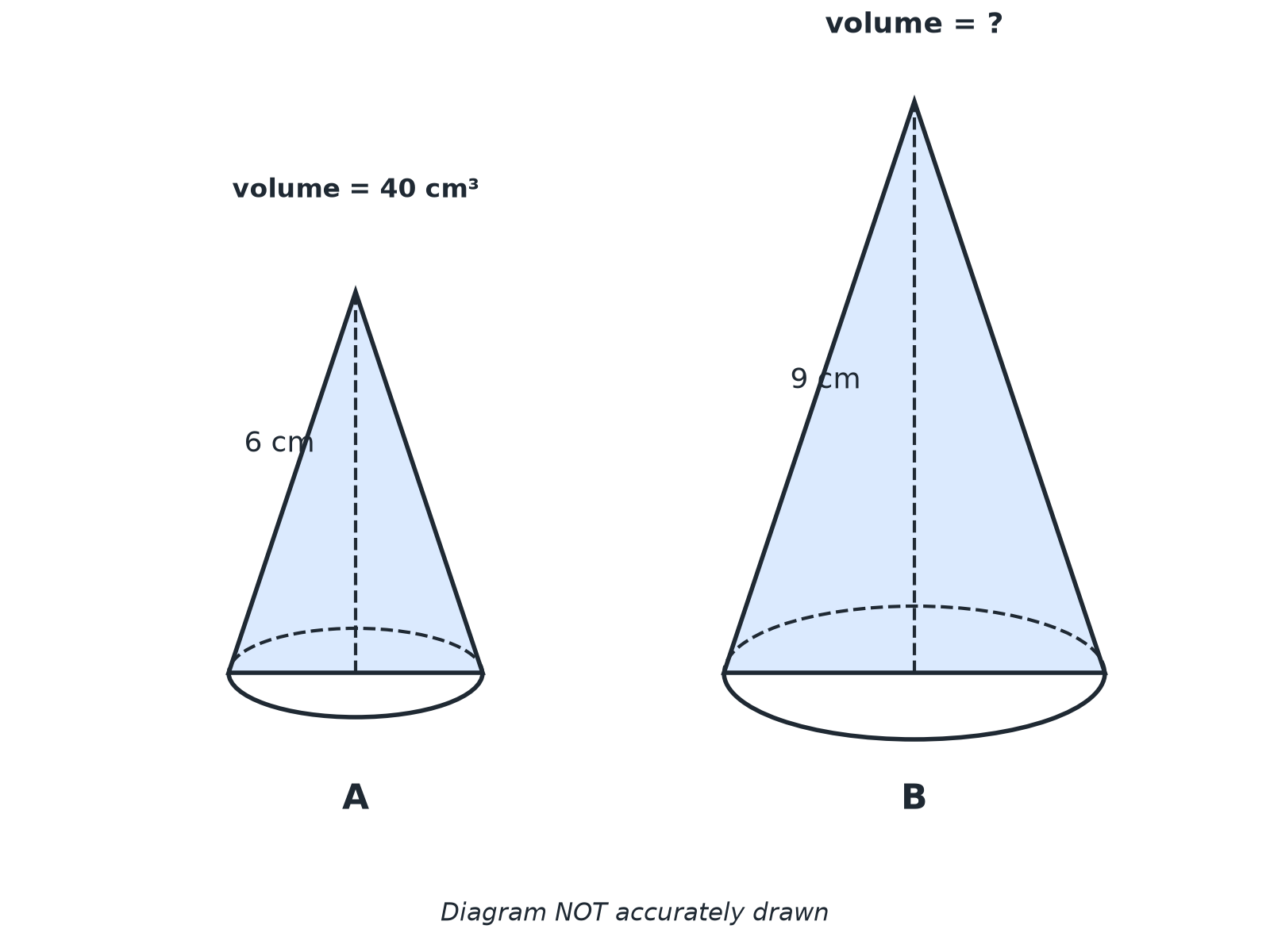
Cone A has height 6 cm and volume 40 cm³. Cone B is similar to A and has height 9 cm. Find the volume of cone B.
Show the solutionHide the solution
- 1 Length scale factor \(\dfrac{9}{6} = 1.5\)
- 2 Volume scale factor \(1.5^3 = 3.375\)
- 3 Volume of B \(40 \times 3.375\)
Answer135 cm³
A Model and the Real Thing
A model statue is 20 cm tall and has mass 2 kg. The real statue is 1.2 m tall and made of the same material. Find the mass of the real statue.
Show the solutionHide the solution
- 1 Length scale factor \(120 \div 20 = 6\)
- 2 Volume (and mass) scale factor \(6^3 = 216\)
- 3 Mass \(2 \times 216\)
Answer432 kg
A Frustum
A cone of height 15 cm has volume 500 cm³. A small cone of height 6 cm is cut off the top, leaving a frustum. Find the volume of the frustum.
Show the solutionHide the solution
- 1 The small cone is similar to the large cone Length scale factor \(\dfrac{6}{15} = 0.4\)
- 2 Volume scale factor \(0.4^3 = 0.064\)
- 3 Volume of the small cone \(500 \times 0.064 = 32\)
- 4 Frustum \(=\) large cone minus small cone \(500 - 32\)
Answer468 cm³
From Volumes to Lengths
Two similar solids have volumes 8 cm³ and 125 cm³. Find the ratio of their lengths and of their surface areas.
Show the solutionHide the solution
- 1 Take the cube root of the volumes \(\sqrt[3]{8} : \sqrt[3]{125} = 2 : 5\)
- 2 Lengths \(2 : 5\)
- 3 Surface areas: square the ratio \(4 : 25\)
AnswerLengths \(2 : 5\); surface areas \(4 : 25\).
Which Scale Factor?
Use \(k\) (lengths)
- Heights, radii, edges, perimeters.
- Anything measured in a straight line.
- Read directly from the two shapes.
Use \(k^2\) or \(k^3\)
- \(k^2\): area, surface area, cross-section.
- \(k^3\): volume, capacity, mass (same material).
- Cube or square root to go backwards.
Bottle Sizes
A small bottle is 10 cm tall and holds 250 ml. A similar large bottle is 15 cm tall. Find the capacity of the large bottle. A label on the small bottle has area 40 cm²; find the label area on the large bottle.
1. Find k.
2. Cube for volume.
3. Square for area.
A good answer shows: Scale factor 1.5. Capacity \(250 \times 1.5^3 = 843.75\) ml, about 844 ml. Label \(40 \times 1.5^2 = 90\) cm².
Can I...?
- 1State the scale factors \(k\), \(k^2\), \(k^3\).
- 2Find a volume of a similar solid.
- 3Find a mass using a volume factor.
- 4Find the surface area of a similar solid.
- 5Use a cube root to find a length ratio.
- 6Find the volume of a frustum.
- 7Choose the right scale factor.
- 8Show clear working.
Summary & Exam Focus
- Lengths \(k\), areas \(k^2\), volumes \(k^3\).
- For the same material, mass scales like volume.
- From a volume ratio take the cube root for lengths.
- A frustum is a large cone minus a similar small cone.
Exam focus
Cone A has height 6 cm and volume 40 cm³. Cone B is similar to A and has height 9 cm. Work out the volume of cone B. (3 marks) (3 marks)
Find the length scale factor first. Cube it for volume. Do not square it.
Key terms
The vocabulary this lesson expects you to use. Each one is linked from the first place it appears above.
- Similar solids
- Solids with the same shape and all lengths in the same ratio.
- Volume scale factor
- \(k^3\).
- Surface area scale factor
- \(k^2\).
- Frustum
- A cone or pyramid with the top cut off parallel to the base.
- Capacity
- The volume a container holds.
- Density
- Mass per unit volume; the same in similar solids of the same material.
Questions and answers
12 questions set on this lesson, with the mark schemes and model answers open.
Cone A and cone B are mathematically similar. The height of cone A is 6 cm and its volume is 40 cm³. The height of cone B is 9 cm. Work out the volume of cone B.
Mark scheme — 3 marks available
- Length scale factor 1.5 — M1
- \(1.5^3 = 3.375\) — M1
- 135 — A1
Model answer
The length scale factor is \(\dfrac{9}{6} = 1.5\). The volume scale factor is \(1.5^3 = 3.375\). The volume is \(40 \times 3.375 = 135\) cm³.
A model of a statue is 20 cm tall and has a mass of 2 kg. The real statue is 1.2 m tall and is made from the same material. Work out the mass of the real statue.
Mark scheme — 3 marks available
- Scale factor 6 — M1
- \(6^3 = 216\) — M1
- 432 — A1
Model answer
The length scale factor is \(120 \div 20 = 6\). The volume scale factor is \(6^3 = 216\). The mass is \(2 \times 216 = 432\) kg.
A cone has a height of 15 cm and a volume of 500 cm³. A smaller cone of height 6 cm is cut off the top, leaving a frustum. The small cone is similar to the large cone. Work out the volume of the frustum.
Mark scheme — 4 marks available
- Scale factor 0.4 — M1
- \(0.4^3 = 0.064\) — M1
- Small cone 32 — A1
- 468 — A1
Model answer
The length scale factor is \(\dfrac{6}{15} = 0.4\) and the volume scale factor is \(0.4^3 = 0.064\). The small cone has volume \(500 \times 0.064 = 32\) cm³. The frustum is \(500 - 32 = 468\) cm³.
Two similar solids have surface areas in the ratio \(4 : 9\). Work out the ratio of their volumes.
Mark scheme — 3 marks available
- Length ratio \(2 : 3\) — M1
- Cubing — M1
- \(8 : 27\) — A1
Model answer
The length ratio is \(\sqrt{4} : \sqrt{9} = 2 : 3\). The volume ratio is \(2^3 : 3^3 = 8 : 27\).
A small bottle is 10 cm tall and holds 250 ml of juice. A similar large bottle is 15 cm tall. Work out the capacity of the large bottle. Give your answer to the nearest ml.
Mark scheme — 3 marks available
- Scale factor 1.5 — M1
- \(250 \times 1.5^3\) — M1
- 844 — A1
Model answer
The scale factor is 1.5, so the volume scale factor is \(1.5^3 = 3.375\). The capacity is \(250 \times 3.375 = 843.75 \approx 844\) ml.
Two similar solids have volumes of 8 cm³ and 125 cm³. The surface area of the smaller solid is 20 cm². Work out the surface area of the larger solid.
Mark scheme — 3 marks available
- Length scale factor \(\dfrac{5}{2}\) — M1
- Area scale factor 6.25 — M1
- 125 — A1
Model answer
The length ratio is \(\sqrt[3]{8} : \sqrt[3]{125} = 2 : 5\), so the area scale factor is \(\left(\dfrac{5}{2}\right)^2 = 6.25\). The surface area is \(20 \times 6.25 = 125\) cm².
The length scale factor of two similar solids is 2. What is the volume scale factor?
Why: \(2^3 = 8\).
A model is 1/10 the size of a real object. The model's volume is what fraction of the real volume?
Why: \(\left(\dfrac{1}{10}\right)^3 = \dfrac{1}{1000}\).
Two similar solids have volume ratio \(1 : 27\). What is the length ratio?
Why: \(\sqrt[3]{27} = 3\), so \(1 : 3\).
Two similar shapes of the same material have length ratio \(1 : 2\). What is the ratio of their masses?
Why: Mass scales like volume: \(1 : 8\).
To find the volume of a frustum you...
Why: Subtract the small similar cone from the large cone.
The surface areas of two similar solids are 25 cm² and 100 cm². If the smaller has volume 30 cm³, what is the volume of the larger?
Why: The length ratio is \(1 : 2\), so the volume is \(30 \times 8 = 240\) cm³.