Viewing as
Teaching this? The teacher view adds 2 files, the mark schemes and the model answers.
Physics · Atomic structure
Background radiation
Describe the natural and man-made sources of background radiation, and explain how radiation dose can vary with occupation and location.
Warm-up
Answer each one, then check.
-
1
What is radiation?
Show answerHide answer
Energy emitted as waves or particles
-
2
Name a rock that contains radioactive material.
Show answerHide answer
Granite
-
3
What does mSv stand for?
Show answerHide answer
-
4
Where do cosmic rays come from?
Show answerHide answer
Space
-
5
What is a Geiger-Müller tube?
Show answerHide answer
A detector of radiation
Learning Objectives
- 1Describe the sources of background radiation.
- 2Explain why radiation dose varies with location and occupation.
- 3Use data on radiation dose in millisieverts.
BACKGROUND RADIATION
Background radiation is around us all of the time. It comes from natural sources such as rocks and cosmic rays and from man-made sources such as fallout from nuclear weapon tests and accidents.
Radiation dose is measured in sieverts (Sv). 1000 millisieverts (mSv) = 1 sievert. You do not need to recall the unit.
Sources of Background Radiation
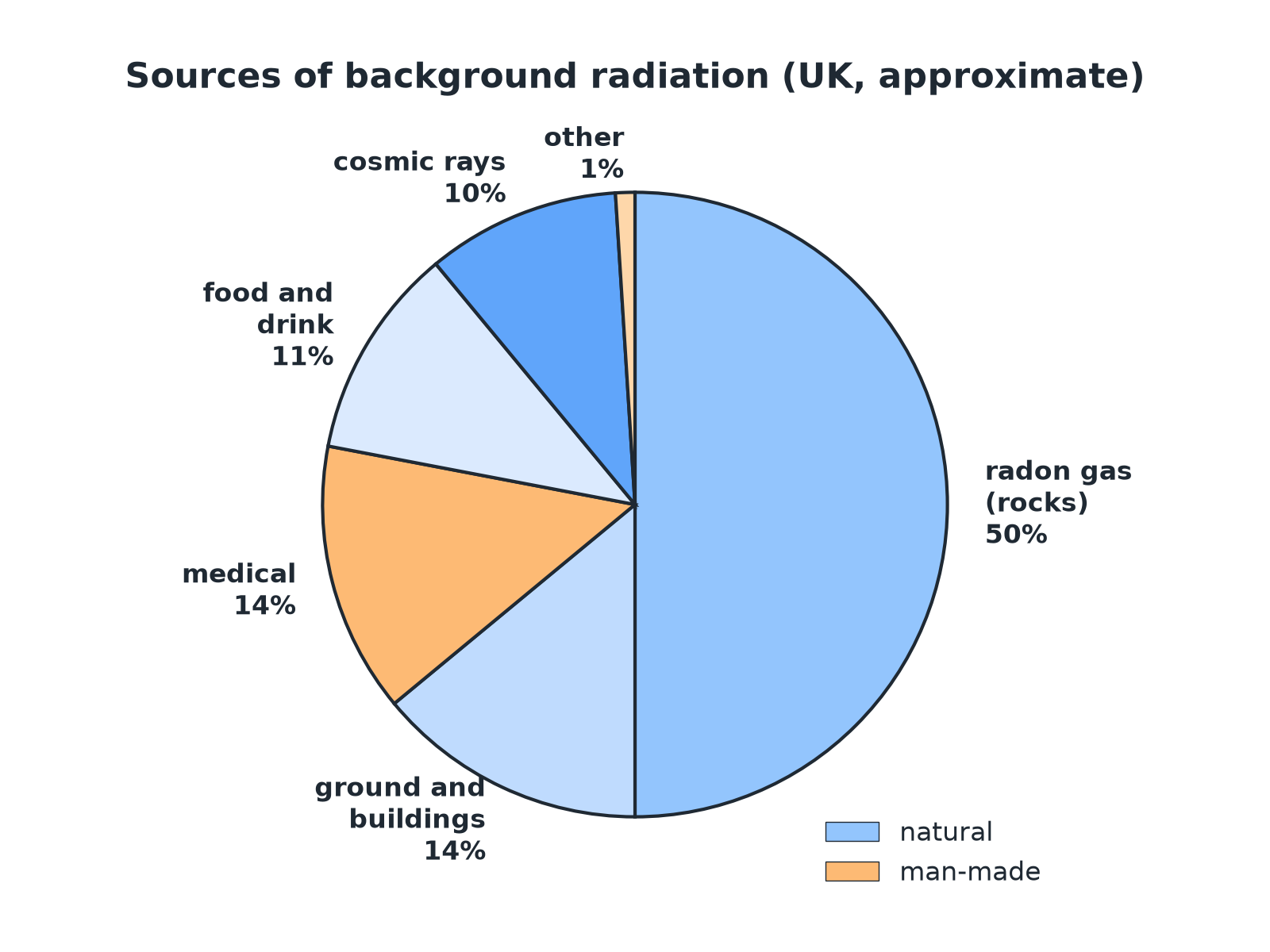
Most background radiation is natural.
Where Does It Come From?
-
Natural: rocks
Radioactive isotopes in rocks such as granite release radon gas.
-
Natural: cosmic rays
High-energy particles from space; stronger at altitude.
-
Natural: food and air
Small amounts in food, drink and the air.
-
Man-made
Fallout from nuclear weapon testing and accidents, and medical procedures.
Why Dose Varies
Location and occupation.
-
Location
Effect: Areas with granite rock have higher radon levels; high altitudes have more cosmic rays.
-
Occupation
Effect: Airline crews (cosmic rays), radiographers and nuclear workers receive higher doses.
-
Medical treatments
Effect: X-rays and scans add to a person's dose.
Using a Pie Chart
The typical annual dose is 2.7 mSv. Radon is 50% of this. Calculate the dose from radon.
Show the solutionHide the solution
- 1 Fraction \(50\% = 0.50\)
- 2 Multiply \(0.50 \times 2.7\)
- 3 Answer \(1.35\) mSv
Answer1.35 mSv (about 1.4 mSv)
Converting Units
Convert 2.7 mSv to sieverts.
Show the solutionHide the solution
- 1 1000 mSv = 1 Sv \(2.7 \div 1000\)
- 2 Answer \(0.0027\) Sv (2.7 × 10⁻³ Sv)
Answer\(2.7 \times 10^{-3}\) Sv
Measuring It
How background is found.
-
Detector
A Geiger-Müller tube and counter measures the count rate.
-
Correct
Subtract the background count rate from measurements on a source.
-
Vary
Background changes with place and time, so measure it in the same place.
Why Does It Differ?
Explain why the background radiation is higher in Cornwall (granite) than in London, and why an airline pilot receives a higher dose than an office worker.
1. Name the source.
2. Link it to location or job.
A good answer shows: Granite rocks contain radioactive isotopes and release radon gas, so background is higher. Pilots fly at high altitude where there are more cosmic rays.
Can I...?
- 1List natural sources.
- 2List man-made sources.
- 3Explain location effects.
- 4Explain occupation effects.
- 5Use a pie chart.
- 6Convert mSv to Sv.
- 7Correct for background.
- 8Explain why background varies.
Summary & Exam Focus
- Natural: rocks, cosmic rays, food.
- Man-made: fallout, medical procedures.
- Dose varies with location and occupation.
- 1000 mSv = 1 Sv.
Exam focus
Give two natural sources of background radiation. (2 marks) (2 marks)
Any two: rocks, cosmic rays, food.
Key terms
The vocabulary this lesson expects you to use. Each one is linked from the first place it appears above.
- Background radiation
- Radiation that is around us all the time.
- Cosmic rays
- High-energy particles from space.
- Radon
- A radioactive gas from rocks.
- Radiation dose
- A measure of the risk of harm from radiation, in sieverts.
- Millisievert
- One thousandth of a sievert.
- Man-made
- Produced by human activity.
Practice questions
Have a go at each one before you open its answer.
-
Question 1 State 2 marks
Give two natural sources of background radiation.
Show answerHide answer
Model answer
Any two from: rocks (including radon gas), cosmic rays, food and drink.
Mark scheme
- First source — 1 mark
- Second source — 1 mark
-
Question 2 State 2 marks
Give one man-made source of background radiation.
Show answerHide answer
Model answer
Fallout from nuclear weapons testing or nuclear accidents (or medical procedures).
Mark scheme
- One correct source — 1 mark
- Man-made linked to human activity — 1 mark
-
Question 3 Use the chart 3 marks
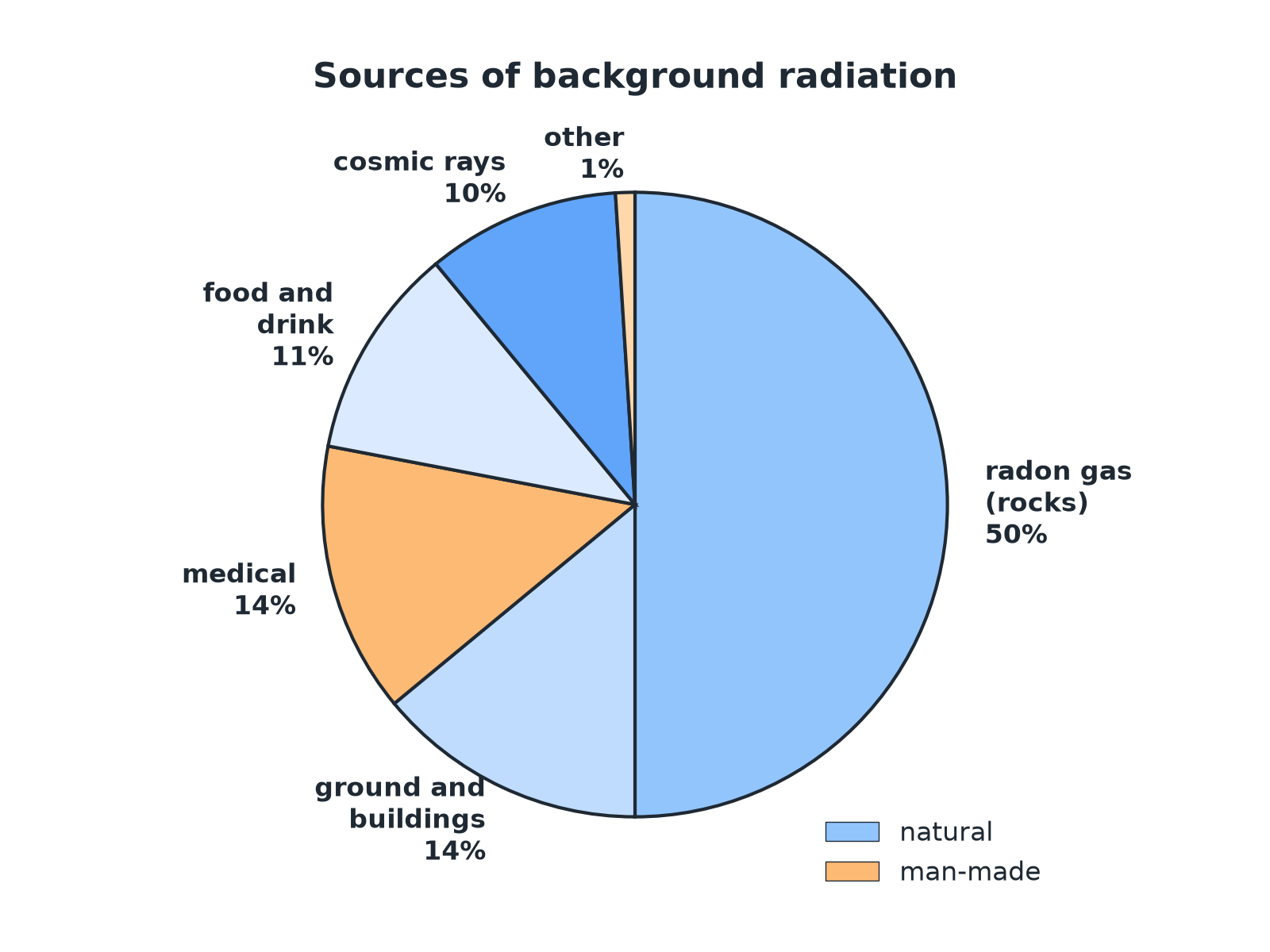
The pie chart shows the sources of background radiation. The total annual dose is 2.7 mSv. Radon is 50% of the total. (a) Calculate the dose from radon. (b) Is most of the background radiation natural or man-made? Give a reason.
Show answerHide answer
Model answer
(a) 0.50 × 2.7 = 1.35 mSv. (b) Natural, because the natural sources (radon, ground, food, cosmic rays) make up most of the chart.
Mark scheme
- 1.35 mSv — 1 mark
- Natural — 1 mark
- Reason from the chart — 1 mark
-
Question 4 Explain 2 marks
The background radiation is higher in some parts of the UK than others. Suggest one reason.
Show answerHide answer
Model answer
Some areas have rocks such as granite that contain radioactive isotopes and release radon gas.
Mark scheme
- Type of rock or radon — 1 mark
- Linked to higher levels in that location — 1 mark
-
Question 5 Explain 3 marks
Airline pilots receive a higher radiation dose than office workers. Explain why. Also state how background radiation is taken into account when measuring the radiation from a radioactive source.
Show answerHide answer
Model answer
Pilots fly at high altitude where cosmic rays are stronger. The background count rate is measured without the source and subtracted from the reading with the source.
Mark scheme
- Cosmic rays at altitude — 1 mark
- Measure background count rate — 1 mark
- Subtract from the reading — 1 mark
Quick check
-
Which is a natural source of background radiation?
Show answerHide answer
A: Cosmic rays
They come from space.
-
Radon gas comes from...
Show answerHide answer
B: rocks
It is released by some rocks.
-
Radiation dose is measured in...
Show answerHide answer
C: sieverts
1 Sv = 1000 mSv.
-
Which job usually gives a higher dose?
Show answerHide answer
D: Airline pilot
Higher cosmic ray exposure.
-
1000 mSv equals...
Show answerHide answer
A: 1 Sv
1000 milli = 1.
Downloads
Free to keep, print and annotate.
- Background radiation.pptx Built from the lesson script on 30 September 2026. View
- Background radiation - Completed Notes.docx The full notes for the lesson, to revise from. Built from the lesson script on 30 September 2026. View
- Background radiation - Exam Questions.docx Built from the lesson script on 30 September 2026. View
Something here looks wrong?
Tell us what and we will go and look. It goes to whoever writes these pages, nobody else, and we do not ask who you are — so there is nothing to sign and nothing comes back to you.