Viewing as
Teaching this? The teacher view adds 2 files, the mark schemes and the model answers.
Physics · Atomic structure
Half-lives, hazards and uses of nuclear radiation
Explain how the hazards of radioactive materials depend on half-life, and describe and evaluate the uses of nuclear radiation in medicine.
Warm-up
Answer each one, then check.
-
1
What is half-life?
Show answerHide answer
The time for activity to halve
-
2
What is a tracer?
Show answerHide answer
A substance that can be followed inside the body
-
3
Which radiation is most penetrating?
Show answerHide answer
Gamma
-
4
Give one danger of ionising radiation.
Show answerHide answer
It can damage or kill cells
-
5
What is standard form?
Show answerHide answer
A number written as \(a \times 10^n\)
Learning Objectives
- 1Explain why the hazards of a radioactive material differ with its half-life.
- 2Describe and evaluate the use of nuclear radiation in exploring internal organs and treating unwanted tissue.
- 3Evaluate the perceived risks of nuclear radiation using data.
- 4Use data given in standard form.
HALF-LIFE AND HAZARD
Radioactive isotopes have a very wide range of half-lives. Short half-lives are very active but decay quickly; long half-lives stay radioactive for a very long time.
In medicine, nuclear radiations are used to explore internal organs and to control or destroy unwanted tissue.
Nuclear Radiation in Medicine
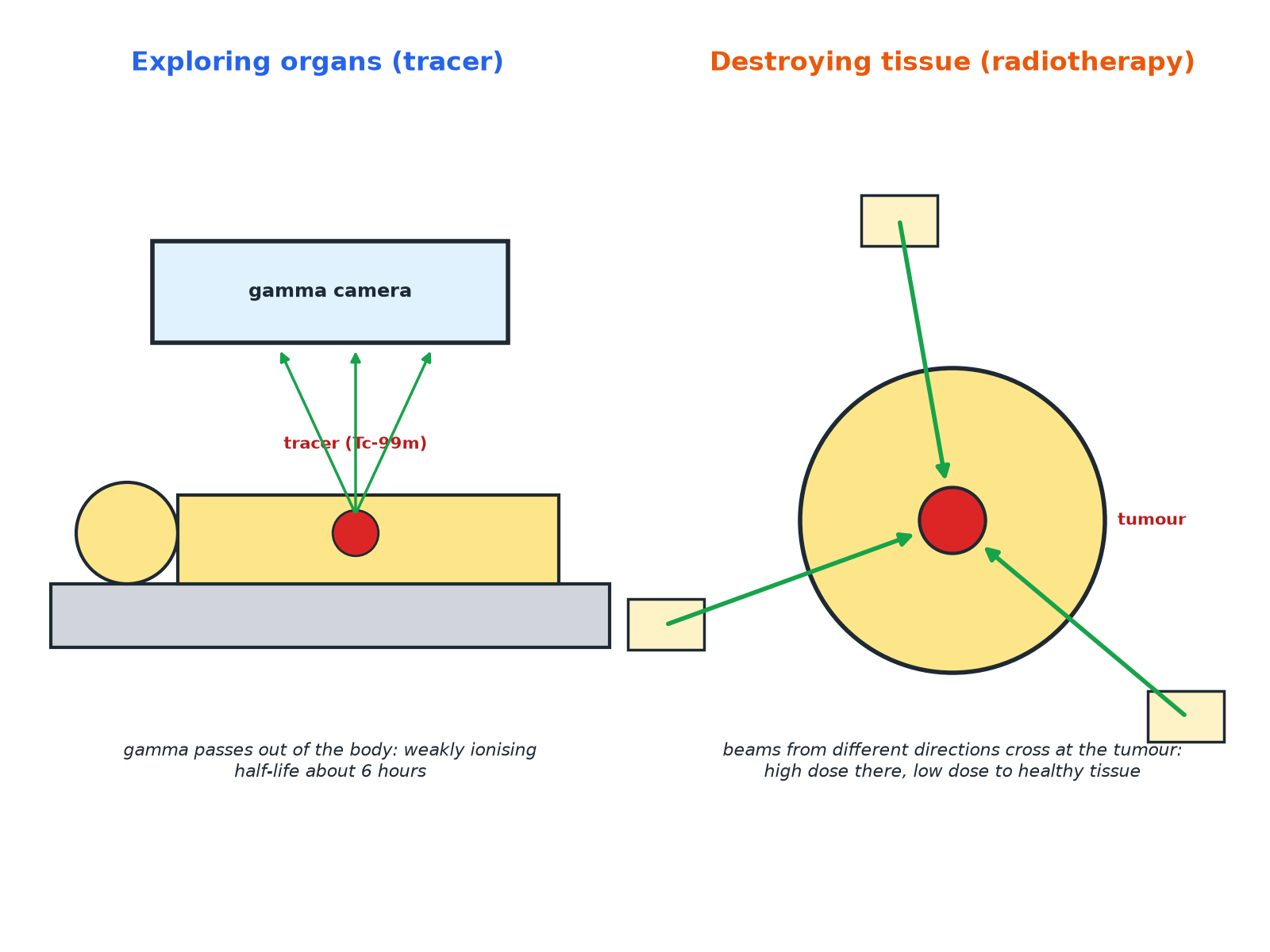
The radiation is chosen for its penetration and half-life.
Half-Life and Hazard
Data (approximate).
-
Technetium-99m
Half-life: 6 hours. Comment: Gamma emitter used as a medical tracer; gone from the body quickly
-
Iodine-131
Half-life: 8 days. Comment: Used to treat the thyroid; decays within weeks
-
Cobalt-60
Half-life: 5 years. Comment: Gamma source for radiotherapy
-
Uranium-238
Half-life: \(4.5 \times 10^{9}\) years. Comment: Stays radioactive for billions of years
Why Half-Life Matters
Explain why a source with a very long half-life is a hazard for a long time, and why a source with a very short half-life is a hazard mainly at first.
Show the solutionHide the solution
- 1 Very long half-life The activity falls extremely slowly, so it remains radioactive for a very long time
- 2 Very short half-life It is very active at first but decays quickly, so it is a hazard for only a short time
AnswerLong half-life: long-term hazard, low activity. Short half-life: intense at first but soon gone.
Choosing a Medical Tracer
Explain why technetium-99m is suitable as a tracer to explore organs in the body.
Show the solutionHide the solution
- 1 Gamma Penetrating, so it passes out of the body to the detector, and weakly ionising, so it does little damage
- 2 Half-life 6 hours Long enough to take the scan but decays quickly so the patient is not radioactive for long
AnswerIt emits gamma rays, which pass out of the body and are weakly ionising, and its half-life is short.
Evaluating Risk
Balance benefits and risks.
-
Benefits
Diagnose disease without surgery; destroy tumours.
-
Risks
Ionising radiation can damage healthy cells and cause cancer.
-
Reduce risk
Use small doses, short half-lives and beams from different directions.
-
Judging
Use the data on dose and consequences to say whether the risk is acceptable.
Evaluate the Scan
A doctor uses technetium-99m (half-life 6 hours, gamma) to scan a patient's kidneys. Give two reasons why it is suitable and one risk.
1. Consider penetration.
2. Consider half-life.
A good answer shows: Reasons: gamma passes out of the body; short half-life. Risk: ionising radiation may damage cells (small).
Can I...?
- 1Explain hazard and half-life.
- 2Explain why gamma tracers are used.
- 3Explain why a short half-life suits a tracer.
- 4Describe radiotherapy.
- 5Explain beams from different directions.
- 6Evaluate risks and benefits.
- 7Read standard form data.
- 8Use data in an answer.
Summary & Exam Focus
- Half-lives range from fractions of a second to billions of years.
- Tracers: gamma, short half-life.
- Radiotherapy: focus beams to destroy tumours.
- Weigh benefits and risks.
Exam focus
Explain why a radioactive tracer used inside the body should emit gamma radiation and have a short half-life. (4 marks) (4 marks)
Gamma passes out of the body and short half-life means it does not remain long.
Key terms
The vocabulary this lesson expects you to use. Each one is linked from the first place it appears above.
- Tracer
- A radioactive substance used to follow a process in the body.
- Radiotherapy
- Treating cancer using nuclear radiation.
- Half-life
- The time for the activity to halve.
- Gamma camera
- A device that detects gamma rays from a tracer.
- Unwanted tissue
- Tissue such as a tumour.
- Risk
- The chance of harm.
Practice questions
Have a go at each one before you open its answer.
-
Question 1 Explain 3 marks
Different radioactive isotopes have different half-lives. Explain why radioactive waste with a very long half-life is a problem.
Show answerHide answer
Model answer
A very long half-life means the material remains radioactive for a very long time (many thousands or millions of years), so it must be stored safely for a long time.
Mark scheme
- Long half-life means it stays radioactive — 1 mark
- For a very long time — 1 mark
- So it must be stored safely — 1 mark
-
Question 2 Explain 4 marks
Technetium-99m is a radioactive isotope with a half-life of 6 hours. It emits gamma radiation. It is injected into a patient so that internal organs can be explored. Explain why technetium-99m is suitable for this use.
Show answerHide answer
Model answer
Gamma radiation can pass out of the body so it can be detected outside. It is weakly ionising so causes little damage. A half-life of 6 hours is long enough to complete the scan but short enough that the radioactivity soon decays.
Mark scheme
- Gamma passes out of the body — 1 mark
- Detected outside the body — 1 mark
- Weakly ionising: little damage — 1 mark
- Short half-life: decays quickly — 1 mark
-
Question 3 Explain 3 marks
In radiotherapy, narrow beams of gamma radiation are directed at a tumour from several different directions. Explain why.
Show answerHide answer
Model answer
Where the beams cross at the tumour the dose is high, which destroys the cancer cells. Healthy tissue only receives one beam at a time, so the dose is low and less damage is done.
Mark scheme
- High dose where the beams cross at the tumour — 1 mark
- Healthy tissue receives low dose — 1 mark
- Reduces damage to healthy cells — 1 mark
-
Question 4 Compare 2 marks
Uranium-238 has a half-life of 4.5 × 10⁹ years. Iodine-131 has a half-life of 8 days. State which isotope stays radioactive for longer and give a reason.
Show answerHide answer
Model answer
Uranium-238, because its half-life is much longer.
Mark scheme
- Uranium-238 — 1 mark
- Much longer half-life — 1 mark
-
Question 5 Evaluate 4 marks
Some people are worried about using radioactive materials in medicine. Evaluate the risks and benefits of using a radioactive tracer.
Show answerHide answer
Model answer
Benefits: organs can be explored without surgery, and diagnosis can be quicker and more accurate. Risks: ionising radiation can damage cells and could cause cancer, but the dose is small and the tracer has a short half-life, so the benefit usually outweighs the risk.
Mark scheme
- Benefit described — 1 mark
- Risk described — 1 mark
- Small dose or short half-life reduces risk — 1 mark
- A conclusion — 1 mark
Quick check
-
A tracer in the body should emit...
Show answerHide answer
B: gamma radiation
It passes out of the body.
-
A short half-life means the source...
Show answerHide answer
C: decays quickly
Its activity soon falls.
-
Radiotherapy is used to...
Show answerHide answer
D: destroy unwanted tissue
It destroys tumours.
-
Beams from different directions...
Show answerHide answer
A: give a high dose only at the tumour
They cross at the tumour.
-
Which has the longest half-life?
Show answerHide answer
B: Uranium-238 (\(4.5 \times 10^{9}\) years)
Billions of years.
Downloads
Free to keep, print and annotate.
- Half-lives hazards and uses of nuclear radiation.pptx Built from the lesson script on 30 September 2026. View
- Half-lives hazards and uses of nuclear radiation - Completed Notes.docx The full notes for the lesson, to revise from. Built from the lesson script on 30 September 2026. View
- Half-lives hazards and uses of nuclear radiation - Exam Questions.docx Built from the lesson script on 30 September 2026. View
Something here looks wrong?
Tell us what and we will go and look. It goes to whoever writes these pages, nobody else, and we do not ask who you are — so there is nothing to sign and nothing comes back to you.