Viewing as
Teacher view: planning notes, the answers to every question, and the teacher copies of the files.
Physics · Electricity
Circuit symbols, charge and current
Draw and interpret circuit diagrams with standard symbols, and use \(Q = It\) to link charge, current and time.
Teacher resources
The teacher copies: slides with the questions built in, the answers, and anything else attached to this lesson for whoever is teaching it.
- Circuit symbols charge and current - Teacher Slides.pptx Teacher The lesson slides with the teacher's notes on each slide, and every question and mark scheme built in. Built from the lesson script on 30 September 2026. View
- Circuit symbols charge and current - Teacher Notes.docx Teacher The complete notes with the teacher's notes and every model answer in full. Built from the lesson script on 30 September 2026. View
Student handouts
The same files the students see, to print or hand out.
- Circuit symbols charge and current.pptx Built from the lesson script on 30 September 2026. View
- Circuit symbols charge and current - Completed Notes.docx The full notes for the lesson, to revise from. Built from the lesson script on 30 September 2026. View
- Circuit symbols charge and current - Exam Questions.docx Built from the lesson script on 30 September 2026. View
Warm-up
Answer each one, then check.
-
1
What is the unit of current?
Show answerHide answer
The ampere (A)
-
2
What is the unit of time in physics calculations?
Show answerHide answer
The second (s)
-
3
Which particles carry current in a metal wire?
Show answerHide answer
Electrons
-
4
What does a battery provide?
Show answerHide answer
A potential difference (a push for charge)
-
5
Convert 2 minutes to seconds.
Show answerHide answer
120 s
Learning Objectives
- 1Draw and interpret circuit diagrams using standard symbols.
- 2State that a source of potential difference is needed to make charge flow in a closed circuit.
- 3Recall and apply \(Q = It\).
- 4State that the current has the same value at any point in a single closed loop.
CHARGE AND CURRENT
charge flow \(=\) current \(\times\) time \(Q = It\)
Electric current is a flow of electrical charge. The size of the current is the rate of flow of charge. Charge is in coulombs (C), current in amperes (A) and time in seconds (s).
Standard Circuit Symbols
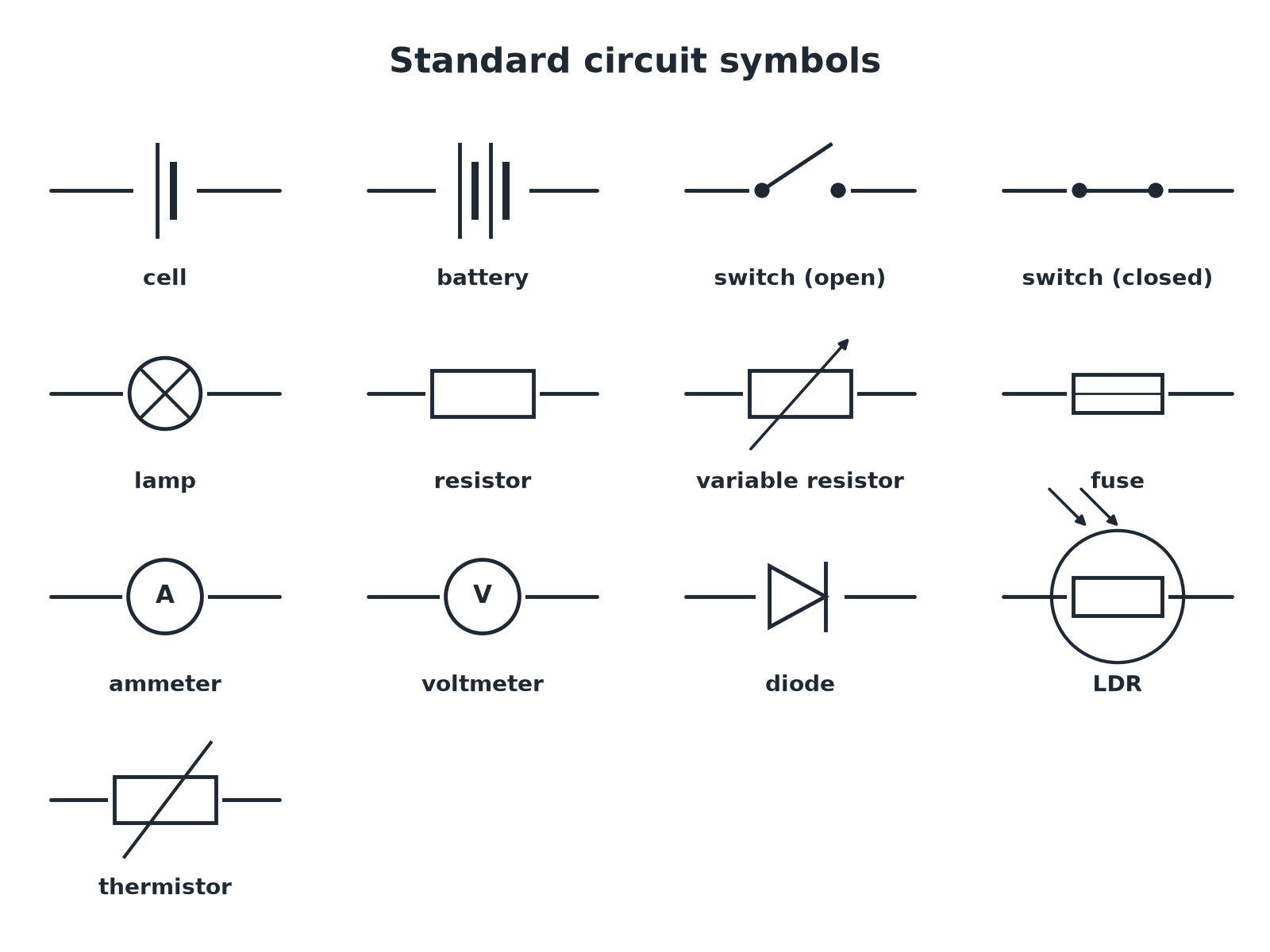
Learn to draw these quickly and neatly.
Drawing a Circuit Diagram
Use a ruler and standard symbols.
-
1
Start with the power supply
Draw a cell or battery.
-
2
Add components in series
Draw straight lines with square corners; no gaps.
-
3
Add the ammeter in series
It goes in the main loop where you want to measure current.
-
4
Add the voltmeter in parallel
It goes across the component you are measuring.
-
5
Check
Every component is joined by lines and the loop is closed.
Charge Flow
A current of 3.0 A flows through a lamp for 20 s. Calculate the charge that flows.
Show the solutionHide the solution
- 1 Write the equation \(Q = It\)
- 2 Substitute \(Q = 3.0 \times 20\)
- 3 Answer \(Q = 60\) C
Answer60 coulombs
Finding the Current
240 C of charge flows through a heater in 2 minutes. Calculate the current.
Show the solutionHide the solution
- 1 Convert the time \(2\) min \(= 120\) s
- 2 Rearrange \(I = Q \div t\)
- 3 Substitute \(I = 240 \div 120\)
- 4 Answer \(I = 2.0\) A
Answer2.0 A
Key Ideas
Learn these.
-
A source of pd is needed
For charge to flow round a closed circuit there must be a source of potential difference, such as a cell.
-
Current in a series loop
The current has the same value at every point in a single closed loop.
-
Current is not used up
Charge keeps flowing round the loop; the components transfer energy from the charge.
-
Ammeter and voltmeter
Ammeter in series measures current. Voltmeter in parallel measures pd.
Circuit Doodles
Draw circuit diagrams for: (a) a cell, a switch and a lamp in series; (b) the same circuit with an ammeter to measure the current in the lamp and a voltmeter to measure the pd across it.
1. Draw the loop with a ruler.
2. Add the meters in the right way.
A good answer shows: (a) A loop containing a cell, closed switch and lamp. (b) The ammeter is in the loop (series); the voltmeter is drawn in parallel with the lamp only.
Can I...?
- 1Recognise standard circuit symbols.
- 2Draw a series circuit.
- 3Place an ammeter and voltmeter correctly.
- 4Use \(Q = It\).
- 5Rearrange for current or time.
- 6Convert minutes to seconds.
- 7Explain why current is the same round a series loop.
- 8State what is needed for charge to flow.
Summary & Exam Focus
- \(Q = It\).
- Symbols: cell, lamp, ammeter (A), voltmeter (V), and so on.
- Ammeters in series, voltmeters in parallel.
- Current is the same at every point in a series loop.
Exam focus
A current of 0.40 A flows for 30 s. Calculate the charge that flows. (2 marks) (2 marks)
Write the equation, substitute, and include the unit C.
Key terms
The vocabulary this lesson expects you to use. Each one is linked from the first place it appears above.
- Electric current
- The rate of flow of electrical charge.
- Charge
- A property of matter that can be positive or negative; measured in coulombs.
- Ampere
- The unit of current; one coulomb per second.
- Coulomb
- The unit of charge.
- Ammeter
- Measures current; connected in series.
- Potential difference
- The energy transferred per unit of charge; measured in volts.
Questions and answers
10 questions set on this lesson, with the mark schemes and model answers open.
A current of 0.40 A flows through a lamp for 30 s. Calculate the charge that flows through the lamp. Use the equation: charge flow = current × time
Mark scheme — 2 marks available
- Correct substitution — 1 mark
- 12 C — 1 mark
Model answer
\(Q = 0.40 \times 30 = 12\) C
Draw a circuit diagram to show a cell, a switch and a lamp connected in series, with an ammeter to measure the current through the lamp and a voltmeter to measure the potential difference across the lamp. Use the correct circuit symbols.
Mark scheme — 4 marks available
- Cell, switch and lamp in a closed series loop — 1 mark
- Ammeter in series — 1 mark
- Voltmeter in parallel with the lamp — 1 mark
- All symbols correct — 1 mark
Model answer
A single closed loop containing a cell, a switch, a lamp and an ammeter, with a voltmeter connected in parallel across the lamp only.
180 C of charge flows through a heater in 1.0 minute. Calculate the current in the heater.
Mark scheme — 3 marks available
- Converts 1.0 minute to 60 s — 1 mark
- Correct substitution — 1 mark
- 3.0 A — 1 mark
Model answer
\(t = 60\) s; \(I = Q \div t = 180 \div 60 = 3.0\) A
In a series circuit, ammeter A1 reads 0.50 A. A second ammeter, A2, is on the other side of a lamp. What does A2 read? Explain your answer.
Mark scheme — 2 marks available
- 0.50 A — 1 mark
- Current is the same at every point in a series loop — 1 mark
Model answer
0.50 A. The current has the same value at every point in a single closed loop; the lamp does not use up the current.
A charge of 12 C flows through a resistor when the current is 0.50 A. Calculate the time for which the current flows.
Mark scheme — 3 marks available
- Rearranges to t = Q ÷ I — 1 mark
- Correct substitution — 1 mark
- 24 s — 1 mark
Model answer
\(t = Q \div I = 12 \div 0.50 = 24\) s
An ammeter must be connected...
Why: An ammeter measures the current so it goes in the loop.
A voltmeter is connected...
Why: It measures the pd across a component.
Charge flow in coulombs is calculated by...
Why: \(Q = It\).
A current of 2 A flows for 10 s. The charge is...
Why: \(2 \times 10 = 20\) C.
In a series circuit, the current is...
Why: The same charge flows round the whole loop.