Viewing as
Teaching this? The teacher view adds 2 files, the mark schemes and the model answers.
Physics · Electricity
Current, resistance and potential difference
Use \(V = IR\) to link potential difference, current and resistance, and describe how to investigate the factors affecting resistance (Required Practical 3).
Warm-up
Answer each one, then check.
-
1
Write the unit of resistance.
Show answerHide answer
Ohm (\(\Omega\))
-
2
What is the unit of potential difference?
Show answerHide answer
Volt (V)
-
3
Where is a voltmeter connected?
Show answerHide answer
In parallel across the component
-
4
What does a longer wire do to resistance?
Show answerHide answer
Increases it
-
5
What is a current?
Show answerHide answer
A flow of charge
Learning Objectives
- 1Explain that current depends on resistance and potential difference.
- 2Recall and apply \(V = IR\).
- 3Describe how to investigate the resistance of a wire and of combinations of resistors (Required Practical 3).
- 4Interpret graphs of resistance against length.
V = IR
potential difference \(=\) current \(\times\) resistance \(V = IR\)
The greater the resistance of a component, the smaller the current for a given potential difference across it. Questions use the term potential difference; voltage also gains credit.
Required Practical 3: Resistance of a Wire
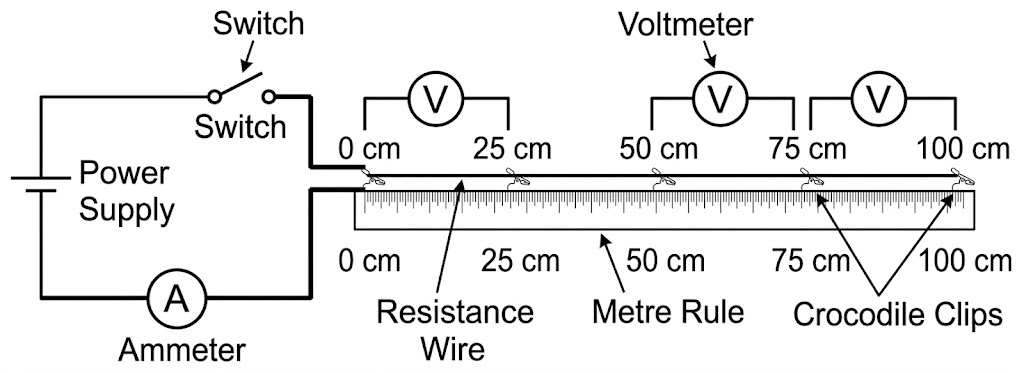
Change only the length of wire between the clips.
Method: Resistance and Length of a Wire
Required Practical 3, part 1.
-
1
Set up
Connect the circuit with the ammeter in series and the voltmeter across the wire.
-
2
Set the length
Clip the crocodile clips at 0.20 m, and record the pd and current.
-
3
Switch off between readings
This keeps the wire at a constant temperature.
-
4
Repeat
Take readings at 0.40 m, 0.60 m, 0.80 m and 1.00 m.
-
5
Calculate
For each length \(R = V \div I\).
-
6
Plot
Draw a graph of resistance against length: a straight line through the origin.
Method: Resistors in Series and Parallel
Required Practical 3, part 2.
-
1
Series
Connect known resistors in series, measure V and I, calculate R = V ÷ I.
-
2
Parallel
Repeat with the same resistors in parallel.
-
3
Compare
The series combination has a larger resistance than either resistor; the parallel combination has a smaller one.
Calculating Current
A 12 V battery is connected across a 4.0 Ω resistor. Calculate the current.
Show the solutionHide the solution
- 1 Rearrange \(I = V \div R\)
- 2 Substitute \(I = 12 \div 4.0\)
- 3 Answer \(I = 3.0\) A
Answer3.0 A
Calculating Potential Difference
A current of 0.50 A flows through a 20 Ω resistor. Calculate the potential difference across it.
Show the solutionHide the solution
- 1 Write the equation \(V = IR\)
- 2 Substitute \(V = 0.50 \times 20\)
- 3 Answer \(V = 10\) V
Answer10 V
Calculating Resistance
A voltmeter reads 6.0 V and an ammeter reads 20 mA. Calculate the resistance.
Show the solutionHide the solution
- 1 Convert the current \(20\) mA \(= 0.020\) A
- 2 Rearrange \(R = V \div I\)
- 3 Substitute \(R = 6.0 \div 0.020\)
- 4 Answer \(R = 300\ \Omega\)
Answer\(300\ \Omega\)
Getting Good Results
Why we switch off between readings.
-
Heating
A current makes the wire hotter, and a hotter metal wire has a higher resistance.
-
Constant temperature
Use a low current and switch off between readings.
-
Zero errors
Check the meters read zero before starting.
-
Repeat
Repeat and average to reduce random errors.
Predict the Graph
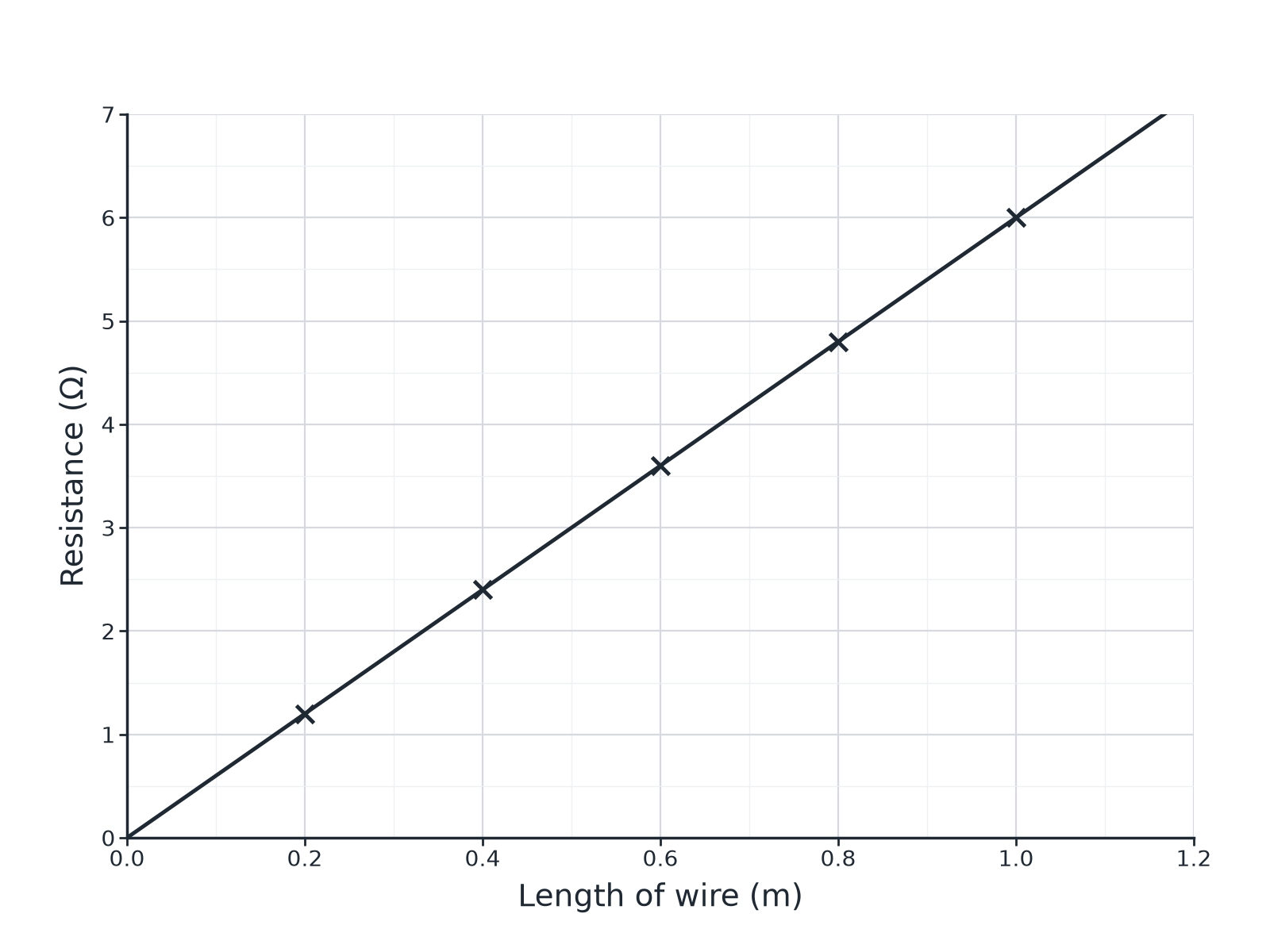
A student measures the resistance of 20 cm, 40 cm, 60 cm, 80 cm and 100 cm of a wire. What does the graph of resistance against length look like? A 30 cm length has a resistance of 1.8 Ω; what is the resistance of 90 cm?
1. Sketch the axes.
2. Use the ratio of lengths.
A good answer shows: A straight line through the origin: resistance is directly proportional to length. 90 cm is three times as long, so R = 5.4 Ω.
Can I...?
- 1Recall V = IR.
- 2Rearrange for I or R.
- 3Convert mA to A.
- 4Describe the resistance of wire method.
- 5Explain why the wire is switched off between readings.
- 6Draw a graph of R against length.
- 7Say what happens to resistance in series and parallel.
- 8Use the correct units.
Summary & Exam Focus
- \(V = IR\).
- Ammeter in series, voltmeter in parallel.
- Longer wire means greater resistance.
- Switch off between readings to keep the temperature constant.
Exam focus
A potential difference of 9.0 V is applied across a resistor and the current is 0.30 A. Calculate the resistance. (2 marks) (2 marks)
State the equation, substitute and give the unit Ω.
Key terms
The vocabulary this lesson expects you to use. Each one is linked from the first place it appears above.
- Resistance
- How much a component opposes the flow of current.
- Ohm
- The unit of resistance (Ω).
- Potential difference
- The energy transferred per coulomb; measured in volts.
- Voltmeter
- Measures pd; connected in parallel.
- Constant temperature
- Kept the same so the resistance does not change for other reasons.
- Directly proportional
- Doubling one quantity doubles the other.
Practice questions
Have a go at each one before you open its answer.
-
Question 1 Calculate 2 marks
The potential difference across a resistor is 9.0 V and the current through it is 0.30 A. Calculate the resistance of the resistor. Use the equation: potential difference = current × resistance
Show answerHide answer
Model answer
\(R = V \div I = 9.0 \div 0.30 = 30\ \Omega\)
Mark scheme
- Correct substitution — 1 mark
- 30 Ω — 1 mark
-
Question 2 Calculate 2 marks
A current of 0.15 A flows through a 40 Ω resistor. Calculate the potential difference across the resistor.
Show answerHide answer
Model answer
\(V = IR = 0.15 \times 40 = 6.0\) V
Mark scheme
- Correct substitution — 1 mark
- 6.0 V — 1 mark
-
Question 3 Use the graph 4 marks
A student investigates how the resistance of a wire depends on its length. The graph shows the results. (a) Describe the relationship shown by the graph. (b) Use the graph to find the resistance of 70 cm of the wire. (c) Suggest why the student switched off the current between readings.
Show answerHide answer
Model answer
(a) The resistance is directly proportional to the length (a straight line through the origin). (b) 4.2 Ω. (c) To stop the wire heating up, because a hotter wire has a higher resistance.
Mark scheme
- Straight line through the origin, or directly proportional — 1 mark
- 4.2 Ω (accept 4.1 to 4.3) — 1 mark
- To keep the temperature constant or stop the wire heating — 1 mark
- Because temperature affects resistance — 1 mark
-
Question 4 Describe 6 marks
Describe an investigation to show how the resistance of a wire depends on its length. Your answer should include a circuit diagram description, the measurements you would take, and how you would keep the test fair and safe.
Show answerHide answer
Model answer
See levels-of-response scheme.
Mark scheme
- Level 3 (5 to 6 marks): a complete method with a correct circuit (ammeter in series, voltmeter across the wire), several lengths, calculation of R = V ÷ I for each, a graph, and control of temperature or safety — 5 to 6 marks
- Level 2 (3 to 4 marks): a method with most of the equipment and measurements, but with gaps in the detail or control — 3 to 4 marks
- Level 1 (1 to 2 marks): simple statements about measuring current and pd for wires — 1 to 2 marks
-
Question 5 Explain 3 marks
Two identical resistors are connected first in series and then in parallel. Explain, without calculation, how the total resistance of each arrangement compares with the resistance of one resistor.
Show answerHide answer
Model answer
In series the total resistance is greater than one resistor because the current has to pass through both. In parallel the total resistance is less than one resistor because there are two paths for the current.
Mark scheme
- Series greater — 1 mark
- Parallel less — 1 mark
- A reason for either — 1 mark
-
Question 6 Calculate 3 marks
A voltmeter reads 6.0 V and an ammeter reads 20 mA. Calculate the resistance of the component.
Show answerHide answer
Model answer
\(I = 0.020\) A; \(R = 6.0 \div 0.020 = 300\ \Omega\)
Mark scheme
- Converts 20 mA to 0.020 A — 1 mark
- Correct substitution — 1 mark
- 300 Ω — 1 mark
Quick check
-
The unit of resistance is the...
Show answerHide answer
C: ohm
Resistance is measured in ohms (Ω).
-
If the pd across a fixed resistor doubles, the current...
Show answerHide answer
D: doubles
\(I = V \div R\).
-
A 6 V supply across a 12 Ω resistor gives a current of...
Show answerHide answer
A: 0.5 A
\(6 \div 12 = 0.5\) A.
-
A longer wire has...
Show answerHide answer
B: a greater resistance
Resistance increases with length.
-
Why switch off the current between readings?
Show answerHide answer
C: The wire would heat up and its resistance would change
Temperature affects resistance.
Downloads
Free to keep, print and annotate.
- Current resistance and potential difference.pptx Built from the lesson script on 30 September 2026. View
- Current resistance and potential difference - Completed Notes.docx The full notes for the lesson, to revise from. Built from the lesson script on 30 September 2026. View
- Current resistance and potential difference - Exam Questions.docx Built from the lesson script on 30 September 2026. View
Something here looks wrong?
Tell us what and we will go and look. It goes to whoever writes these pages, nobody else, and we do not ask who you are — so there is nothing to sign and nothing comes back to you.