Viewing as
Teacher view: planning notes, the answers to every question, and the teacher copies of the files.
Physics · Electricity
Electric fields
Draw the electric field pattern of an isolated charged sphere, explain the concept of an electric field, and explain sparking and non-contact forces using fields.
Teacher resources
The teacher copies: slides with the questions built in, the answers, and anything else attached to this lesson for whoever is teaching it.
- Electric fields - Teacher Slides.pptx Teacher The lesson slides with the teacher's notes on each slide, and every question and mark scheme built in. Built from the lesson script on 30 September 2026. View
- Electric fields - Teacher Notes.docx Teacher The complete notes with the teacher's notes and every model answer in full. Built from the lesson script on 30 September 2026. View
Student handouts
The same files the students see, to print or hand out.
- Electric fields.pptx Built from the lesson script on 30 September 2026. View
- Electric fields - Completed Notes.docx The full notes for the lesson, to revise from. Built from the lesson script on 30 September 2026. View
- Electric fields - Exam Questions.docx Built from the lesson script on 30 September 2026. View
Warm-up
Answer each one, then check.
-
1
What is a field?
Show answerHide answer
A region where a force acts on certain objects
-
2
Which charges attract?
Show answerHide answer
Unlike charges
-
3
What is a non-contact force?
Show answerHide answer
A force between objects that are not touching
-
4
What charge does an electron have?
Show answerHide answer
Negative
-
5
What is a spark?
Show answerHide answer
A sudden flow of charge through air
Learning Objectives
- 1Explain the concept of an electric field.
- 2Draw the electric field pattern for an isolated charged sphere.
- 3Describe how the strength of the field changes with distance.
- 4Explain non-contact forces and sparking using the idea of a field.
ELECTRIC FIELDS
A charged object creates an electric field around itself. A second charged object placed in the field experiences a force.
The field is strongest close to the charged object and gets weaker with distance. The force gets stronger as the distance between the objects decreases.
Field Around a Charged Sphere
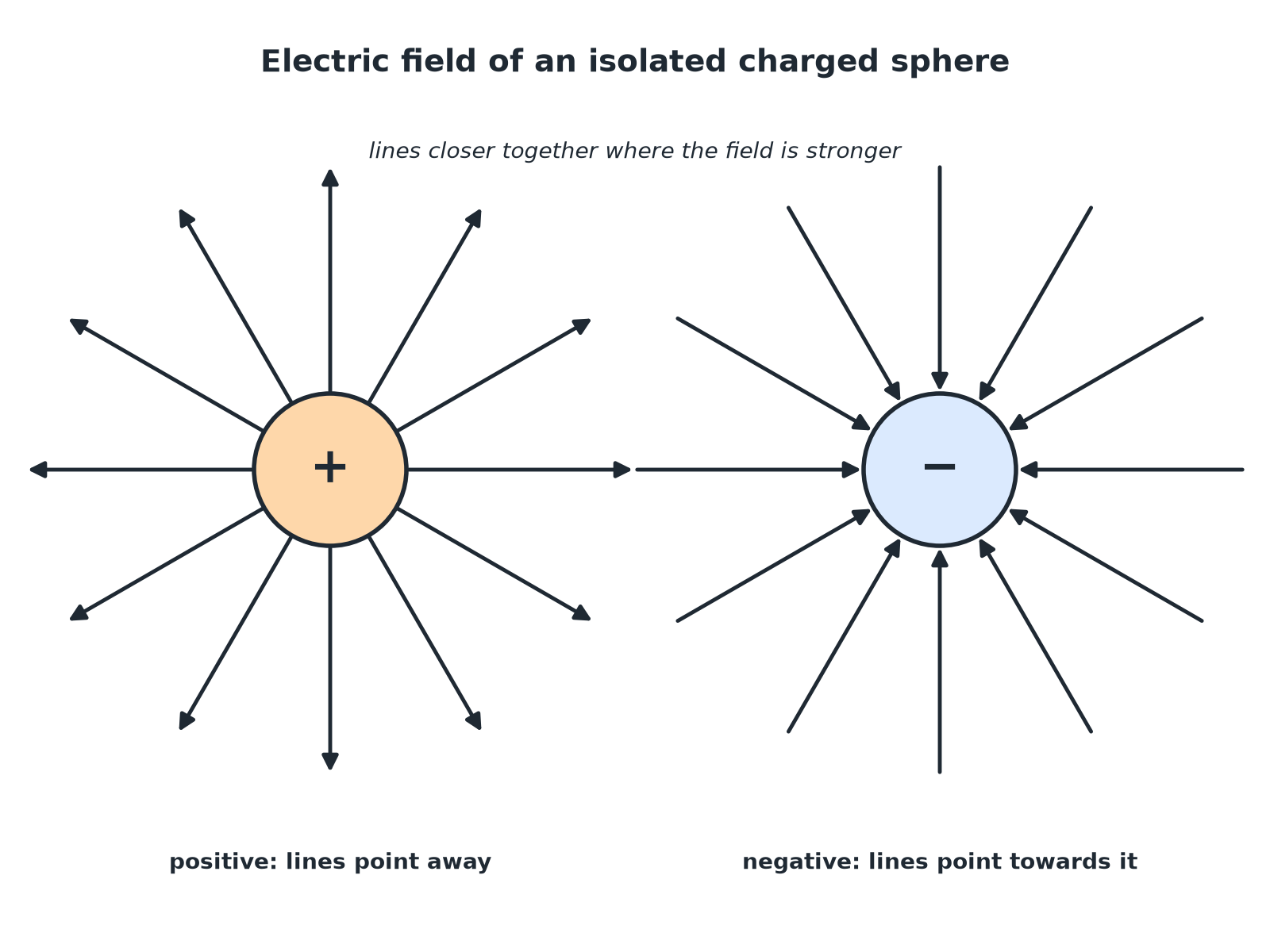
Arrows show the direction of the force on a positive charge.
Drawing the Field of an Isolated Sphere
Follow the rules.
-
1
Draw the sphere
A circle with plus or minus signs.
-
2
Draw straight lines
At least 8 lines, evenly spaced, starting at the surface and going radially.
-
3
Add arrows
Away from a positive sphere; towards a negative sphere.
-
4
Show the strength
Lines are closer together near the sphere, where the field is stronger.
Force in a Field
A small positive charge is placed near a positively charged sphere. Describe the force on it and how it changes as the charge is moved closer.
Show the solutionHide the solution
- 1 Direction The charge is repelled: the force is away from the sphere
- 2 As it moves closer The field is stronger, so the force gets stronger
AnswerThe force is repulsive and increases as the distance decreases.
Explaining a Spark
Explain how the idea of an electric field helps to explain sparking.
Show the solutionHide the solution
- 1 Charged object Creates a strong electric field around itself
- 2 Air The strong field can make air molecules lose electrons (ionise)
- 3 Charge flows The ionised air conducts, so charge flows as a spark
AnswerA strong electric field ionises the air so charge can flow: a spark.
Non-Contact Forces
Fields explain forces at a distance.
-
Field
A charged object does not touch the other object, but its field acts on it.
-
Distance
The further away, the weaker the field and the force.
-
Direction
Field lines show the direction of the force on a positive charge.
Draw the Field
Draw the electric field around (a) a positively charged sphere and (b) a negatively charged sphere. Show the arrows and how the strength varies.
1. Draw at least eight lines.
2. Add arrows in the right direction.
A good answer shows: (a) Radial lines with arrows pointing away, closer together at the sphere. (b) Radial lines with arrows pointing towards the sphere.
Can I...?
- 1Define an electric field.
- 2Draw the field around a positive sphere.
- 3Draw the field around a negative sphere.
- 4Say how strength changes with distance.
- 5Explain non-contact force with fields.
- 6Explain sparking with fields.
- 7Use arrows correctly.
- 8Draw evenly spaced lines.
Summary & Exam Focus
- An electric field surrounds a charged object.
- Field lines point away from positive and towards negative.
- The field is strongest close to the object.
- A strong field can ionise air and cause a spark.
Exam focus
Draw the electric field pattern around an isolated negatively charged sphere. (2 marks) (2 marks)
Straight lines, arrows pointing towards the sphere.
Key terms
The vocabulary this lesson expects you to use. Each one is linked from the first place it appears above.
- Electric field
- The region around a charged object where another charge feels a force.
- Field lines
- Lines showing the direction of the force on a positive charge.
- Isolated sphere
- A charged sphere far from any other charges.
- Ionise
- Remove or add electrons to make ions.
- Non-contact force
- A force between objects that are not touching.
- Field strength
- How large the force on a charge is at a point.
Questions and answers
10 questions set on this lesson, with the mark schemes and model answers open.
Draw the electric field pattern of an isolated negatively charged sphere.
Mark scheme — 2 marks available
- Straight radial lines — 1 mark
- Arrows pointing towards the sphere — 1 mark
Model answer
At least four straight lines going radially towards the sphere with arrows pointing towards it.
The diagram shows a positively charged sphere with two field lines drawn. Complete the diagram to show the electric field. Explain what the diagram shows about the field strength.
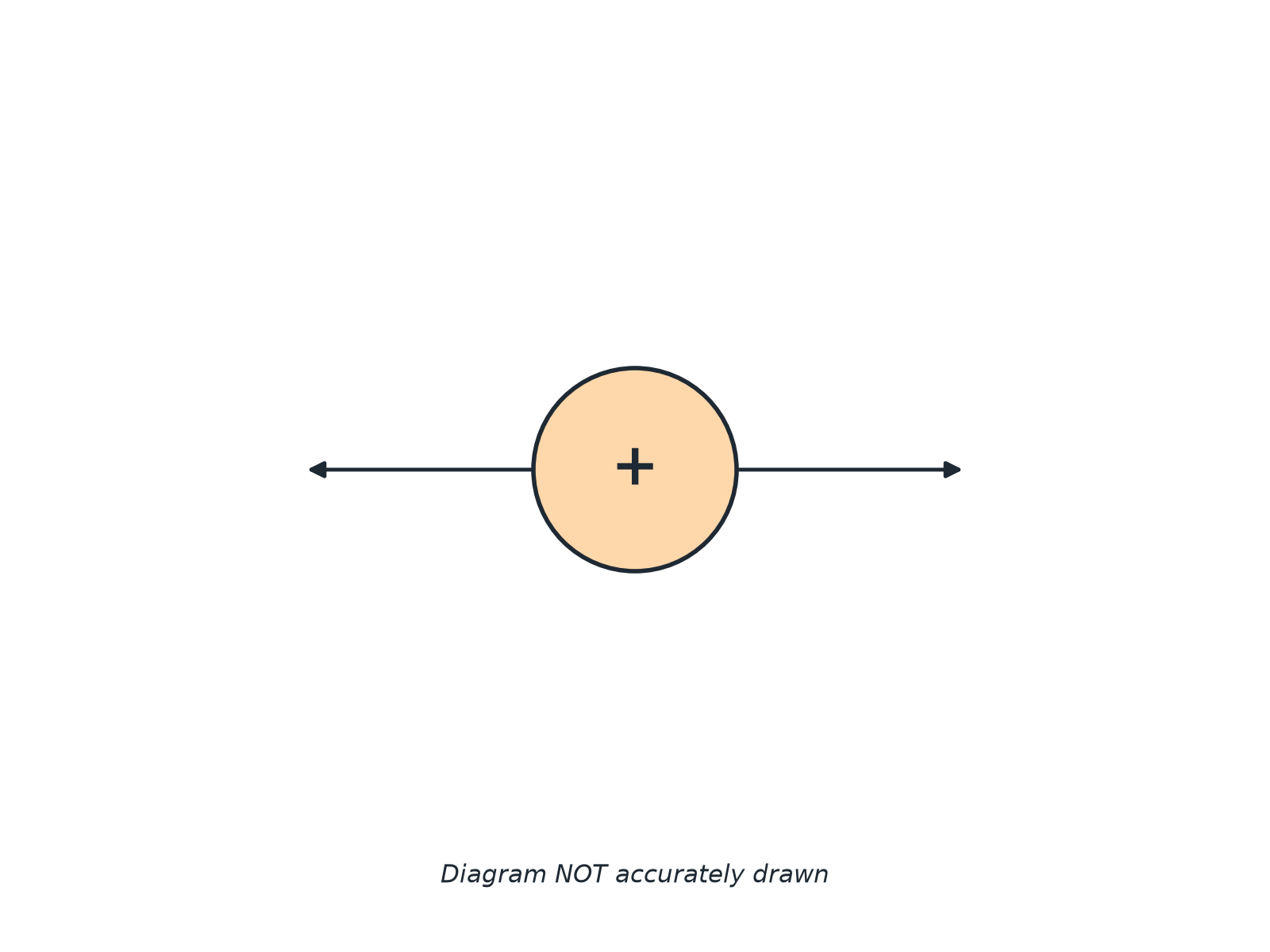
Mark scheme — 3 marks available
- Additional radial straight lines evenly spaced — 1 mark
- Arrows pointing away — 1 mark
- Field strongest close to the sphere — 1 mark
Model answer
Add at least six more radial lines with arrows pointing away from the sphere, evenly spaced. The lines are closer together near the sphere, so the field is stronger close to the sphere.
A small positive charge is moved towards a positively charged sphere. Explain how the force on the small charge changes.
Mark scheme — 2 marks available
- Force increases as the distance decreases — 1 mark
- The field is stronger closer to the sphere — 1 mark
Model answer
The force is repulsive and increases as the charge gets closer, because the field is stronger closer to the sphere.
Explain how the idea of an electric field helps to explain how a charged comb can pick up small pieces of paper without touching them.
Mark scheme — 3 marks available
- Charged object has an electric field — 1 mark
- The field exerts a force on other objects — 1 mark
- Non-contact force of attraction — 1 mark
Model answer
The charged comb has an electric field around it. The field exerts a non-contact force on the paper pieces, so they are attracted without touching.
Explain, using the idea of an electric field, how a spark can jump between a charged sphere and a metal rod.
Mark scheme — 3 marks available
- Strong field near the sphere — 1 mark
- Ionises the air — 1 mark
- Charge flows through the air as a spark — 1 mark
Model answer
The charged sphere creates a strong electric field. When the field is strong enough it ionises the air between the sphere and the rod, making the air conduct, so charge flows as a spark.
The electric field around a positive sphere points...
Why: Field lines point away from positive charge.
The field is strongest...
Why: It weakens with distance.
A force between charges that are not touching is a...
Why: The field acts at a distance.
Field lines around a negative sphere point...
Why: Arrows point towards negative charge.
A spark happens when a strong field...
Why: The ionised air conducts.