Viewing as
Teacher view: planning notes, the answers to every question, and the teacher copies of the files.
Physics · Electricity
Energy transfers in everyday appliances
Describe how appliances transfer energy, and use \(E = Pt\) and \(E = QV\) to calculate energy transferred by electrical work.
Teacher resources
The teacher copies: slides with the questions built in, the answers, and anything else attached to this lesson for whoever is teaching it.
- Energy transfers in everyday appliances - Teacher Slides.pptx Teacher The lesson slides with the teacher's notes on each slide, and every question and mark scheme built in. Built from the lesson script on 30 September 2026. View
- Energy transfers in everyday appliances - Teacher Notes.docx Teacher The complete notes with the teacher's notes and every model answer in full. Built from the lesson script on 30 September 2026. View
Student handouts
The same files the students see, to print or hand out.
- Energy transfers in everyday appliances.pptx Built from the lesson script on 30 September 2026. View
- Energy transfers in everyday appliances - Completed Notes.docx The full notes for the lesson, to revise from. Built from the lesson script on 30 September 2026. View
- Energy transfers in everyday appliances - Exam Questions.docx Built from the lesson script on 30 September 2026. View
Warm-up
Answer each one, then check.
-
1
What is the unit of energy?
Show answerHide answer
Joule (J)
-
2
What is the unit of charge?
Show answerHide answer
Coulomb (C)
-
3
Convert 3 minutes to seconds.
Show answerHide answer
180 s
-
4
What is \(P = VI\)?
Show answerHide answer
Power = pd × current
-
5
What does a motor transfer energy to?
Show answerHide answer
The kinetic store
Learning Objectives
- 1Describe how domestic appliances transfer energy from batteries or the mains to kinetic energy stores or heating.
- 2Recall and apply \(E = Pt\).
- 3Recall and apply \(E = QV\).
- 4Relate the power rating of appliances to changes in stored energy.
ELECTRICAL WORK
energy transferred \(=\) power \(\times\) time \(E = Pt\) and energy transferred \(=\) charge flow \(\times\) potential difference \(E = QV\)
Work is done when charge flows in a circuit. The energy an appliance transfers depends on how long it is on for and its power.
Appliances and Their Energy Transfers
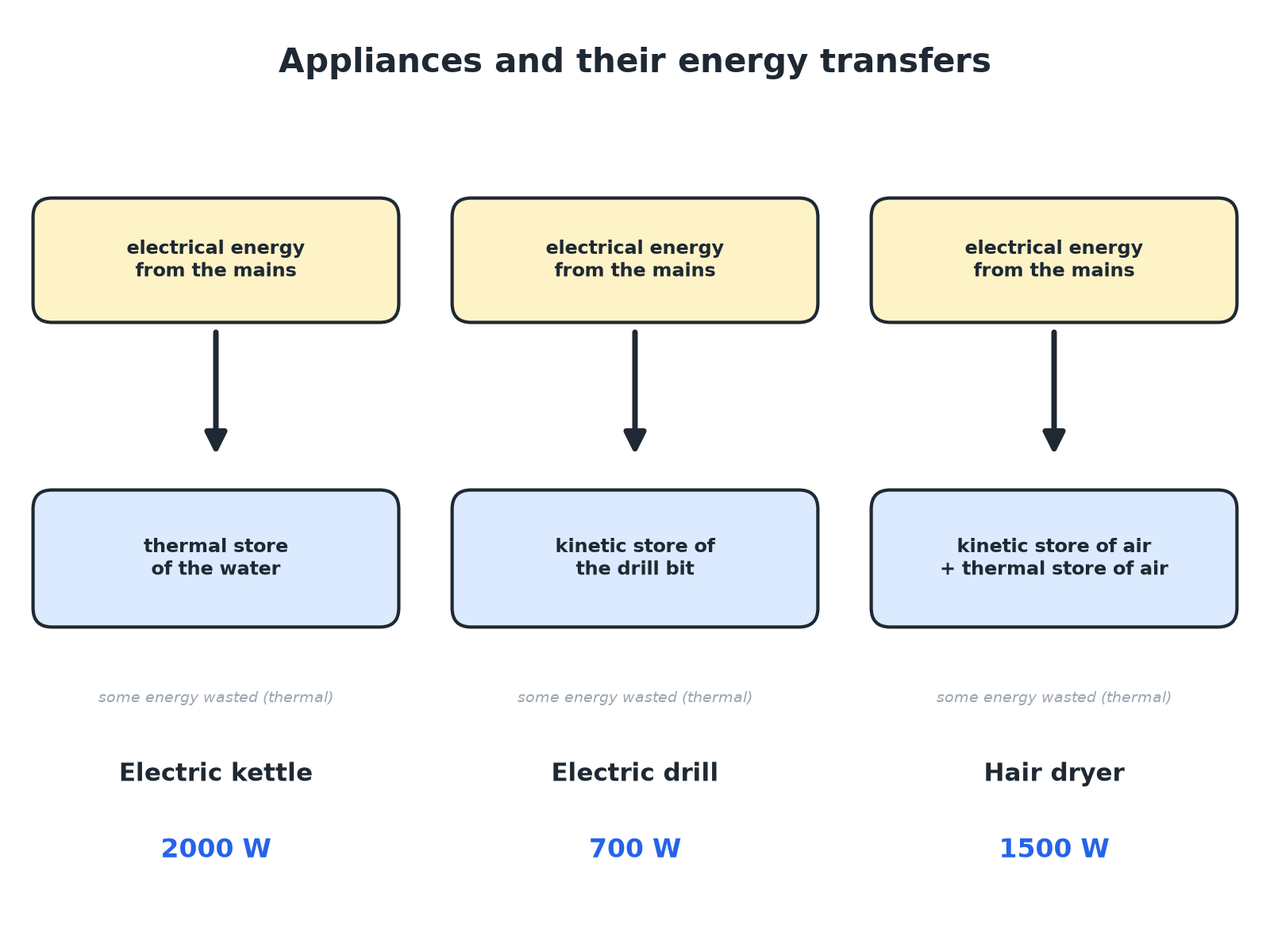
Different appliances give different useful transfers.
Energy from Power and Time
A 2000 W kettle is switched on for 3.0 minutes. Calculate the energy it transfers.
Show the solutionHide the solution
- 1 Convert the time \(3.0\) min \(= 180\) s
- 2 Substitute \(E = Pt = 2000 \times 180\)
- 3 Answer \(E = 360\,000\) J
Answer360 000 J (360 kJ)
Energy from Charge and pd
500 C of charge flows through a 12 V battery-powered motor. Calculate the energy transferred.
Show the solutionHide the solution
- 1 Write the equation \(E = QV\)
- 2 Substitute \(E = 500 \times 12\)
- 3 Answer \(E = 6000\) J
Answer6000 J
Comparing Appliances
A 700 W drill is used for 60 s. A 1500 W hair dryer is used for 60 s. Which transfers more energy?
Show the solutionHide the solution
- 1 Drill \(700 \times 60 = 42\,000\) J
- 2 Hair dryer \(1500 \times 60 = 90\,000\) J
AnswerThe hair dryer transfers more energy because its power is greater for the same time.
Power Ratings
What the rating tells you.
-
Meaning
The power rating is the energy the appliance transfers each second.
-
Energy used
Energy depends on the power rating and how long the appliance is on.
-
Motors
Transfer electrical energy to the kinetic energy store of the motor.
-
Heaters
Transfer electrical energy to the thermal energy store.
Energy Bill
A 3.0 kW electric shower is used for 8.0 minutes. Calculate the energy transferred, in joules. Explain what happens to the energy.
1. Convert kW and minutes.
2. Multiply.
A good answer shows: \(3000 \times 480 = 1\,440\,000\) J (1.44 MJ). Electrical energy is transferred to the thermal store of the water; some is dissipated.
Can I...?
- 1Describe the energy transfer in a kettle.
- 2Describe the energy transfer in a motor.
- 3Recall E = Pt.
- 4Recall E = QV.
- 5Convert time to seconds.
- 6Compare appliances.
- 7Explain power rating.
- 8Give units correctly.
Summary & Exam Focus
- \(E = Pt\) and \(E = QV\).
- Kettle: electrical to thermal store.
- Motor: electrical to kinetic store.
- Power rating: energy per second.
Exam focus
A 2000 W kettle is on for 3.0 minutes. Calculate the energy transferred. (3 marks) (3 marks)
Convert minutes to seconds first.
Key terms
The vocabulary this lesson expects you to use. Each one is linked from the first place it appears above.
- Electrical work
- Energy transferred when charge flows in a circuit.
- Power rating
- The power of an appliance in normal use.
- Appliance
- A device that transfers electrical energy usefully.
- Kinetic store
- The energy of a moving object.
- Thermal store
- The energy of hot objects.
- Charge
- Measured in coulombs.
Questions and answers
10 questions set on this lesson, with the mark schemes and model answers open.
A kettle has a power of 2000 W. It is switched on for 3.0 minutes. Calculate the energy transferred by the kettle. Use the equation: energy transferred = power × time
Mark scheme — 3 marks available
- Converts to 180 s — 1 mark
- Correct substitution — 1 mark
- 360 000 J — 1 mark
Model answer
\(t = 180\) s; \(E = 2000 \times 180 = 360\,000\) J
A charge of 500 C flows through a motor connected to a 12 V battery. Calculate the energy transferred to the motor. Use the equation: energy transferred = charge flow × potential difference
Mark scheme — 2 marks available
- Correct substitution — 1 mark
- 6000 J — 1 mark
Model answer
\(E = 500 \times 12 = 6000\) J
Describe the main energy transfer when an electric drill is used.
Mark scheme — 2 marks available
- Electrical energy transferred — 1 mark
- To the kinetic store of the drill — 1 mark
Model answer
Electrical energy from the mains is transferred to the kinetic energy store of the drill bit (and some to the thermal store and sound).
A hair dryer has a power of 1500 W. A phone charger has a power of 10 W. Explain why the hair dryer transfers more energy in one minute.
Mark scheme — 3 marks available
- Power is energy transferred per second — 1 mark
- 1500 J each second and 10 J each second — 1 mark
- Same time so hair dryer transfers more — 1 mark
Model answer
Power is the energy transferred each second, so 1500 W transfers 1500 J each second and 10 W transfers 10 J each second. In the same time the hair dryer transfers much more energy.
A 3.0 kW electric shower is used for 8.0 minutes. Calculate the energy transferred in megajoules (MJ).
Mark scheme — 4 marks available
- Converts to 3000 W — 1 mark
- Converts to 480 s — 1 mark
- 1 440 000 J — 1 mark
- 1.44 MJ — 1 mark
Model answer
\(P = 3000\) W; \(t = 480\) s; \(E = 1\,440\,000\) J = 1.44 MJ
Energy transferred by an appliance is power multiplied by...
Why: \(E = Pt\).
A motor transfers electrical energy mainly to the...
Why: The motor turns.
A 100 W lamp on for 10 s transfers...
Why: 100 × 10.
10 C flows through a 12 V pd. Energy transferred is...
Why: \(E = QV = 10 \times 12\).
Two appliances are on for the same time. The one with the higher power...
Why: Energy = power × time.