Viewing as
Teacher view: planning notes, the answers to every question, and the teacher copies of the files.
Physics · Electricity
Series and parallel circuits
Describe and calculate current, potential difference and resistance in series and parallel circuits.
Teacher resources
The teacher copies: slides with the questions built in, the answers, and anything else attached to this lesson for whoever is teaching it.
- Series and parallel circuits - Teacher Slides.pptx Teacher The lesson slides with the teacher's notes on each slide, and every question and mark scheme built in. Built from the lesson script on 30 September 2026. View
- Series and parallel circuits - Teacher Notes.docx Teacher The complete notes with the teacher's notes and every model answer in full. Built from the lesson script on 30 September 2026. View
Student handouts
The same files the students see, to print or hand out.
- Series and parallel circuits.pptx Built from the lesson script on 30 September 2026. View
- Series and parallel circuits - Completed Notes.docx The full notes for the lesson, to revise from. Built from the lesson script on 30 September 2026. View
- Series and parallel circuits - Exam Questions.docx Built from the lesson script on 30 September 2026. View
Warm-up
Answer each one, then check.
-
1
What is the same everywhere in a series loop?
Show answerHide answer
The current
-
2
What does an ammeter measure?
Show answerHide answer
Current
-
3
How is a voltmeter connected?
Show answerHide answer
In parallel
-
4
What is the equation linking V, I and R?
Show answerHide answer
\(V = IR\)
-
5
Add \(4 + 8\).
Show answerHide answer
12
Learning Objectives
- 1Describe the differences between series and parallel circuits.
- 2Use \(R_{total} = R_1 + R_2\) for resistors in series.
- 3Calculate currents, pds and resistances in series circuits.
- 4Explain why adding resistors in series increases and in parallel decreases the total resistance.
SERIES AND PARALLEL
Series: same current, pd shared, \(R_{total} = R_1 + R_2\). Parallel: same pd, currents add, \(R_{total}\) is less than the smallest resistor.
You are not required to calculate the total resistance of two resistors in parallel.
Series and Parallel
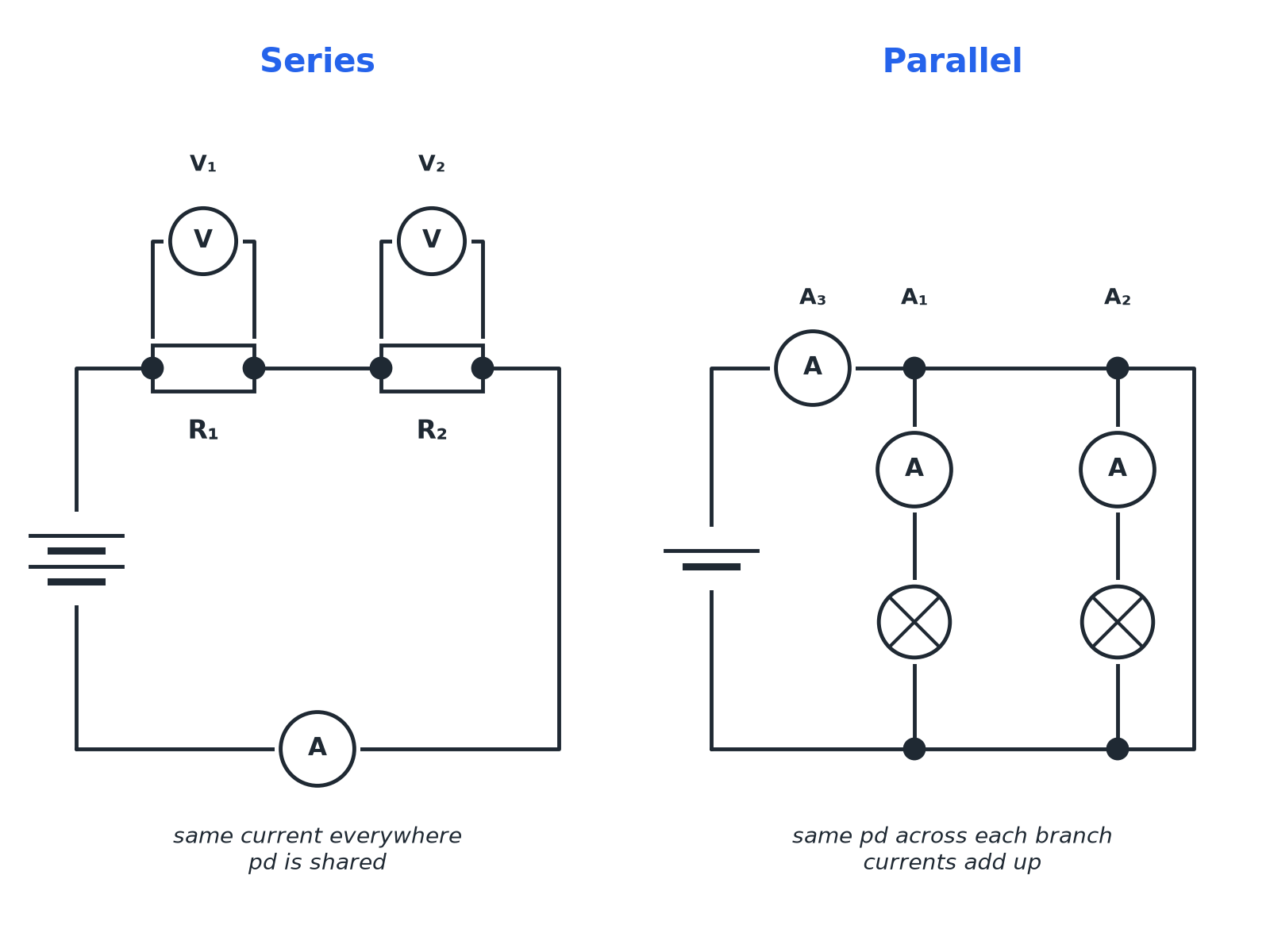
One path or several paths for the current.
Series or Parallel?
Series
- One loop for the current.
- The same current through each component.
- The supply pd is shared between components.
- Total resistance = R1 + R2.
Parallel
- More than one loop.
- The same pd across each branch.
- The currents in the branches add to the total current.
- Total resistance is less than the smallest resistor.
Series Circuit
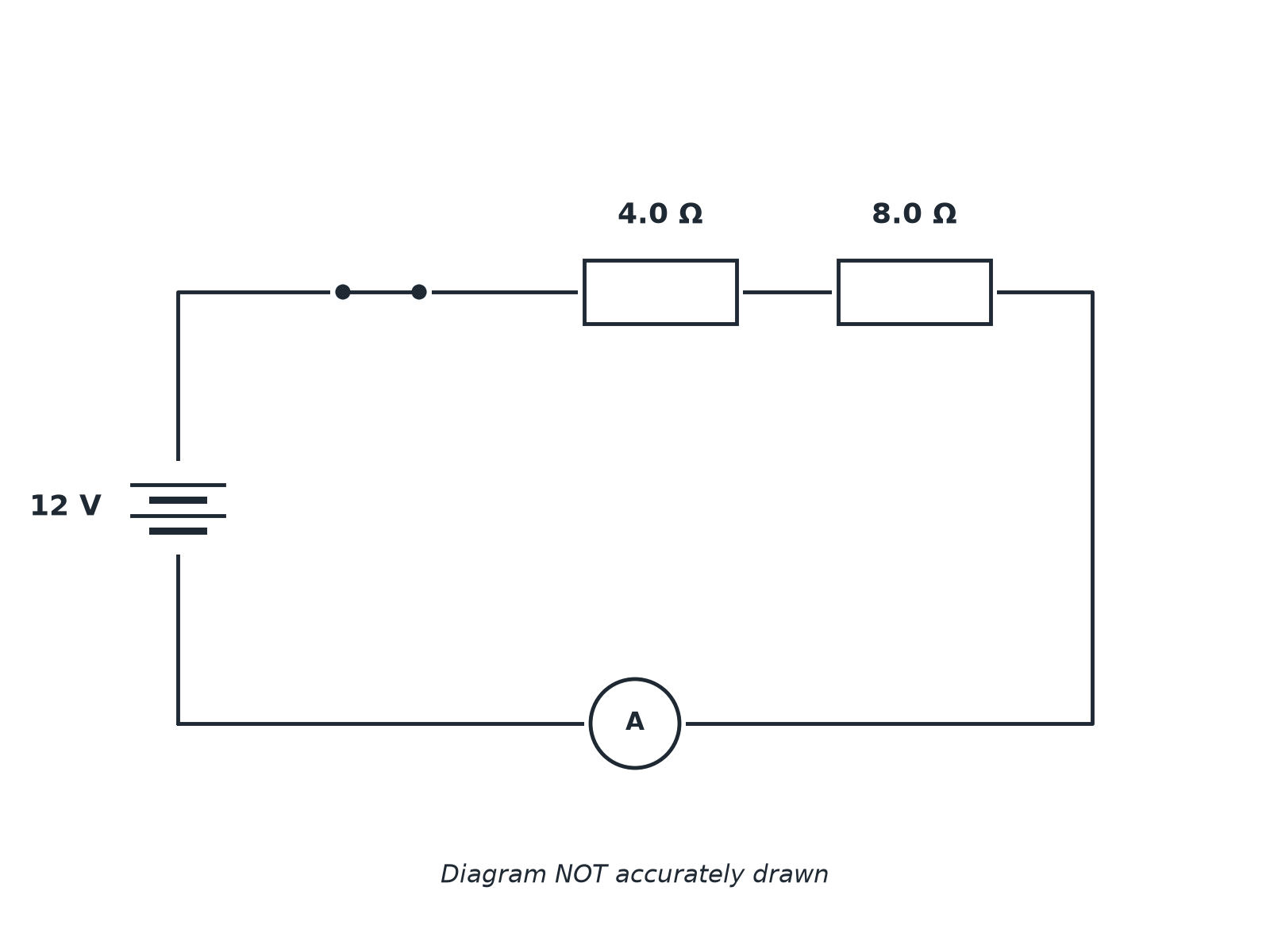
A 12 V battery is connected in series with resistors of 4.0 Ω and 8.0 Ω. Calculate the current and the pd across each resistor.
Show the solutionHide the solution
- 1 Total resistance \(R = 4.0 + 8.0 = 12\ \Omega\)
- 2 Current \(I = V \div R = 12 \div 12 = 1.0\) A
- 3 Pd across 4.0 Ω \(V = IR = 1.0 \times 4.0 = 4.0\) V
- 4 Pd across 8.0 Ω \(V = 1.0 \times 8.0 = 8.0\) V
- 5 Check \(4.0 + 8.0 = 12\) V
AnswerCurrent 1.0 A; pds 4.0 V and 8.0 V.
Parallel Circuit
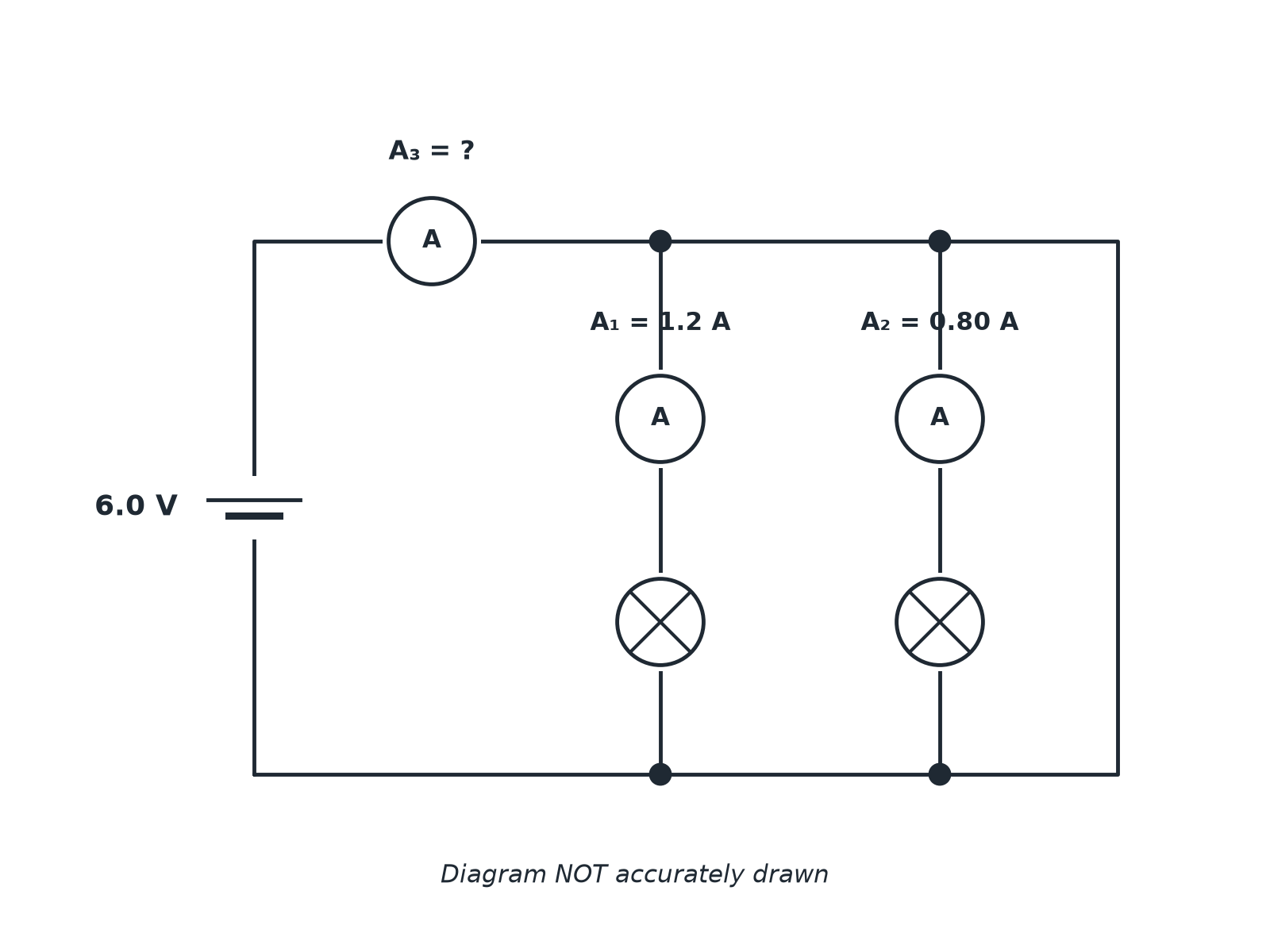
Two lamps are connected in parallel to a 6.0 V supply. A1 reads 1.2 A and A2 reads 0.80 A. What does A3 in the main wire read?
Show the solutionHide the solution
- 1 Currents in the branches add \(I_{total} = 1.2 + 0.80\)
- 2 Answer \(I_{total} = 2.0\) A
Answer2.0 A; each lamp has 6.0 V across it.
Why Resistance Changes
Explain it in words.
-
In series
The current has to pass through each resistor one after another, so the total opposition is greater.
-
In parallel
There are more paths for the current, so more charge can flow: the total resistance is less than any single resistor.
-
Uses of series circuits
Measurement and testing, for example a circuit with a thermistor and an ammeter.
-
Uses of parallel circuits
House lighting: each lamp has the full supply pd and can be switched on separately.
Circuit Puzzle
A 9.0 V cell is connected to two resistors in series, 6.0 Ω and 12 Ω. (a) Find the total resistance. (b) Find the current. (c) Find the pd across the 12 Ω resistor.
1. Add the resistances.
2. Find I, then V across each.
A good answer shows: (a) 18 Ω (b) \(9.0 \div 18 = 0.50\) A (c) \(0.50 \times 12 = 6.0\) V
Can I...?
- 1Describe series and parallel circuits.
- 2Add resistors in series.
- 3Find the current in a series circuit.
- 4Find the pd across each resistor.
- 5Add branch currents in parallel.
- 6State that pd is the same across parallel branches.
- 7Explain why total resistance changes.
- 8Draw a circuit diagram.
Summary & Exam Focus
- Series: \(R_{total} = R_1 + R_2\), same current, shared pd.
- Parallel: same pd, currents add, total resistance less than the smallest.
- Ammeters in series, voltmeters in parallel.
- Household circuits use parallel wiring.
Exam focus
A 12 V battery is connected in series to resistors of 4.0 Ω and 8.0 Ω. Calculate the current. (3 marks) (3 marks)
Add the resistances first, then use V = IR.
Key terms
The vocabulary this lesson expects you to use. Each one is linked from the first place it appears above.
- Series
- Components connected one after another in a single loop.
- Parallel
- Components connected on separate branches.
- Equivalent resistance
- The single resistance that could replace the combination.
- Branch
- One of the paths in a parallel circuit.
- Total resistance
- The resistance of the whole circuit.
Questions and answers
11 questions set on this lesson, with the mark schemes and model answers open.
The diagram shows a 12 V battery connected to two resistors in series. Calculate (a) the total resistance and (b) the current in the circuit.
Mark scheme — 3 marks available
- Adds resistances — 1 mark
- 12 Ω — 1 mark
- 1.0 A — 1 mark
Model answer
(a) \(R = 4.0 + 8.0 = 12\ \Omega\). (b) \(I = 12 \div 12 = 1.0\) A
Use your answer to the previous question to calculate the potential difference across the 8.0 Ω resistor. The current is 1.0 A.
Mark scheme — 3 marks available
- Correct equation — 1 mark
- Correct substitution — 1 mark
- 8.0 V — 1 mark
Model answer
\(V = IR = 1.0 \times 8.0 = 8.0\) V
The diagram shows two lamps connected in parallel to a 6.0 V supply. Ammeter A1 reads 1.2 A and A2 reads 0.80 A. (a) Calculate the reading on A3. (b) State the pd across each lamp.
Mark scheme — 3 marks available
- Adds the branch currents — 1 mark
- 2.0 A — 1 mark
- 6.0 V — 1 mark
Model answer
(a) 1.2 + 0.80 = 2.0 A. (b) 6.0 V across each lamp.
Explain why the lights in a house are connected in parallel rather than in series.
Mark scheme — 2 marks available
- Each lamp gets the full supply pd — 1 mark
- Lamps can be switched independently or one failing does not stop the others — 1 mark
Model answer
In parallel each lamp has the full supply potential difference across it, and each lamp can be switched on and off independently of the others.
Explain, in terms of the flow of current, why adding a second resistor in series increases the total resistance but adding a second resistor in parallel decreases the total resistance.
Mark scheme — 3 marks available
- Series: current passes through both, so resistance is greater — 1 mark
- Parallel: two paths — 1 mark
- More current for the same pd, so total resistance is less — 1 mark
Model answer
In series the current must pass through both resistors so the opposition is greater. In parallel there are two paths, so more current can flow for the same potential difference, so the total resistance is less.
A 9.0 V cell is connected to a 6.0 Ω resistor and a 12 Ω resistor in series. Calculate the potential difference across the 12 Ω resistor.
Mark scheme — 4 marks available
- Total resistance 18 Ω — 1 mark
- Current 0.50 A — 1 mark
- Correct substitution — 1 mark
- 6.0 V — 1 mark
Model answer
\(R = 18\ \Omega\); \(I = 9.0 \div 18 = 0.50\) A; \(V = 0.50 \times 12 = 6.0\) V
In a series circuit the total resistance is...
Why: \(R_{total} = R_1 + R_2\).
In a parallel circuit, the pd across each branch is...
Why: Each branch is connected directly to the supply.
Two branches carry 0.5 A and 0.3 A. The main current is...
Why: Branch currents add.
Resistors of 5 Ω and 10 Ω in series give...
Why: Add the resistances.
Adding a resistor in parallel...
Why: There are more paths for the current.