Viewing as
Teacher view: planning notes, the answers to every question, and the teacher copies of the files.
Physics · Electricity
Static charge
Explain how insulating materials become charged when rubbed, and describe attraction, repulsion and sparking in terms of the transfer of electrons.
Teacher resources
The teacher copies: slides with the questions built in, the answers, and anything else attached to this lesson for whoever is teaching it.
- Static charge - Teacher Slides.pptx Teacher The lesson slides with the teacher's notes on each slide, and every question and mark scheme built in. Built from the lesson script on 30 September 2026. View
- Static charge - Teacher Notes.docx Teacher The complete notes with the teacher's notes and every model answer in full. Built from the lesson script on 30 September 2026. View
Student handouts
The same files the students see, to print or hand out.
- Static charge.pptx Built from the lesson script on 30 September 2026. View
- Static charge - Completed Notes.docx The full notes for the lesson, to revise from. Built from the lesson script on 30 September 2026. View
- Static charge - Exam Questions.docx Built from the lesson script on 30 September 2026. View
Warm-up
Answer each one, then check.
-
1
What charge do electrons have?
Show answerHide answer
Negative
-
2
What is an insulator?
Show answerHide answer
A material that does not conduct electricity
-
3
What is a non-contact force?
Show answerHide answer
A force between objects that are not touching
-
4
What charge does a proton have?
Show answerHide answer
Positive
-
5
Like charges...
Show answerHide answer
Learning Objectives
- 1Describe the production of static electricity by rubbing.
- 2Explain charging in terms of the transfer of electrons.
- 3Describe evidence that charged objects exert non-contact forces.
- 4Explain sparking.
STATIC ELECTRICITY
When insulating materials are rubbed together, electrons are transferred: the material that gains electrons becomes negatively charged and the one that loses them is left with an equal positive charge.
Objects with the same type of charge repel; objects with different types of charge attract.
Charging by Rubbing
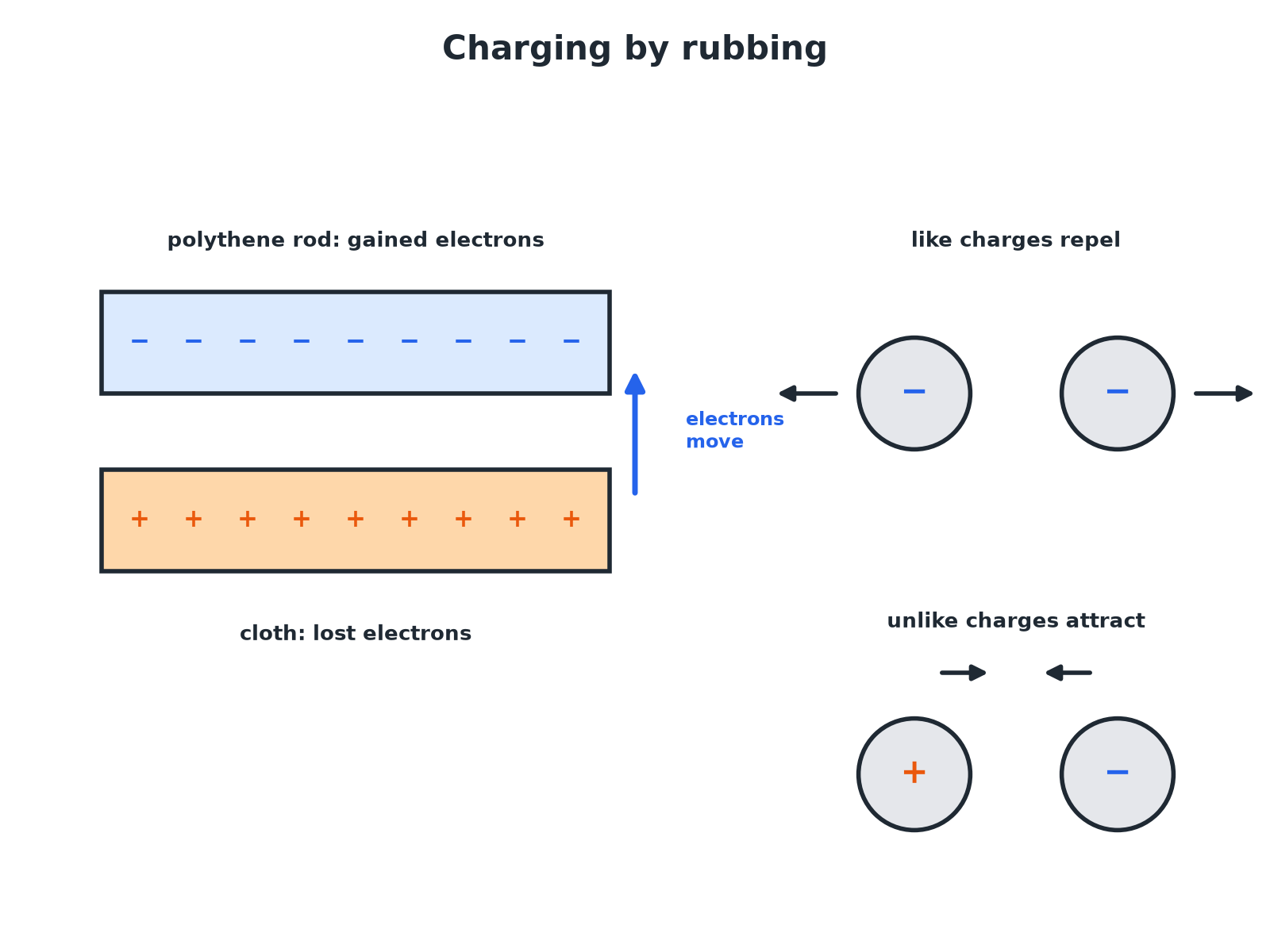
Only electrons move; protons stay in the nuclei.
Explaining Charging
Explain why a polythene rod becomes negatively charged when rubbed with a cloth.
Show the solutionHide the solution
- 1 Friction Rubbing transfers energy so electrons can move
- 2 Electrons move Negatively charged electrons are rubbed off the cloth and on to the rod
- 3 The rod Gains electrons, so it becomes negatively charged
- 4 The cloth Loses electrons and is left with an equal positive charge
AnswerElectrons transfer from the cloth to the rod; the rod becomes negative and the cloth positive.
Sparking
Explain how a spark can jump from a charged object to an earthed conductor.
Show the solutionHide the solution
- 1 Charge builds A large amount of charge collects on the object
- 2 Strong field The electric field between the object and the conductor becomes very strong
- 3 Air ionises The air becomes ionised and conducts, so charge flows as a spark
AnswerCharge builds up until the field is strong enough to make air conduct, and the charge flows as a spark.
Evidence of Non-Contact Forces
-
Repulsion
Two charged rods of the same charge push each other apart.
-
Attraction
A charged rod attracts small pieces of paper or a stream of water.
-
Hanging balls
Suspended charged balls move apart or together without touching.
-
Balloon on a wall
A rubbed balloon can stick to a wall.
Common Mistakes
Be precise.
-
Only electrons move
Positive charges (protons) are fixed in the nucleus and do not move when rubbed.
-
Insulators
Only insulators keep the charge; a metal rod held in the hand loses its charge.
-
Say gained or lost
Say 'gained electrons', not 'gained negative charge'.
Rub and Predict
A student rubs a cloth on a balloon. The balloon is then attracted to the wall. Explain what has happened to the electrons and what type of charge the balloon has.
1. Say which way electrons moved.
2. State the charge on each object.
A good answer shows: Electrons are transferred from the cloth to the balloon. The balloon gains electrons and becomes negatively charged; it attracts the wall.
Can I...?
- 1Explain how rubbing makes charge.
- 2Say which particles move.
- 3State the charge on each object.
- 4Describe attraction and repulsion.
- 5Describe evidence for non-contact forces.
- 6Explain sparking.
- 7Explain why insulators keep charge.
- 8Use the terms gained and lost electrons.
Summary & Exam Focus
- Rubbing insulators transfers electrons.
- The material that gains electrons is negative; the one that loses electrons is positive.
- Like charges repel, unlike attract.
- Sparks occur when the field is strong enough to ionise air.
Exam focus
Explain how a polythene rod becomes negatively charged when rubbed with a cloth. (3 marks) (3 marks)
Say which way the electrons move.
Key terms
The vocabulary this lesson expects you to use. Each one is linked from the first place it appears above.
- Static electricity
- Charge that builds up on an insulator.
- Electron
- A negatively charged particle.
- Non-contact force
- A force between objects that are not touching.
- Earthing
- Connecting to the ground so charge can flow away.
- Repel
- Push apart.
- Attract
- Pull together.
Questions and answers
10 questions set on this lesson, with the mark schemes and model answers open.
A polythene rod is rubbed with a cloth and becomes negatively charged. Explain how the rod becomes negatively charged.
Mark scheme — 3 marks available
- Electrons transferred — 1 mark
- From the cloth to the rod — 1 mark
- Rod gains electrons so it is negative — 1 mark
Model answer
Electrons are transferred from the cloth to the rod when they are rubbed together. The rod gains electrons so it becomes negative.
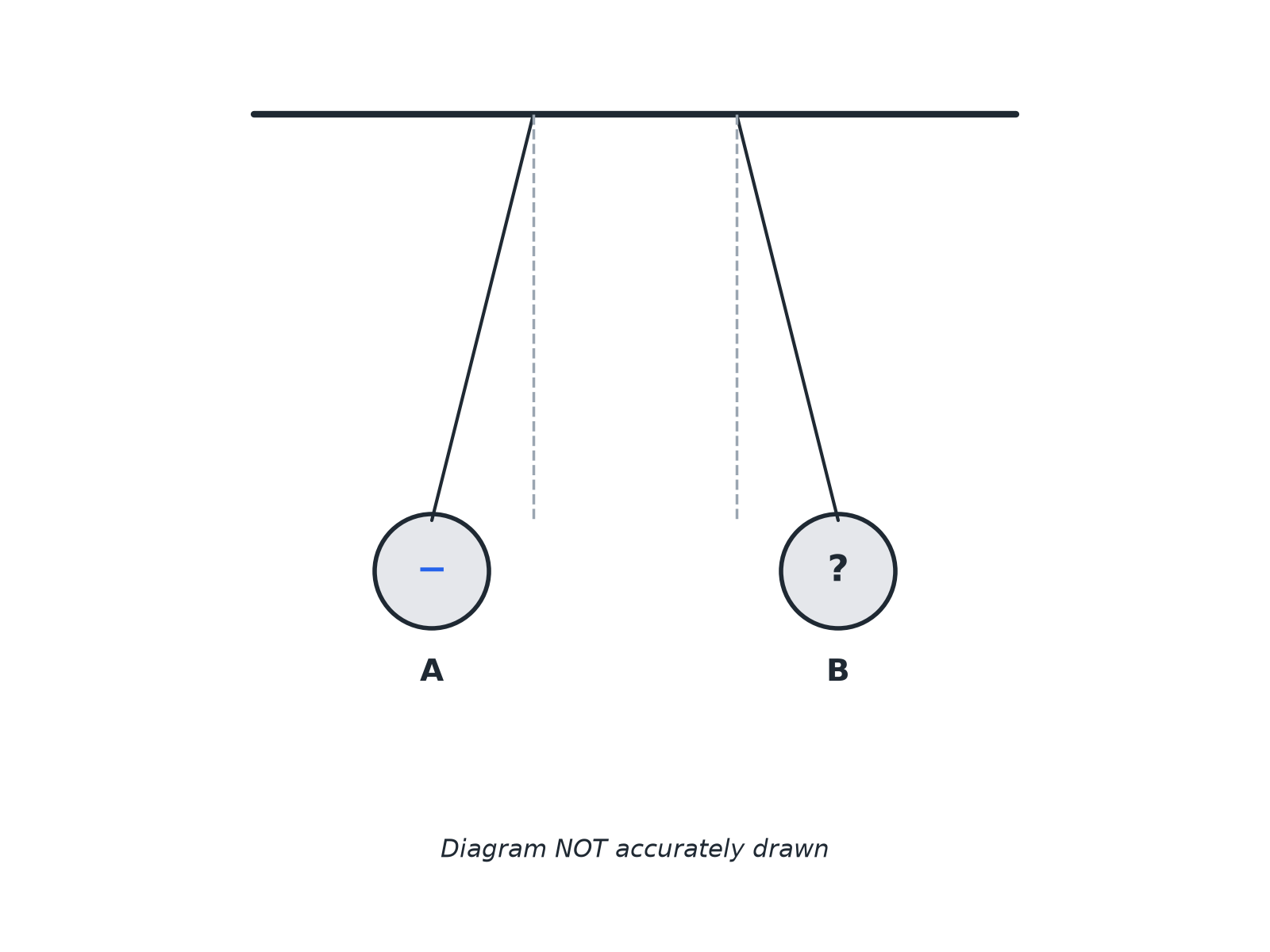
The diagram shows two charged balls hanging from threads. Ball A is negatively charged. (a) State the type of charge on ball B. (b) Name the type of force acting between the balls.
Mark scheme — 3 marks available
- Negative — 1 mark
- Because they repel (like charges) — 1 mark
- Non-contact force — 1 mark
Model answer
(a) Negative (they repel). (b) A non-contact force (electrostatic repulsion).
A student walks across a nylon carpet and then gets a small electric shock when touching a metal door handle. Explain why.
Mark scheme — 3 marks available
- Rubbing transfers electrons — 1 mark
- The student becomes charged — 1 mark
- Charge flows to earth through the handle — 1 mark
Model answer
Electrons are rubbed off the carpet onto the student (or the other way round), so the student becomes charged. When the student touches the metal handle, charge flows through the metal to earth, causing a spark or shock.
Explain why a charged balloon can stick to a wall even though the balloon and wall do not touch.
Mark scheme — 2 marks available
- Non-contact force — 1 mark
- Attraction between charged balloon and wall — 1 mark
Model answer
The charged balloon exerts a non-contact force (electrostatic force of attraction) on the wall.
Lightning is a very large spark. Explain how charge builds up in a cloud and what causes the lightning.
Mark scheme — 4 marks available
- Electrons transferred by collisions or friction — 1 mark
- Cloud charged, large pd between cloud and ground — 1 mark
- Strong electric field ionises the air — 1 mark
- Charge flows as a spark — 1 mark
Model answer
Collisions between ice particles in the cloud transfer electrons, so parts of the cloud become charged. A large potential difference forms between the cloud and the ground. The electric field becomes strong enough to ionise the air, which conducts, and charge flows as lightning.
Which particles move when an insulator is rubbed?
Why: Only electrons are free to move.
A material that gains electrons becomes...
Why: It has more electrons than protons.
Two negatively charged objects...
Why: Like charges repel.
Positive and negative objects...
Why: Unlike charges attract.
A charged object attracting paper is an example of...
Why: The objects are not touching.