Viewing as
Teaching this? The teacher view adds 2 files, the mark schemes and the model answers.
Physics · Energy
National and global energy resources
Describe the main energy resources, distinguish renewable from non-renewable, compare their uses and reliability, and evaluate their environmental impact.
Warm-up
Answer each one, then check.
-
1
Name a fossil fuel.
Show answerHide answer
Coal, oil or natural gas
-
2
What does renewable mean?
Show answerHide answer
Can be replenished as it is used
-
3
What gas do fossil fuels release when burned?
Show answerHide answer
Carbon dioxide
-
4
What is generated in a power station?
Show answerHide answer
Electricity
-
5
Name a use of energy resources other than electricity.
Show answerHide answer
Transport or heating
Learning Objectives
- 1Name the main energy resources.
- 2Distinguish renewable and non-renewable resources.
- 3Compare their uses: transport, electricity generation, heating.
- 4Explain why some resources are more reliable than others.
- 5Describe environmental impacts and explain trends in resource use.
RENEWABLE
A renewable energy resource is one that is being, or can be, replenished as it is used.
Non-renewable resources will run out: fossil fuels (coal, oil, gas) and nuclear fuel. Renewable: bio-fuel, wind, hydro-electricity, geothermal, tides, the Sun and water waves.
Renewable and Non-renewable Resources
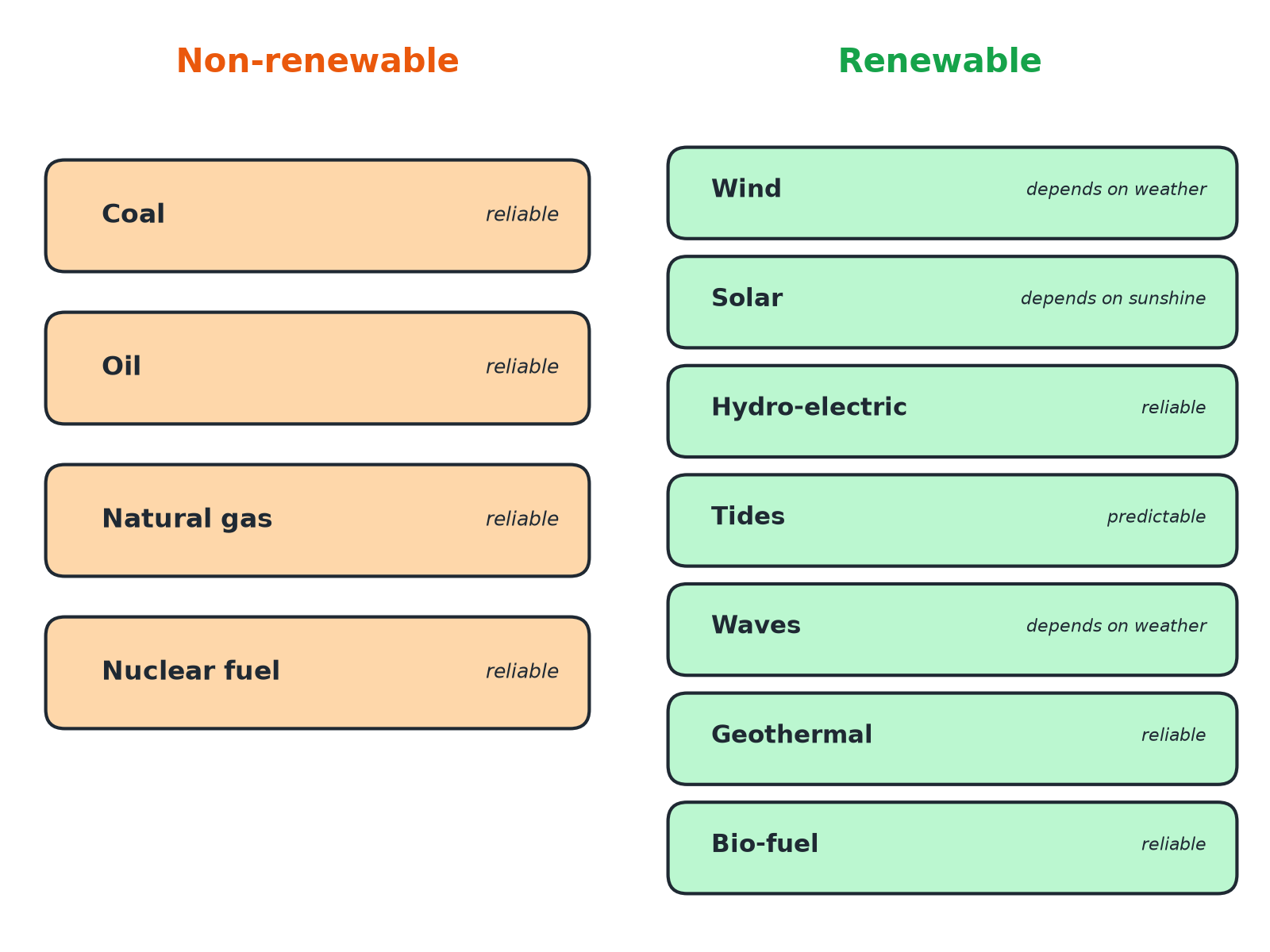
Reliable means it can produce power when needed.
Comparing Energy Resources
Use this to compare for evaluation questions.
-
Coal, oil, gas
Renewable?: No. Reliable?: Yes. Main environmental issue: Release carbon dioxide (global warming); coal and oil also cause acid rain or pollution
-
Nuclear fuel
Renewable?: No. Reliable?: Yes. Main environmental issue: Radioactive waste; risk of accidents; very low carbon dioxide
-
Wind
Renewable?: Yes. Reliable?: No: depends on wind speed. Main environmental issue: Visual and noise impact; can affect birds
-
Solar
Renewable?: Yes. Reliable?: No: only in daylight and sunshine. Main environmental issue: Land use for large solar farms
-
Hydro-electric
Renewable?: Yes. Reliable?: Mostly, if water is stored. Main environmental issue: Flooding valleys destroys habitats
-
Tides and waves
Renewable?: Yes. Reliable?: Tides are predictable; waves vary. Main environmental issue: Can affect marine life and sea views
-
Bio-fuel
Renewable?: Yes. Reliable?: Yes, can be stored. Main environmental issue: Land used for crops; carbon dioxide released when burned
-
Geothermal
Renewable?: Yes. Reliable?: Yes. Main environmental issue: Only possible in some places
Uses of Energy Resources
-
Transport
Petrol, diesel and bio-fuels power vehicles.
-
Electricity generation
Fossil fuels, nuclear fuel, wind, solar, hydro, tides, waves and geothermal turn generators or solar cells.
-
Heating
Gas and bio-fuels heat homes; geothermal and solar can heat water directly.
-
Descriptions of the power station process
are not required for this specification.
Why Are Some More Reliable?
Reliability means the resource can supply energy on demand.
-
Fuels
Coal, oil, gas, nuclear fuel and bio-fuel can be stored and used when needed.
-
Weather
Wind and solar depend on weather and time of day.
-
Predictable
Tides are predictable because they depend on the Moon and Sun.
Patterns and Trends
Use of renewables has grown.
-
Reasons for growth
To reduce carbon dioxide emissions, government targets, falling costs of wind and solar.
-
Slow change
Building new power stations is expensive and takes time.
-
Science and society
Science can identify environmental problems but political, social, ethical and economic factors decide how they are tackled.
Evaluate the Options
A town needs a new power source. In groups, choose between a wind farm, a gas power station and a nuclear power station, giving two advantages and two disadvantages of each.
1. List advantages.
2. List disadvantages.
3. Decide and justify.
A good answer shows: Wind: no fuel or CO2 in use but not reliable, visual impact. Gas: reliable but produces CO2 and uses a finite fuel. Nuclear: reliable and low CO2 but produces radioactive waste and is costly to build and decommission.
Can I...?
- 1Name the main energy resources.
- 2Say which are renewable.
- 3Compare uses of resources.
- 4Explain reliability.
- 5Describe environmental impacts.
- 6Describe trends in use.
- 7Evaluate two resources.
- 8Use data to justify a conclusion.
Summary & Exam Focus
- Renewable resources are replenished as they are used.
- Fossil fuels and nuclear fuel are non-renewable.
- Wind and solar are not reliable; fuels are reliable.
- Each resource has environmental impacts.
Exam focus
State two renewable energy resources. (2 marks) (2 marks)
Give complete, specific resources such as wind or hydro-electricity.
Key terms
The vocabulary this lesson expects you to use. Each one is linked from the first place it appears above.
- Renewable
- A resource that is replenished as it is used.
- Non-renewable
- A resource that will run out.
- Fossil fuel
- Coal, oil or natural gas formed from ancient organisms.
- Reliable
- Able to supply energy whenever it is needed.
- Bio-fuel
- A fuel made from plant or animal matter.
- Global warming
- Rise in the Earth's average temperature linked to greenhouse gases.
Practice questions
Have a go at each one before you open its answer.
-
Question 1 State 2 marks
Give two examples of non-renewable energy resources.
Show answerHide answer
Model answer
Any two from: coal, oil, natural gas, nuclear fuel.
Mark scheme
- First example — 1 mark
- Second example — 1 mark
-
Question 2 State 2 marks
What is meant by a renewable energy resource?
Show answerHide answer
Model answer
A resource that is being or can be replenished as it is used.
Mark scheme
- Replenished — 1 mark
- As it is used — 1 mark
-
Question 3 Use the data 4 marks
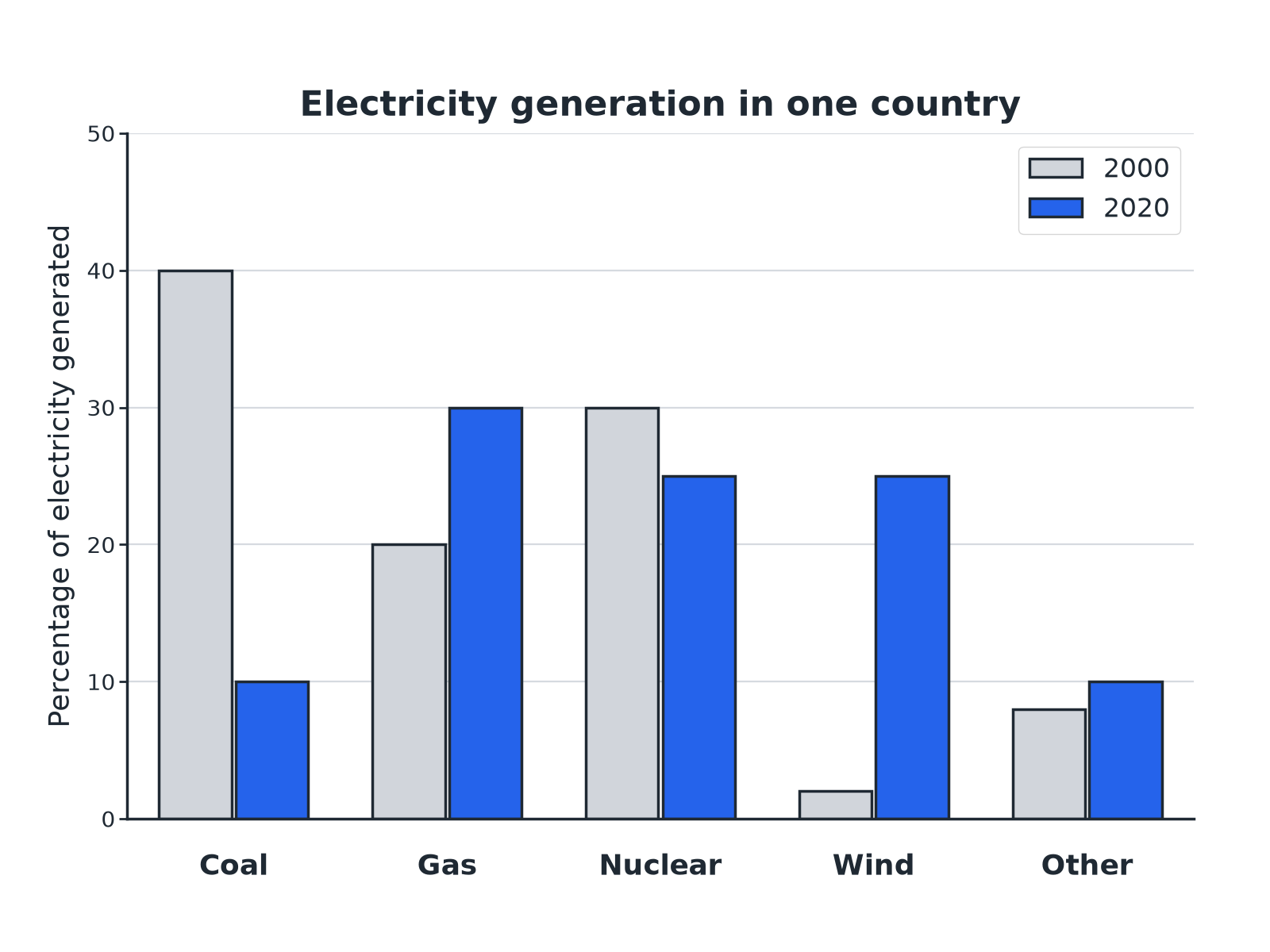
The bar chart shows the percentage of a country's electricity generated by different resources in 2000 and in 2020. (a) Describe two changes between 2000 and 2020. (b) Suggest one reason for one of these changes.
Show answerHide answer
Model answer
(a) Any two: coal fell from 40% to 10%; gas rose from 20% to 30%; wind rose from 2% to 25%; nuclear fell slightly. (b) To reduce carbon dioxide emissions and global warming; government targets or falling cost of wind turbines.
Mark scheme
- First change with data — 1 mark
- Second change with data — 1 mark
- Reason — 1 mark
- Linked to the change chosen — 1 mark
-
Question 4 Explain 3 marks
Wind turbines and gas power stations can both generate electricity. Compare the reliability of the two and explain the difference.
Show answerHide answer
Model answer
Gas power stations are reliable because gas can be stored and burned when needed. Wind turbines are less reliable because the wind speed changes and they only produce electricity when it is windy.
Mark scheme
- Gas is more reliable — 1 mark
- Gas can be stored or supplied on demand — 1 mark
- Wind depends on the weather — 1 mark
-
Question 5 Evaluate 6 marks
Evaluate the use of nuclear fuel and wind to generate electricity. Include environmental effects and reliability in your answer.
Show answerHide answer
Model answer
See levels-of-response scheme.
Mark scheme
- Level 3 (5 to 6 marks): a balanced comparison covering reliability, environmental impact and at least one of cost, carbon dioxide or waste, and a justified conclusion — 5 to 6 marks
- Level 2 (3 to 4 marks): several valid points for both, with some comparison — 3 to 4 marks
- Level 1 (1 to 2 marks): simple statements about one or both — 1 to 2 marks
-
Question 6 Suggest 2 marks
Some countries still use fossil fuels even though they know about the environmental problems. Suggest two reasons for this.
Show answerHide answer
Model answer
Any two from: renewable resources can be expensive to set up; renewables are not always reliable; countries have economic, political or social reasons or depend on fossil fuel industries.
Mark scheme
- First reason — 1 mark
- Second reason — 1 mark
Quick check
-
Which is a renewable resource?
Show answerHide answer
D: Wind
Wind is replenished as it is used.
-
Which is non-renewable?
Show answerHide answer
A: Nuclear fuel
Uranium will run out.
-
Which resource is least reliable?
Show answerHide answer
B: Solar
Solar depends on sunshine.
-
Burning fossil fuels contributes to...
Show answerHide answer
C: global warming
They release carbon dioxide.
-
Which resource produces radioactive waste?
Show answerHide answer
D: Nuclear fuel
Nuclear reactors produce waste that stays radioactive for a long time.
Downloads
Free to keep, print and annotate.
- National and global energy resources.pptx Built from the lesson script on 30 September 2026. View
- National and global energy resources - Completed Notes.docx The full notes for the lesson, to revise from. Built from the lesson script on 30 September 2026. View
- National and global energy resources - Exam Questions.docx Built from the lesson script on 30 September 2026. View
Something here looks wrong?
Tell us what and we will go and look. It goes to whoever writes these pages, nobody else, and we do not ask who you are — so there is nothing to sign and nothing comes back to you.