Viewing as
Teacher view: planning notes, the answers to every question, and the teacher copies of the files.
Physics · Particle model of matter
Particle motion and pressure in gases
Explain gas pressure using the particle model, describe how temperature and volume affect pressure, and use \(pV = \text{constant}\).
Teacher resources
The teacher copies: slides with the questions built in, the answers, and anything else attached to this lesson for whoever is teaching it.
- Particle motion and pressure in gases - Teacher Slides.pptx Teacher The lesson slides with the teacher's notes on each slide, and every question and mark scheme built in. Built from the lesson script on 30 September 2026. View
- Particle motion and pressure in gases - Teacher Notes.docx Teacher The complete notes with the teacher's notes and every model answer in full. Built from the lesson script on 30 September 2026. View
Student handouts
The same files the students see, to print or hand out.
- Particle motion and pressure in gases.pptx Built from the lesson script on 30 September 2026. View
- Particle motion and pressure in gases - Completed Notes.docx The full notes for the lesson, to revise from. Built from the lesson script on 30 September 2026. View
- Particle motion and pressure in gases - Exam Questions.docx Built from the lesson script on 30 September 2026. View
Warm-up
Answer each one, then check.
-
1
What is pressure?
Show answerHide answer
Force per unit area
-
2
What is the unit of pressure?
Show answerHide answer
Pascal (Pa)
-
3
How do gas particles move?
Show answerHide answer
Randomly and quickly
-
4
Convert 100 kPa to Pa.
Show answerHide answer
100 000 Pa
-
5
Write 3 × 4 = ?
Show answerHide answer
12
Learning Objectives
- 1Explain how the motion of gas molecules is related to temperature and pressure.
- 2Explain qualitatively the relation between temperature and pressure of a gas at constant volume.
- 3Explain how changing the volume of a gas at constant temperature changes its pressure.
- 4Use \(pV = \text{constant}\).
GAS PRESSURE
Gas molecules are in constant random motion. Their collisions with the container walls cause the pressure, which acts at right angles to the wall.
For a fixed mass of gas at constant temperature, \(pressure \times volume = constant\), \(pV = \text{constant}\). It is given on the equation sheet.
Gas in a Container
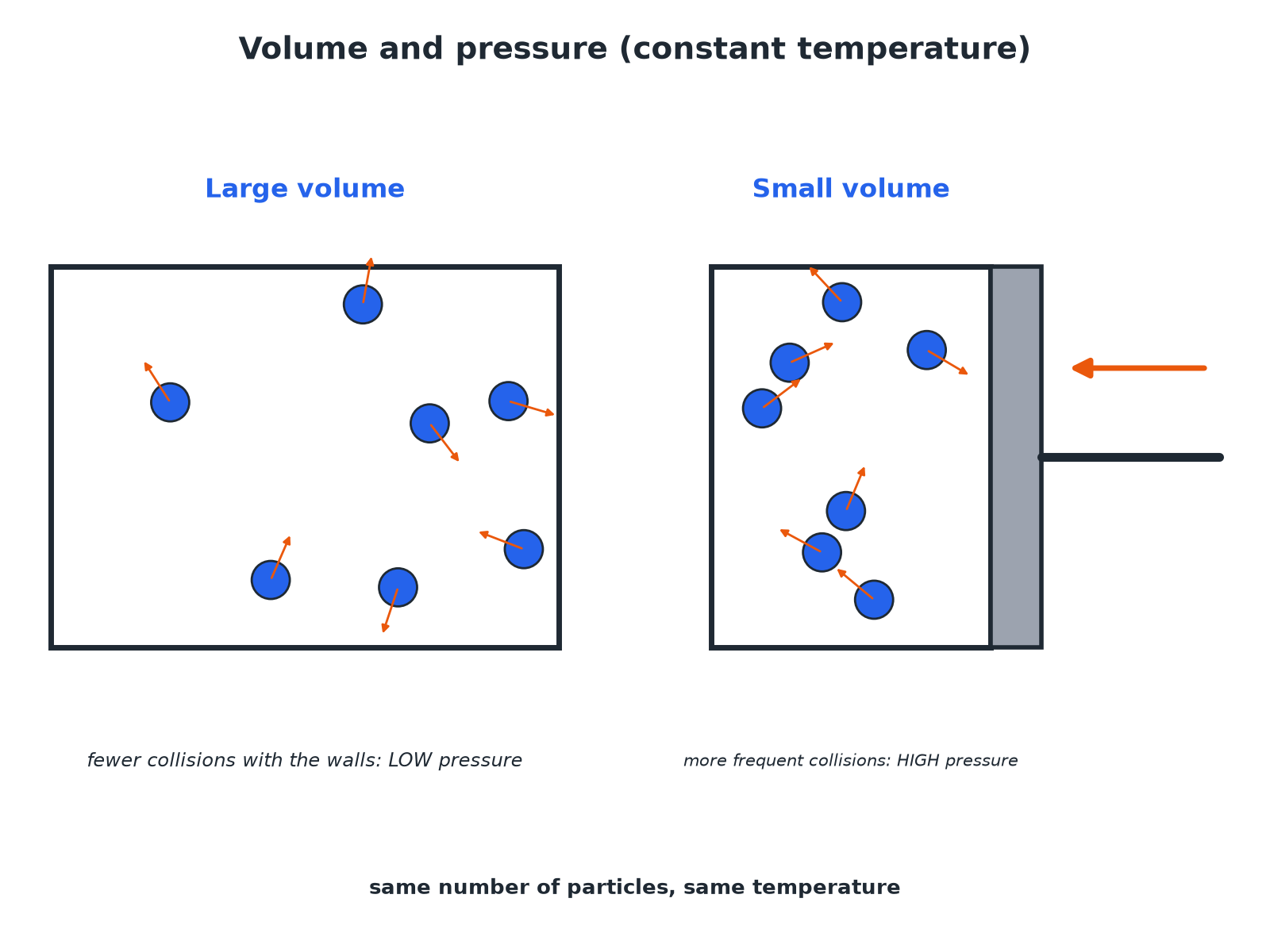
Smaller volume means more frequent collisions.
Explaining Pressure
Use this chain of reasoning.
-
1
Particles move randomly
They collide with the walls of the container.
-
2
Each collision exerts a tiny force
At right angles to the wall.
-
3
Many collisions
Together they give a steady force on the wall, and pressure = force ÷ area.
What Affects Gas Pressure
Learn the explanation for each.
-
Temperature up (constant volume)
Effect on pressure: Increases. Explanation: Particles move faster, so collide harder and more often.
-
Volume down (constant temperature)
Effect on pressure: Increases. Explanation: Particles are closer together so collide more often with the walls.
-
Volume up (constant temperature)
Effect on pressure: Decreases. Explanation: Particles collide less often with the walls.
Using pV = constant
A gas at 100 000 Pa occupies 0.30 m³. It is compressed to 0.10 m³ at constant temperature. Calculate the new pressure.
Show the solutionHide the solution
- 1 Write the relationship \(p_1V_1 = p_2V_2\)
- 2 Substitute \(100\,000 \times 0.30 = p_2 \times 0.10\)
- 3 Rearrange \(p_2 = \dfrac{30\,000}{0.10}\)
- 4 Answer \(p_2 = 300\,000\) Pa
Answer300 000 Pa
Heating at Constant Volume
Explain why the pressure in a sealed can increases when it is heated.
Show the solutionHide the solution
- 1 Temperature rises The average kinetic energy of the molecules increases
- 2 Faster molecules They hit the walls harder and more often
- 3 Result The force on the walls, and so the pressure, increases
AnswerPressure increases because the faster molecules collide with the walls more often and with greater force.
Common Mistakes
Avoid these.
-
Molecules expand
The molecules do not get bigger: they move faster.
-
Collisions
Say 'more frequent and harder', not just 'more collisions'.
-
Units
Pressure in pascals (Pa) and volume in m³.
-
Constant
pV = constant only for a fixed mass at constant temperature.
Squash the Gas
A syringe holds 60 cm³ of air at 100 kPa. The plunger is pushed until the volume is 20 cm³ at constant temperature. Predict and calculate the new pressure.
1. Use p₁V₁ = p₂V₂.
2. Explain with particles.
A good answer shows: The pressure increases (particles hit the walls more often). p₂ = 100 × 60 ÷ 20 = 300 kPa.
Can I...?
- 1Explain gas pressure with particles.
- 2Say the force is at right angles to the wall.
- 3Explain the effect of temperature.
- 4Explain the effect of volume.
- 5Use \(pV = \text{constant}\).
- 6Give units of pressure.
- 7Compress and expand gases.
- 8Give clear explanations.
Summary & Exam Focus
- Gas pressure is caused by collisions with the walls.
- Higher temperature: faster molecules, more force, more often.
- Smaller volume at constant temperature: higher pressure.
- \(pV = \text{constant}\).
Exam focus
Explain, in terms of particles, why the pressure of a gas in a sealed container increases when the gas is heated. (3 marks) (3 marks)
Say faster molecules hit the walls more often and harder.
Key terms
The vocabulary this lesson expects you to use. Each one is linked from the first place it appears above.
- Pressure
- Force per unit area.
- Pascal
- The unit of pressure; one newton per square metre.
- Random motion
- Movement in any direction with no pattern.
- Fixed mass
- A sealed amount of gas with no particles added or removed.
- Compress
- Squash into a smaller volume.
- Kinetic energy
- Energy of movement.
Questions and answers
10 questions set on this lesson, with the mark schemes and model answers open.
A sealed container of gas is heated and the volume is constant. Explain, in terms of the particles, why the pressure of the gas increases.
Mark scheme — 3 marks available
- Particles move faster or gain kinetic energy — 1 mark
- Collide with walls more often or harder — 1 mark
- So pressure increases — 1 mark
Model answer
The particles gain kinetic energy and move faster. They collide with the walls more often and with greater force, so the force on the walls per unit area increases.
The volume of a gas in a syringe is reduced. The temperature is constant. Explain, in terms of the particles, why the pressure increases.
Mark scheme — 3 marks available
- Volume decreases so the particles are closer — 1 mark
- More frequent collisions with the walls — 1 mark
- Pressure increases — 1 mark
Model answer
The particles are closer together, so they collide with the walls more often. The force per unit area increases, so the pressure increases.
A fixed mass of gas has a pressure of 100 000 Pa and a volume of 0.30 m³. The gas is compressed at constant temperature to a volume of 0.10 m³. Calculate the new pressure. Use the equation: pressure × volume = constant
Mark scheme — 3 marks available
- Correct substitution — 1 mark
- Rearranges — 1 mark
- 300 000 Pa — 1 mark
Model answer
\(100\,000 \times 0.30 = p \times 0.10\); \(p = 300\,000\) Pa
State the direction of the force exerted by gas particles on the wall of a container.
Mark scheme — 1 mark available
- At right angles to the wall — 1 mark
Model answer
At right angles to the wall.
A syringe contains 60 cm³ of air at a pressure of 100 kPa. The plunger is pushed in until the volume is 24 cm³. The temperature is constant. Calculate the new pressure of the air in kPa.
Mark scheme — 4 marks available
- pV constant — 1 mark
- Correct substitution — 1 mark
- Correct rearrangement — 1 mark
- 250 kPa — 1 mark
Model answer
\(100 \times 60 = p \times 24\); \(p = 250\) kPa
Gas pressure is caused by...
Why: Collisions exert a force on the walls.
Heating a gas at constant volume makes the pressure...
Why: The particles move faster.
Halving the volume of a gas at constant temperature makes the pressure...
Why: pV = constant.
The force on a wall from gas pressure is...
Why: It acts perpendicular to the surface.
The unit of pressure is the...
Why: Pa = N/m².