Viewing as
Teacher view: planning notes, the answers to every question, and the teacher copies of the files.
Physics · Forces
Braking distances and large decelerations
Explain the factors that affect braking distance, how brakes work in terms of work done and energy, and the dangers of large decelerations.
Teacher resources
The teacher copies: slides with the questions built in, the answers, and anything else attached to this lesson for whoever is teaching it.
- Braking distances and large decelerations - Teacher Slides.pptx Teacher The lesson slides with the teacher's notes on each slide, and every question and mark scheme built in. Built from the lesson script on 30 September 2026. View
- Braking distances and large decelerations - Teacher Notes.docx Teacher The complete notes with the teacher's notes and every model answer in full. Built from the lesson script on 30 September 2026. View
Student handouts
The same files the students see, to print or hand out.
- Braking distances and large decelerations.pptx Built from the lesson script on 30 September 2026. View
- Braking distances and large decelerations - Completed Notes.docx The full notes for the lesson, to revise from. Built from the lesson script on 30 September 2026. View
- Braking distances and large decelerations - Exam Questions.docx Built from the lesson script on 30 September 2026. View
Warm-up
Answer each one, then check.
-
1
What is friction?
Show answerHide answer
A force opposing motion
-
2
What is kinetic energy?
Show answerHide answer
Energy stored in a moving object
-
3
What is deceleration?
Show answerHide answer
Slowing down
-
4
What is work done?
Show answerHide answer
Energy transferred by a force
-
5
What does the brake do to the wheel?
Show answerHide answer
Uses friction to slow it
Learning Objectives
- 1Explain how road conditions and the condition of the vehicle affect braking distance.
- 2Explain how the brakes reduce the kinetic energy of a vehicle by work done against friction.
- 3Explain why greater speed needs a greater braking force to stop in the same distance.
- 4Explain the dangers of large decelerations, and estimate the forces involved (Higher tier).
BRAKING
When a force is applied to the brakes, the work done by the friction force between the brakes and the wheel reduces the kinetic energy of the vehicle and increases the temperature of the brakes.
The greater the braking force, the greater the deceleration. Large decelerations may cause brakes to overheat or a loss of control.
Braking Distance Depends on Conditions
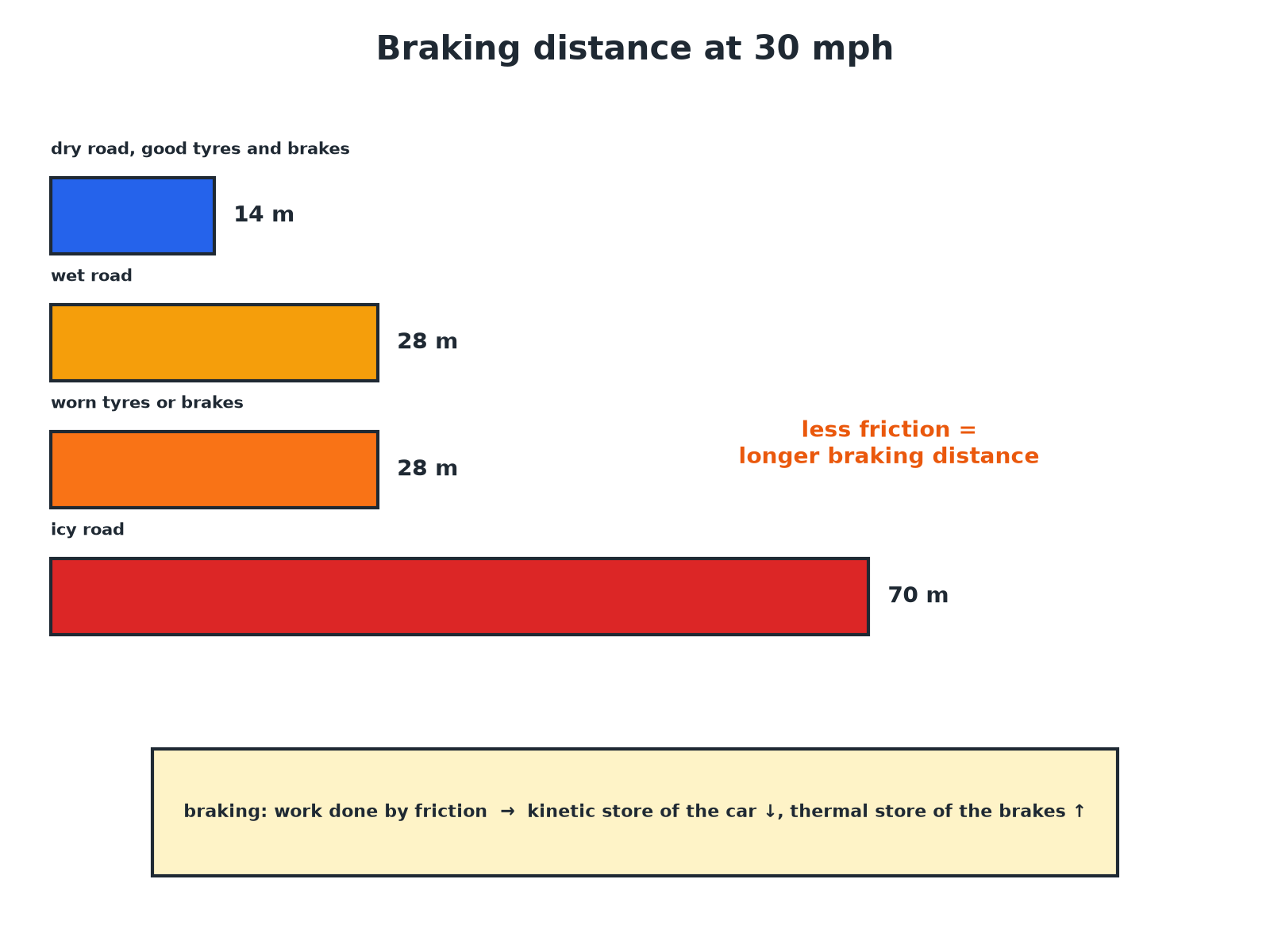
Less friction means a longer braking distance.
What Affects Braking Distance
Increases braking distance
- Higher speed.
- Wet or icy roads (less friction).
- Worn tyres (less grip).
- Worn brakes (less braking force).
- A heavier vehicle (more kinetic energy).
Reduces braking distance
- Lower speed.
- Dry road.
- Good tyres with deep treads.
- Well-maintained brakes.
Braking Force
A car of mass 1200 kg travelling at 25 m/s stops in 50 m. Estimate the average braking force.
Show the solutionHide the solution
- 1 Kinetic energy \(E_k = \tfrac{1}{2}mv^2 = 0.5 \times 1200 \times 25^2 = 375\,000\) J
- 2 Work done by the brakes \(W = Fs\), so \(F = 375\,000 \div 50\)
- 3 Answer \(F = 7500\) N
AnswerAbout 7500 N.
Deceleration
For the same car, calculate the deceleration.
Show the solutionHide the solution
- 1 Use F = ma \(a = F \div m = 7500 \div 1200\)
- 2 Answer \(a = 6.25\) m/s²
Answer6.25 m/s² (deceleration).
Dangers of Large Decelerations
Explain the dangers of a very large deceleration.
Show the solutionHide the solution
- 1 Large force A large braking force is needed
- 2 Overheating Brakes can overheat and fade
- 3 Loss of control Tyres may lose grip and the car may skid
- 4 Passengers Occupants experience large forces that can cause injury
AnswerBrakes overheat, the car can skid, and people in the vehicle are harmed.
Energy
What happens to the energy.
-
Kinetic to thermal
Work done against friction transfers the car's kinetic energy to the thermal energy of the brakes and tyres.
-
Speed
Doubling speed quadruples kinetic energy, so the braking distance is about four times as long.
-
Braking force
A greater speed needs a greater braking force to stop in the same distance.
-
Estimate (Higher)
Use Fs = ½mv² to estimate forces.
Why Is Wet Worse?
A car's braking distance at 30 mph is 14 m on a dry road and 28 m on a wet road. Explain the difference. Estimate the braking distance on a wet road at 60 mph, where the dry distance is 55 m.
1. Link to friction.
2. Use the ratio.
A good answer shows: Wet roads have less friction so the deceleration is less and the distance is longer. At 60 mph, wet braking distance is about double the dry: about 110 m.
Can I...?
- 1Explain braking distance factors.
- 2Explain brakes and kinetic energy.
- 3Explain why speed matters.
- 4Explain wet and icy roads.
- 5Explain worn tyres and brakes.
- 6Explain brake overheating.
- 7Estimate a braking force.
- 8Explain dangers of deceleration.
Summary & Exam Focus
- Braking: work done by friction reduces kinetic energy.
- Wet or icy roads and worn tyres reduce friction.
- Higher speed needs a larger braking force.
- Large decelerations can overheat brakes and cause skids.
Exam focus
Explain why the braking distance of a car is greater on a wet road than on a dry road. (2 marks) (2 marks)
Less friction between the tyres and the road.
Key terms
The vocabulary this lesson expects you to use. Each one is linked from the first place it appears above.
- Braking distance
- The distance travelled while the brakes slow a vehicle.
- Deceleration
- A negative acceleration: slowing down.
- Friction
- A force between surfaces that opposes motion.
- Kinetic energy
- Energy of a moving object.
- Brake fade
- Loss of braking power when brakes overheat.
- Skid
- When tyres lose grip and slide.
Questions and answers
10 questions set on this lesson, with the mark schemes and model answers open.
Explain why the braking distance of a car is greater on a wet road than on a dry road.
Mark scheme — 2 marks available
- Less friction on a wet road — 1 mark
- Smaller deceleration, so longer distance — 1 mark
Model answer
There is less friction between the tyres and the wet road, so the braking force (and deceleration) is smaller and the car takes a longer distance to stop.
The graph shows the braking distance of a car at different speeds on a dry road and on a wet road. (a) Use the graph to find the braking distance at 50 mph on a wet road. (b) Explain the difference between the two lines.
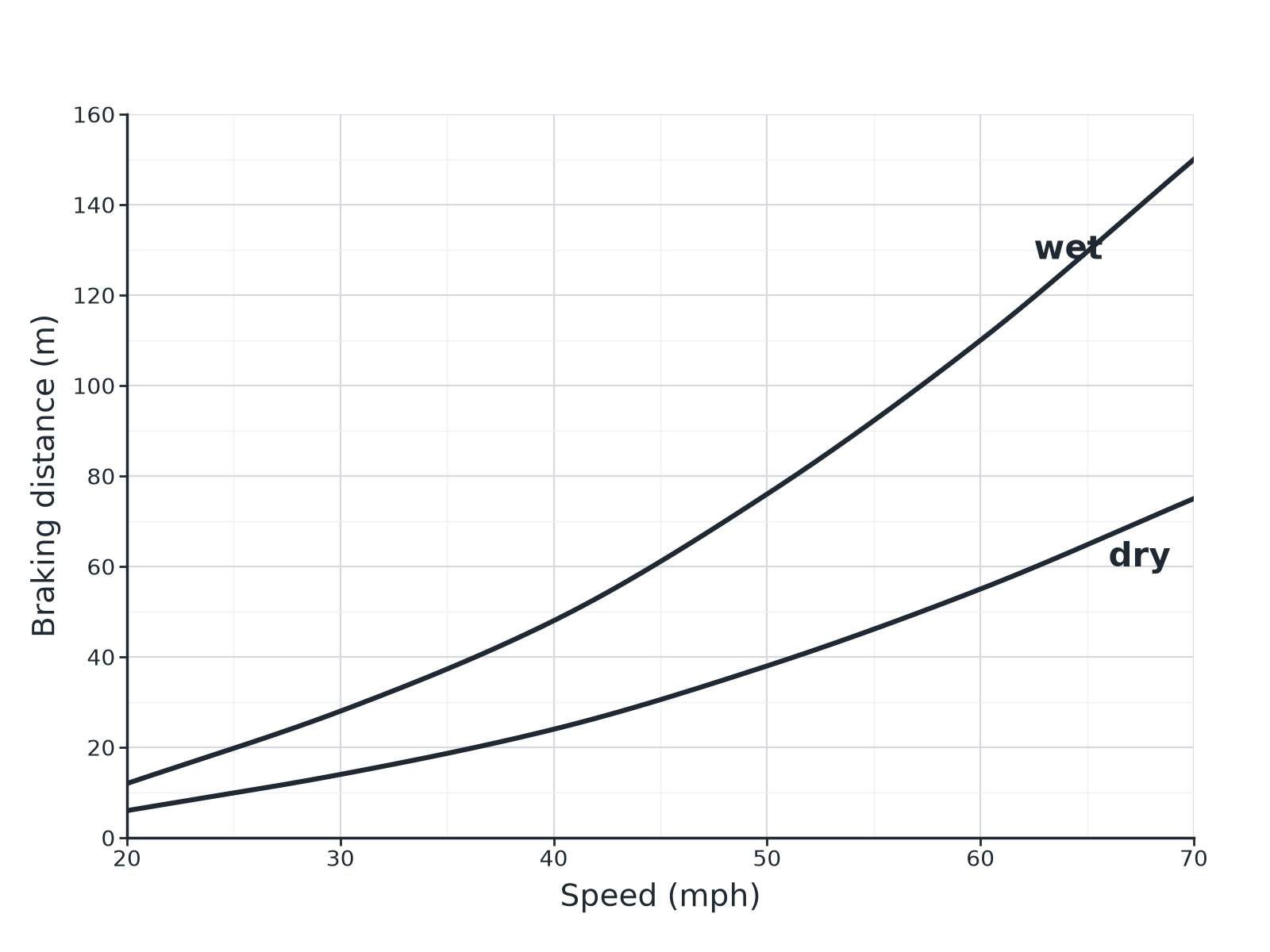
Mark scheme — 3 marks available
- About 76 m (accept 72 to 80) — 1 mark
- Less friction on the wet road — 1 mark
- So greater braking distance — 1 mark
Model answer
(a) About 76 m. (b) There is less friction between the tyres and a wet road, so the braking distance is greater.
When a car brakes, the brakes become hot. Explain why in terms of energy and work.
Mark scheme — 3 marks available
- Work done by the friction force — 1 mark
- Kinetic energy store decreases — 1 mark
- Thermal energy store of brakes increases — 1 mark
Model answer
The friction force between the brakes and the wheel does work. The kinetic energy of the car decreases and the thermal energy store of the brakes increases.
A car of mass 1000 kg travelling at 20 m/s is brought to rest in a distance of 40 m. Estimate the average braking force.
Mark scheme — 4 marks available
- Kinetic energy 200 000 J — 1 mark
- Work done = Fs — 1 mark
- Correct substitution — 1 mark
- 5000 N — 1 mark
Model answer
\(E_k = 0.5 \times 1000 \times 20^2 = 200\,000\) J; \(F = 200\,000 \div 40 = 5000\) N
Explain the dangers of a very large deceleration of a car.
Mark scheme — 3 marks available
- Brakes overheat — 1 mark
- Loss of control or skidding — 1 mark
- Risk of injury — 1 mark
Model answer
A large deceleration needs a large braking force, which can cause the brakes to overheat, the tyres to lose grip and the car to skid, and it may injure the people in the car.
Braking distance increases if the road is...
Why: Less friction.
When a car brakes, kinetic energy is transferred to...
Why: Friction heats the brakes.
Doubling the speed makes the braking distance about...
Why: Kinetic energy depends on speed squared.
Worn tyres cause a...
Why: Less grip.
A very large deceleration can cause...
Why: It is dangerous.