Viewing as
Teacher view: planning notes, the answers to every question, and the teacher copies of the files.
Physics · Forces
Newton's First Law
State and apply Newton's First Law to objects at rest, at constant velocity and with changing motion, and describe inertia (Higher tier).
Teacher resources
The teacher copies: slides with the questions built in, the answers, and anything else attached to this lesson for whoever is teaching it.
- Newtons First Law - Teacher Slides.pptx Teacher The lesson slides with the teacher's notes on each slide, and every question and mark scheme built in. Built from the lesson script on 30 September 2026. View
- Newtons First Law - Teacher Notes.docx Teacher The complete notes with the teacher's notes and every model answer in full. Built from the lesson script on 30 September 2026. View
Student handouts
The same files the students see, to print or hand out.
- Newtons First Law.pptx Built from the lesson script on 30 September 2026. View
- Newtons First Law - Completed Notes.docx The full notes for the lesson, to revise from. Built from the lesson script on 30 September 2026. View
- Newtons First Law - Exam Questions.docx Built from the lesson script on 30 September 2026. View
Warm-up
Answer each one, then check.
-
1
What is a resultant force?
Show answerHide answer
A single force with the same effect as all the forces
-
2
What are balanced forces?
Show answerHide answer
Equal and opposite forces
-
3
What is velocity?
Show answerHide answer
Speed in a given direction
-
4
What is friction?
Show answerHide answer
A force opposing motion
-
5
What is constant velocity?
Show answerHide answer
Same speed in the same direction
Learning Objectives
- 1State Newton's First Law.
- 2Apply it to objects moving at constant velocity and to objects whose speed or direction changes.
- 3Explain that when a vehicle travels at a steady speed the resistive forces balance the driving force.
- 4Explain inertia (Higher tier).
NEWTON'S FIRST LAW
If the resultant force on an object is zero, a stationary object remains stationary and a moving object continues at the same speed in the same direction.
The velocity of an object will only change if a resultant force acts on it.
Balanced and Unbalanced Forces
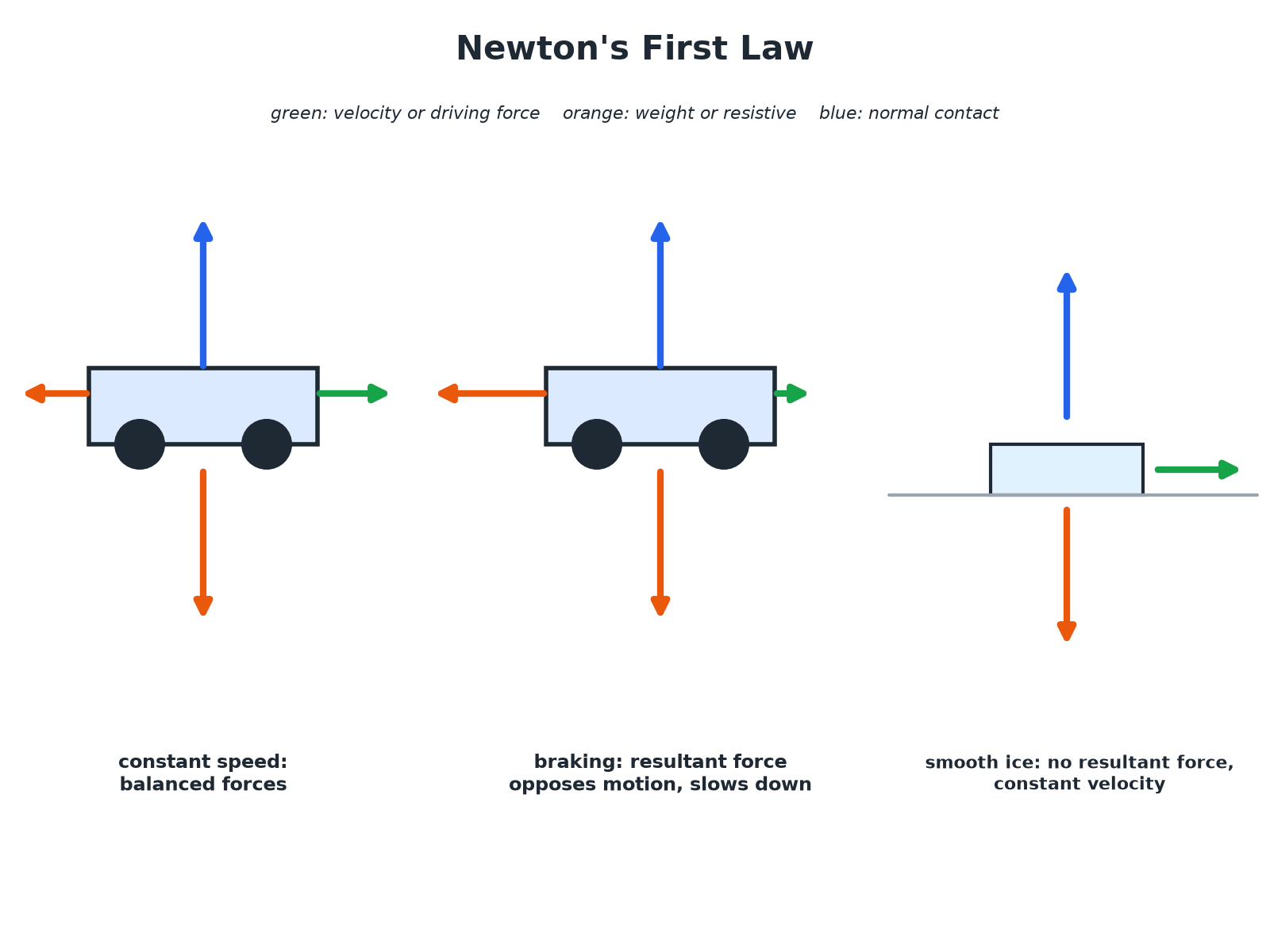
No resultant force means no change in velocity.
Steady Speed
A car travels at a steady 20 m/s. The driving force is 1500 N. What is the resistive force?
Show the solutionHide the solution
- 1 Steady speed Velocity is constant, so the resultant force is zero
- 2 Forces balance Resistive force = driving force
Answer1500 N, in the opposite direction.
Changing Velocity
A car brakes from 20 m/s to rest. Explain the motion using Newton's First Law.
Show the solutionHide the solution
- 1 Velocity changes So there must be a resultant force
- 2 Braking force Greater than the driving force, acting against the motion
AnswerA resultant force opposes the motion, so the car decelerates.
Inertia (Higher)
Explain why a passenger moves forwards when a car brakes suddenly.
Show the solutionHide the solution
- 1 Before braking The passenger moves with the car at a constant velocity
- 2 Braking The car slows, but no force acts on the passenger from the seat
- 3 Inertia The passenger's body tends to continue at the same velocity, so moves forward relative to the car
AnswerInertia: objects tend to keep their state of rest or uniform motion.
Key Ideas
Use the law in explanations.
-
Zero resultant
Stationary or constant velocity.
-
Non-zero resultant
The velocity (speed or direction) changes.
-
Direction matters
A circular motion needs a resultant force towards the centre.
-
Inertia (Higher)
The tendency of objects to continue in their state of rest or uniform motion.
Apply the Law
Explain each in terms of forces: (a) a cyclist coasts at constant speed on a flat road with no pedalling (hint: think of ideal conditions) (b) a book stays on a table (c) a ball rolls to a stop on grass.
1. Is there a resultant force?
2. Does velocity change?
A good answer shows: (a) In ideal conditions with no resistive force the resultant is zero. (b) Weight and normal contact force are balanced. (c) Friction gives a resultant force opposing the motion.
Can I...?
- 1State the first law.
- 2Apply it to constant velocity.
- 3Apply it to changing velocity.
- 4Explain balanced forces on a car.
- 5Explain stopping in terms of forces.
- 6Define inertia.
- 7Explain passenger motion.
- 8Use resultant force.
Summary & Exam Focus
- Resultant zero: stationary or constant velocity.
- Resultant non-zero: velocity changes.
- Steady speed: driving force equals resistive force.
- Inertia: tendency to continue the same motion.
Exam focus
A car travels at a constant speed. Use Newton's First Law to explain what this tells you about the forces. (2 marks) (2 marks)
The resultant force is zero.
Key terms
The vocabulary this lesson expects you to use. Each one is linked from the first place it appears above.
- Newton's First Law
- An object keeps its velocity unless a resultant force acts on it.
- Inertia
- The tendency of an object to stay at rest or keep moving at constant velocity.
- Balanced forces
- Forces with a resultant of zero.
- Uniform velocity
- Constant speed in a straight line.
- Resistive force
- A force opposing motion.
- Driving force
- A force that makes a vehicle move.
Questions and answers
10 questions set on this lesson, with the mark schemes and model answers open.
State Newton's First Law of motion.
Mark scheme — 2 marks available
- Zero resultant: stationary stays stationary — 1 mark
- Moving object keeps the same velocity — 1 mark
Model answer
If the resultant force on an object is zero, a stationary object stays stationary and a moving object continues at the same speed and in the same direction.
A car travels along a level road at a steady speed. The driving force is 1500 N. State the resistive force and explain your answer.
Mark scheme — 2 marks available
- 1500 N — 1 mark
- Resultant force zero — 1 mark
Model answer
1500 N. The speed is constant so the resultant force is zero and the forces are balanced.
A lorry's driver takes his foot off the accelerator. The lorry slows down. Use Newton's First Law to explain why.
Mark scheme — 3 marks available
- Resistive forces remain — 1 mark
- Resultant force acts against the motion — 1 mark
- Velocity changes so the lorry slows — 1 mark
Model answer
When the driving force stops, the resistive forces (friction and air resistance) become the resultant force, which acts against the motion and reduces the velocity.
A passenger in a car moves forwards when the car brakes suddenly. Explain why, using the idea of inertia.
Mark scheme — 3 marks available
- Passenger moving with the car — 1 mark
- Inertia: tendency to keep the same velocity — 1 mark
- Keeps moving forwards as the car slows — 1 mark
Model answer
The passenger was moving at the same velocity as the car. Inertia is the tendency to continue at the same velocity, so the passenger keeps moving forwards while the car slows.
A puck slides at a constant velocity across very smooth ice. Explain why it does not slow down.
Mark scheme — 2 marks available
- Negligible friction — 1 mark
- Resultant force zero so velocity constant — 1 mark
Model answer
There is almost no friction, so the resultant force is about zero and the velocity stays the same.
Newton's first law says that with no resultant force an object...
Why: It stays at rest or moves at constant velocity.
A car at constant speed has a resultant force of...
Why: Balanced forces.
A change in velocity needs...
Why: Newton's first law.
Inertia is the tendency to...
Why: Stay at rest or keep moving uniformly.
A ball rolling to a stop shows...
Why: Friction opposes the motion.