Viewing as
Teacher view: planning notes, the answers to every question, and the teacher copies of the files.
Physics · Forces
Terminal velocity
Explain terminal velocity in terms of the forces acting on a falling object, and interpret velocity–time graphs for objects reaching terminal velocity.
Teacher resources
The teacher copies: slides with the questions built in, the answers, and anything else attached to this lesson for whoever is teaching it.
- Terminal velocity - Teacher Slides.pptx Teacher The lesson slides with the teacher's notes on each slide, and every question and mark scheme built in. Built from the lesson script on 30 September 2026. View
- Terminal velocity - Teacher Notes.docx Teacher The complete notes with the teacher's notes and every model answer in full. Built from the lesson script on 30 September 2026. View
Student handouts
The same files the students see, to print or hand out.
- Terminal velocity.pptx Built from the lesson script on 30 September 2026. View
- Terminal velocity - Completed Notes.docx The full notes for the lesson, to revise from. Built from the lesson script on 30 September 2026. View
- Terminal velocity - Exam Questions.docx Built from the lesson script on 30 September 2026. View
Warm-up
Answer each one, then check.
-
1
What is weight?
Show answerHide answer
The force of gravity on an object
-
2
What is air resistance?
Show answerHide answer
A force opposing motion through the air
-
3
What does balanced mean?
Show answerHide answer
Forces equal and opposite
-
4
What is acceleration?
Show answerHide answer
Rate of change of velocity
-
5
What is the gradient of a v-t graph?
Show answerHide answer
Acceleration
Learning Objectives
- 1Describe the forces on an object falling through a fluid.
- 2Explain why the object reaches a terminal velocity.
- 3Draw and interpret velocity–time graphs for terminal velocity.
- 4Explain the effect of opening a parachute.
TERMINAL VELOCITY
An object falling through a fluid initially accelerates due to gravity. As its speed increases, the resistive force increases until the resultant force is zero and the object moves at its terminal velocity.
At terminal velocity the weight and the resistive force (air resistance or drag) are balanced, so there is no acceleration.
Falling to Terminal Velocity
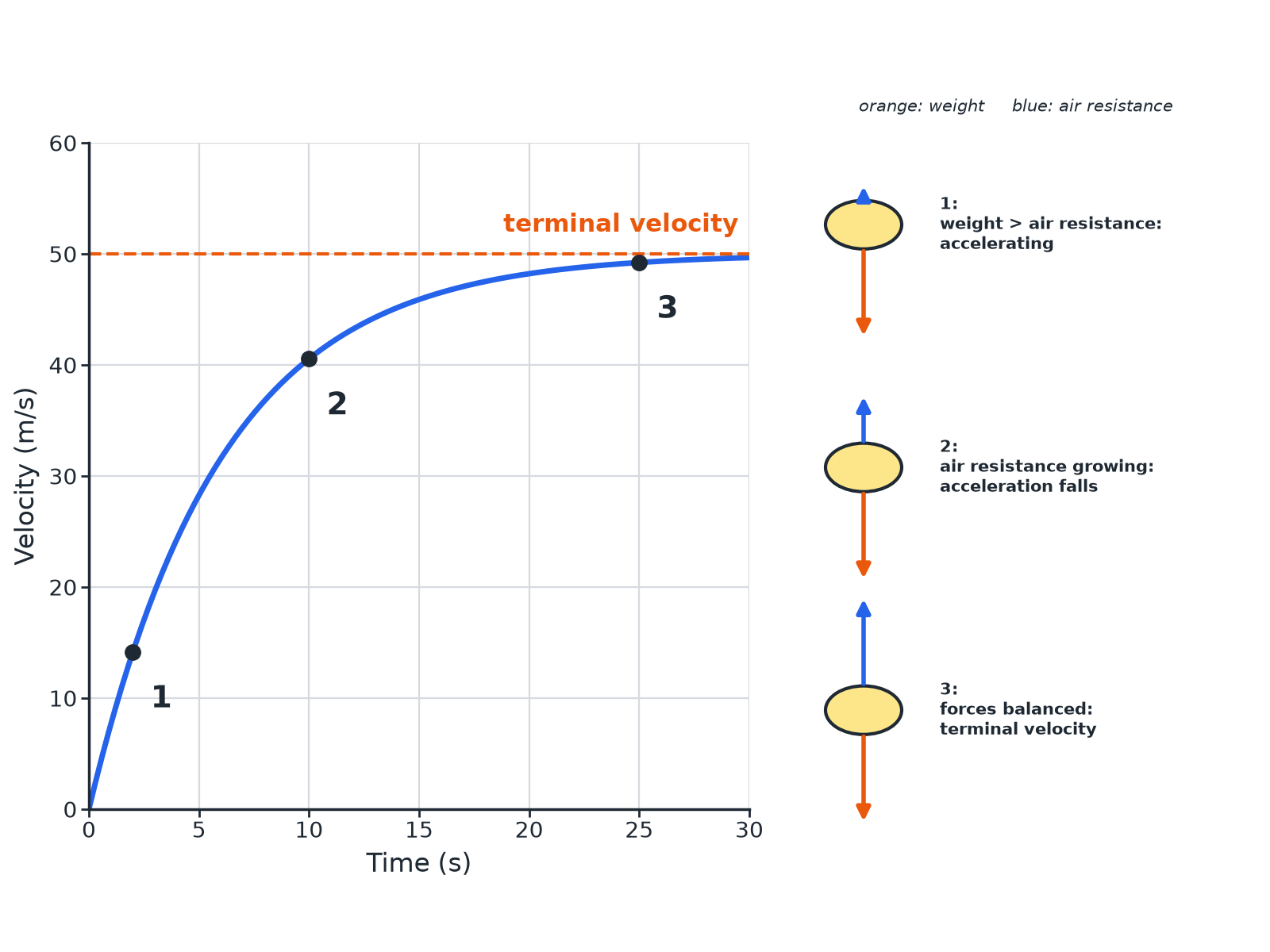
As speed rises, air resistance rises until the forces balance.
What Happens to a Skydiver
Stage by stage.
-
1
Start
Only weight acts (almost no air resistance): large downward resultant, acceleration about 9.8 m/s².
-
2
Speeding up
Air resistance increases with speed, so the resultant force and acceleration decrease.
-
3
Terminal velocity
Air resistance equals weight: resultant zero, constant velocity.
-
4
Parachute opens
Large increase in air resistance: upward resultant, skydiver decelerates.
-
5
New terminal velocity
A lower speed where air resistance again equals weight.
Resultant Force
A skydiver weighs 700 N. At one instant the air resistance is 400 N. Find the resultant force. What is the air resistance at terminal velocity?
Show the solutionHide the solution
- 1 Resultant \(700 - 400 = 300\) N downwards
- 2 At terminal velocity The resultant is zero, so air resistance = weight = 700 N
Answer300 N downwards; 700 N at terminal velocity.
Why a Parachute Helps
Explain why opening a parachute reduces the terminal velocity.
Show the solutionHide the solution
- 1 Area A large surface area is opened
- 2 Air resistance It is much larger at the same speed
- 3 Forces balance At a much lower speed, so the new terminal velocity is lower
AnswerThe greater air resistance balances the weight at a lower speed.
Reading the Graph
Common exam features.
-
Gradient
Decreases as the object falls faster.
-
Flat section
Terminal velocity: zero acceleration.
-
Steep fall after parachute
Deceleration.
-
Shape
Explain each part with the forces.
Parachute Test
A parachutist reaches 50 m/s before opening a parachute. After opening, their speed falls to 5 m/s. Explain both terminal velocities.
1. Compare air resistance and weight.
2. Say when resultant is zero.
A good answer shows: Before: air resistance on the body equals the weight at 50 m/s. After: the parachute gives much larger air resistance, so the speed falls until it equals the weight again at 5 m/s.
Can I...?
- 1State the forces on a falling object.
- 2Explain acceleration at the start.
- 3Explain why acceleration falls.
- 4Define terminal velocity.
- 5Interpret a graph.
- 6Explain a parachute.
- 7Find the resultant.
- 8Use force balance.
Summary & Exam Focus
- At the start weight is greater than air resistance.
- Air resistance increases with speed.
- Terminal velocity: forces balanced, resultant zero.
- Parachute: greater air resistance, lower terminal velocity.
Exam focus
Explain why a skydiver reaches a terminal velocity. (3 marks) (3 marks)
Air resistance rises until it equals the weight.
Key terms
The vocabulary this lesson expects you to use. Each one is linked from the first place it appears above.
- Terminal velocity
- The constant velocity reached when the resistive force equals the driving force.
- Air resistance
- A force opposing motion through air.
- Drag
- A resistive force in a fluid.
- Resultant force
- The single force equal to all the forces combined.
- Surface area
- The size of the surface.
- Fluid
- A liquid or gas.
Questions and answers
10 questions set on this lesson, with the mark schemes and model answers open.
A skydiver jumps from a plane. Explain why the skydiver reaches a terminal velocity.
Mark scheme — 3 marks available
- Weight greater than air resistance at first — 1 mark
- Air resistance increases with speed — 1 mark
- Forces balance: constant speed — 1 mark
Model answer
At first the weight is greater than the air resistance so the skydiver accelerates. As the speed increases the air resistance increases. Eventually the air resistance equals the weight, the resultant force is zero and the speed is constant.
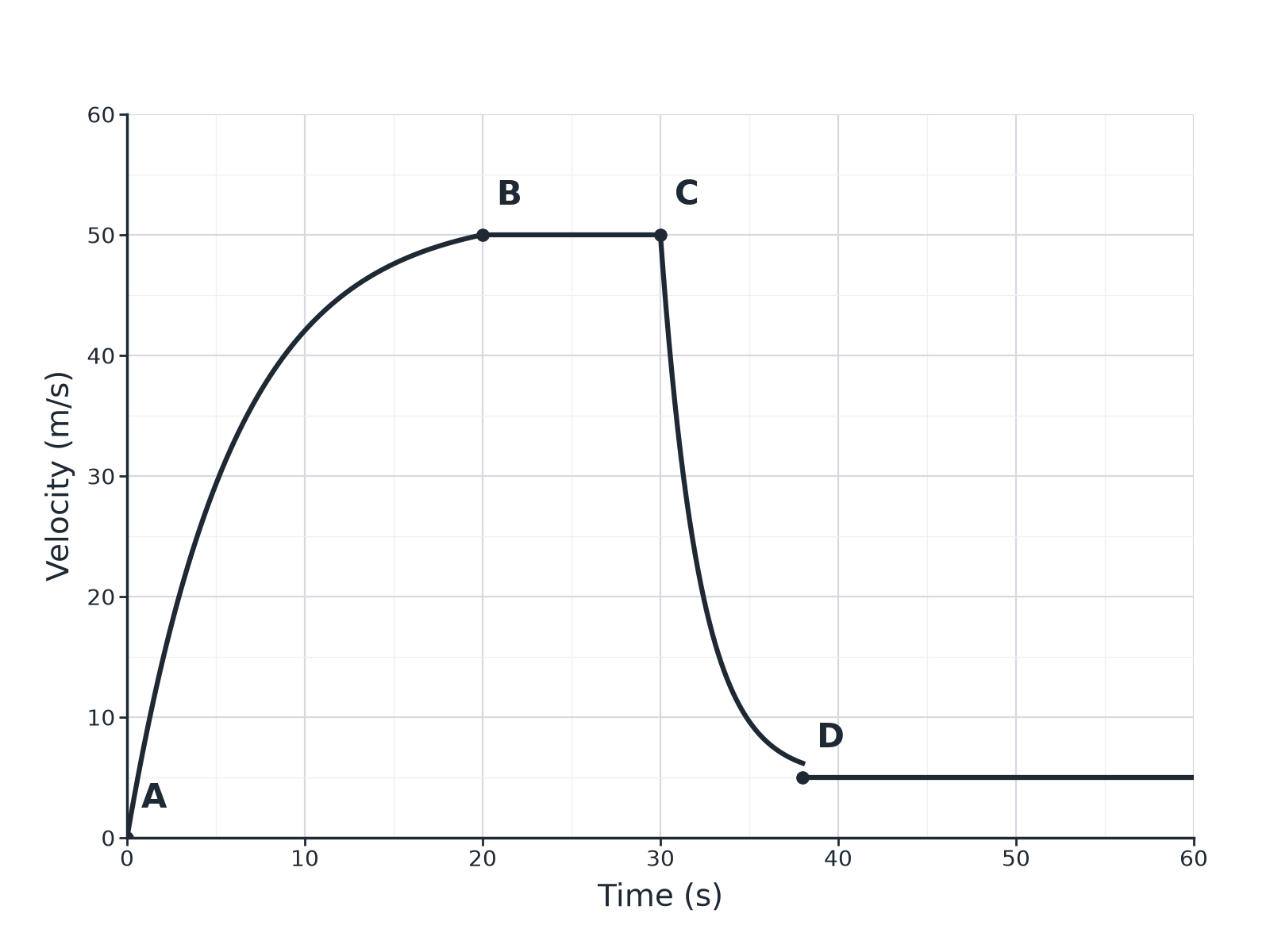
The graph shows the velocity of a parachutist. (a) State what happens to the velocity between A and B. (b) Explain why the velocity is constant between B and C. (c) At C the parachute opens. Explain what happens between C and D.
Mark scheme — 5 marks available
- A to B: accelerating, getting less — 1 mark
- B to C: air resistance equals weight — 1 mark
- Resultant force zero — 1 mark
- C to D: air resistance greater than weight — 1 mark
- Decelerates to a lower terminal velocity — 1 mark
Model answer
(a) The velocity increases (accelerates), but by less and less. (b) Air resistance equals weight, so the resultant is zero (terminal velocity). (c) The parachute increases the air resistance so it is greater than the weight; the parachutist decelerates until air resistance equals weight at a lower velocity.
A skydiver has a weight of 700 N. The air resistance is 400 N. Calculate the resultant force on the skydiver and state its direction.
Mark scheme — 2 marks available
- 300 N — 1 mark
- Downwards — 1 mark
Model answer
700 − 400 = 300 N downwards.
A parachute increases the air resistance on a skydiver. Explain why the skydiver's terminal velocity is lower with the parachute open.
Mark scheme — 3 marks available
- Larger area means greater air resistance — 1 mark
- Forces balance at a lower speed — 1 mark
- So lower terminal velocity — 1 mark
Model answer
With a large surface area the air resistance is much greater at any speed. The air resistance equals the weight at a lower speed, so the terminal velocity is lower.
State the size of the resultant force on a skydiver falling at terminal velocity and what this means for the acceleration.
Mark scheme — 2 marks available
- Zero resultant force — 1 mark
- Zero acceleration — 1 mark
Model answer
The resultant force is zero, so the acceleration is zero (constant velocity).
At terminal velocity the resultant force is...
Why: Forces are balanced.
As a skydiver speeds up, air resistance...
Why: It depends on speed.
Opening a parachute...
Why: Larger area.
On a velocity–time graph, terminal velocity is a...
Why: Constant velocity.
At the moment of jumping the acceleration is about...
Why: Air resistance is almost zero.