Viewing as
Teacher view: planning notes, the answers to every question, and the teacher copies of the files.
Physics · Forces
Work done and energy transfer
Use \(W = Fs\) to calculate work done, describe the energy transfers, and explain why work done against friction raises temperature.
Teacher resources
The teacher copies: slides with the questions built in, the answers, and anything else attached to this lesson for whoever is teaching it.
- Work done and energy transfer - Teacher Slides.pptx Teacher The lesson slides with the teacher's notes on each slide, and every question and mark scheme built in. Built from the lesson script on 30 September 2026. View
- Work done and energy transfer - Teacher Notes.docx Teacher The complete notes with the teacher's notes and every model answer in full. Built from the lesson script on 30 September 2026. View
Student handouts
The same files the students see, to print or hand out.
- Work done and energy transfer.pptx Built from the lesson script on 30 September 2026. View
- Work done and energy transfer - Completed Notes.docx The full notes for the lesson, to revise from. Built from the lesson script on 30 September 2026. View
- Work done and energy transfer - Exam Questions.docx Built from the lesson script on 30 September 2026. View
Warm-up
Answer each one, then check.
-
1
What is energy measured in?
Show answerHide answer
-
2
What is a force measured in?
Show answerHide answer
Newtons
-
3
What is distance measured in?
Show answerHide answer
Metres
-
4
What is friction?
Show answerHide answer
A force opposing motion
-
5
Name an energy store that increases when something warms up.
Show answerHide answer
Thermal
Learning Objectives
- 1Define work done.
- 2Recall and apply \(W = Fs\).
- 3Convert between newton-metres and joules.
- 4Describe the energy transfers when work is done, including against friction.
WORK DONE
work done \(=\) force \(\times\) distance moved along the line of action of the force \(W = Fs\)
One joule of work is done when a force of one newton moves an object one metre. 1 J = 1 Nm.
Work Done
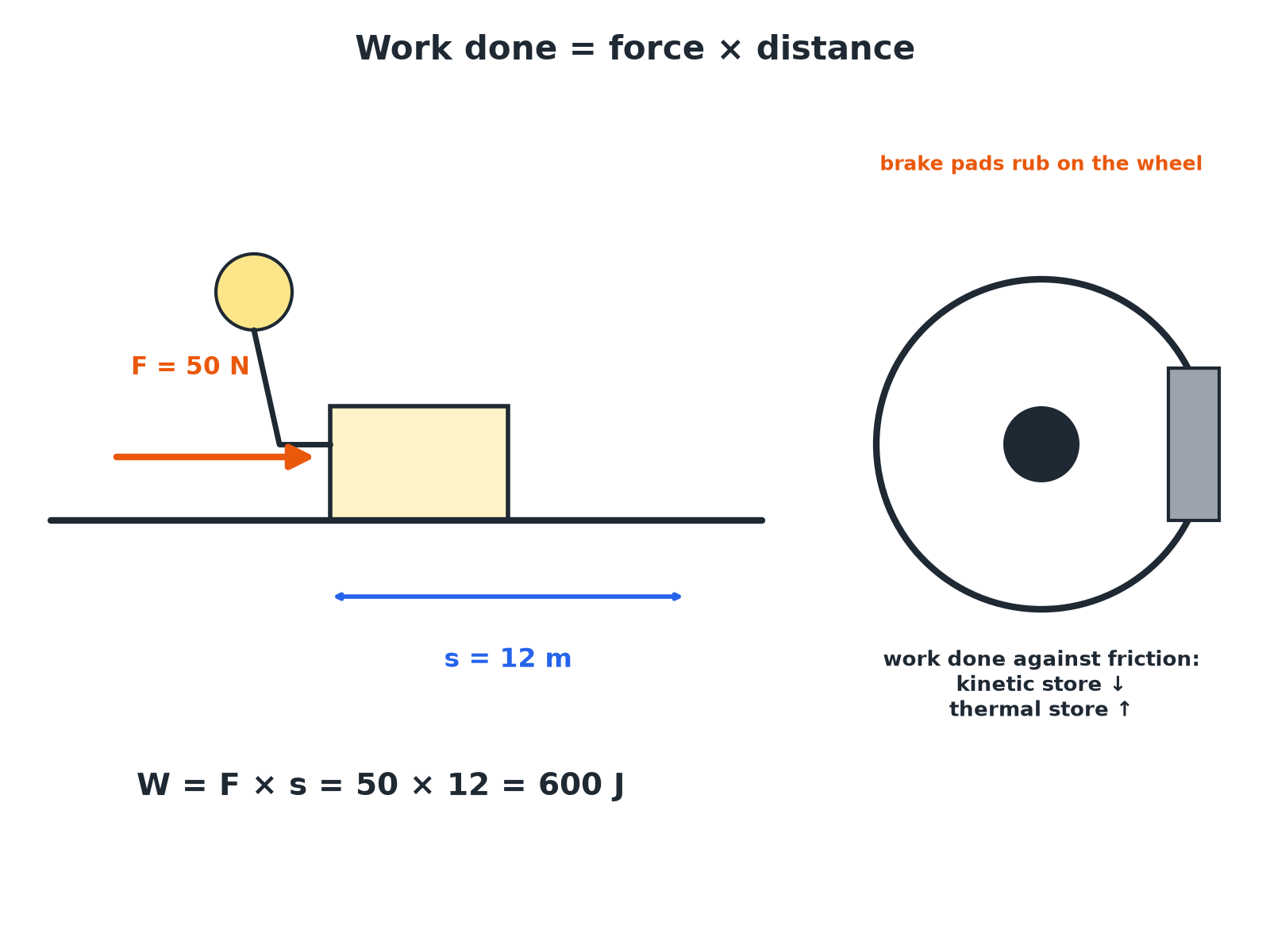
Work done is energy transferred by a force.
Calculating Work Done
A force of 50 N pushes a box 12 m along the floor. Calculate the work done.
Show the solutionHide the solution
- 1 Write the equation \(W = Fs\)
- 2 Substitute \(W = 50 \times 12\)
- 3 Answer \(W = 600\) J
Answer600 J
Finding the Force
A crate is moved 8.0 m by a force. The work done is 1200 J. Find the force.
Show the solutionHide the solution
- 1 Rearrange \(F = W \div s\)
- 2 Substitute \(F = 1200 \div 8.0\)
- 3 Answer \(F = 150\) N
Answer150 N
Work Against Friction
Explain why the brakes on a bicycle get warm when it slows down.
Show the solutionHide the solution
- 1 Friction force The brake pads rub on the wheel
- 2 Work done Work is done against the frictional force
- 3 Energy transfer Energy is transferred from the kinetic store to the thermal store of the brakes
AnswerThe kinetic energy of the bicycle is transferred to the thermal energy of the brakes and wheel.
Key Ideas
Learn these links.
-
Work is energy transferred
When a force moves an object, energy is transferred.
-
Distance
Measured in the direction of the force.
-
Friction
Work done against friction raises the temperature of the object.
-
Units
Convert kJ to J before calculating.
Work It Out
A student pushes a trolley with a force of 40 N for 6.0 m. How much work is done? What happens to the energy if the trolley is moving at a steady speed on a rough floor?
1. Calculate the work.
2. Describe the energy transfer.
A good answer shows: W = 40 × 6.0 = 240 J. The energy is transferred to the thermal store of the trolley and floor by friction.
Can I...?
- 1Define work done.
- 2Use \(W = Fs\).
- 3Rearrange for F or s.
- 4Convert Nm to J.
- 5Describe energy transfer.
- 6Explain heating due to friction.
- 7Use the unit joule.
- 8Show the working.
Summary & Exam Focus
- \(W = Fs\).
- 1 J = 1 Nm.
- Work done against friction raises the temperature.
- Work is energy transferred.
Exam focus
A force of 50 N moves a box 12 m. Calculate the work done. (2 marks) (2 marks)
Multiply force by distance and give J.
Key terms
The vocabulary this lesson expects you to use. Each one is linked from the first place it appears above.
- Work done
- Energy transferred when a force moves an object.
- Joule
- The unit of work and energy.
- Newton-metre
- A joule: one newton moving an object one metre.
- Friction
- A force between surfaces that opposes motion.
- Displacement
- The distance moved in a particular direction.
- Dissipated
- Transferred to less useful stores.
Questions and answers
10 questions set on this lesson, with the mark schemes and model answers open.
A person pushes a box with a force of 50 N. The box moves 12 m. Calculate the work done. Use the equation: work done = force × distance
Mark scheme — 2 marks available
- Correct substitution — 1 mark
- 600 J — 1 mark
Model answer
\(50 \times 12 = 600\) J
A force does 1200 J of work moving a crate 8.0 m. Calculate the force.
Mark scheme — 3 marks available
- Rearranges to F = W ÷ s — 1 mark
- Correct substitution — 1 mark
- 150 N — 1 mark
Model answer
\(F = W \div s = 1200 \div 8.0 = 150\) N
A bicycle rider brakes and the brake pads become warm. Explain why.
Mark scheme — 2 marks available
- Work done against friction — 1 mark
- Kinetic to thermal energy store — 1 mark
Model answer
Work is done against the friction between the pads and the wheel. The kinetic energy of the bicycle is transferred to the thermal energy store of the brakes.
State what one joule of work means in terms of force and distance.
Mark scheme — 2 marks available
- Force of 1 N — 1 mark
- Moves an object 1 m — 1 mark
Model answer
One joule is the work done when a force of one newton moves an object a distance of one metre in the direction of the force.
A crane lifts a 200 kg load through 15 m at constant speed. Gravitational field strength = 9.8 N/kg. Calculate the work done on the load by the crane.
Mark scheme — 4 marks available
- Force = weight = mg — 1 mark
- 1960 N — 1 mark
- Correct substitution into W = Fs — 1 mark
- 29 400 J — 1 mark
Model answer
\(F = 200 \times 9.8 = 1960\) N; \(W = 1960 \times 15 = 29\,400\) J
Work done is measured in...
Why: The same unit as energy.
A force of 10 N moves an object 3 m. Work done is...
Why: 10 × 3.
1 joule equals...
Why: Nm.
Work done against friction causes...
Why: Energy transferred to the thermal store.
To find the force you use...
Why: Rearrange the equation.