Viewing as
Teaching this? The teacher view adds 2 files, the mark schemes and the model answers.
Physics · Magnetism and electromagnetism
Induced potential
Describe the generator effect: how a potential difference and current are induced by a changing magnetic field, and what affects their size and direction (Physics only).
Warm-up
Answer each one, then check.
-
1
What does a voltmeter measure?
Show answerHide answer
Potential difference
-
2
What is a magnetic field?
Show answerHide answer
Region where a force acts on a magnet
-
3
What is a current?
Show answerHide answer
A flow of charge
-
4
What is a coil?
Show answerHide answer
Loops of wire
-
5
What is a conductor?
Show answerHide answer
Allows current to flow
Learning Objectives
- 1Describe the generator effect.
- 2Describe how a potential difference is induced in a wire or coil by moving a magnet.
- 3Explain the direction of the induced current and its effect (Higher).
- 4Describe the factors that increase the size of the induced potential difference.
THE GENERATOR EFFECT
The generator effect is when a potential difference is induced across a conductor that moves relative to a magnetic field, or when the magnetic field through a conductor changes. If the conductor is part of a complete circuit, a current is induced.
Nothing is induced if there is no change: a stationary magnet in a stationary coil produces no potential difference.
Inducing a Potential Difference
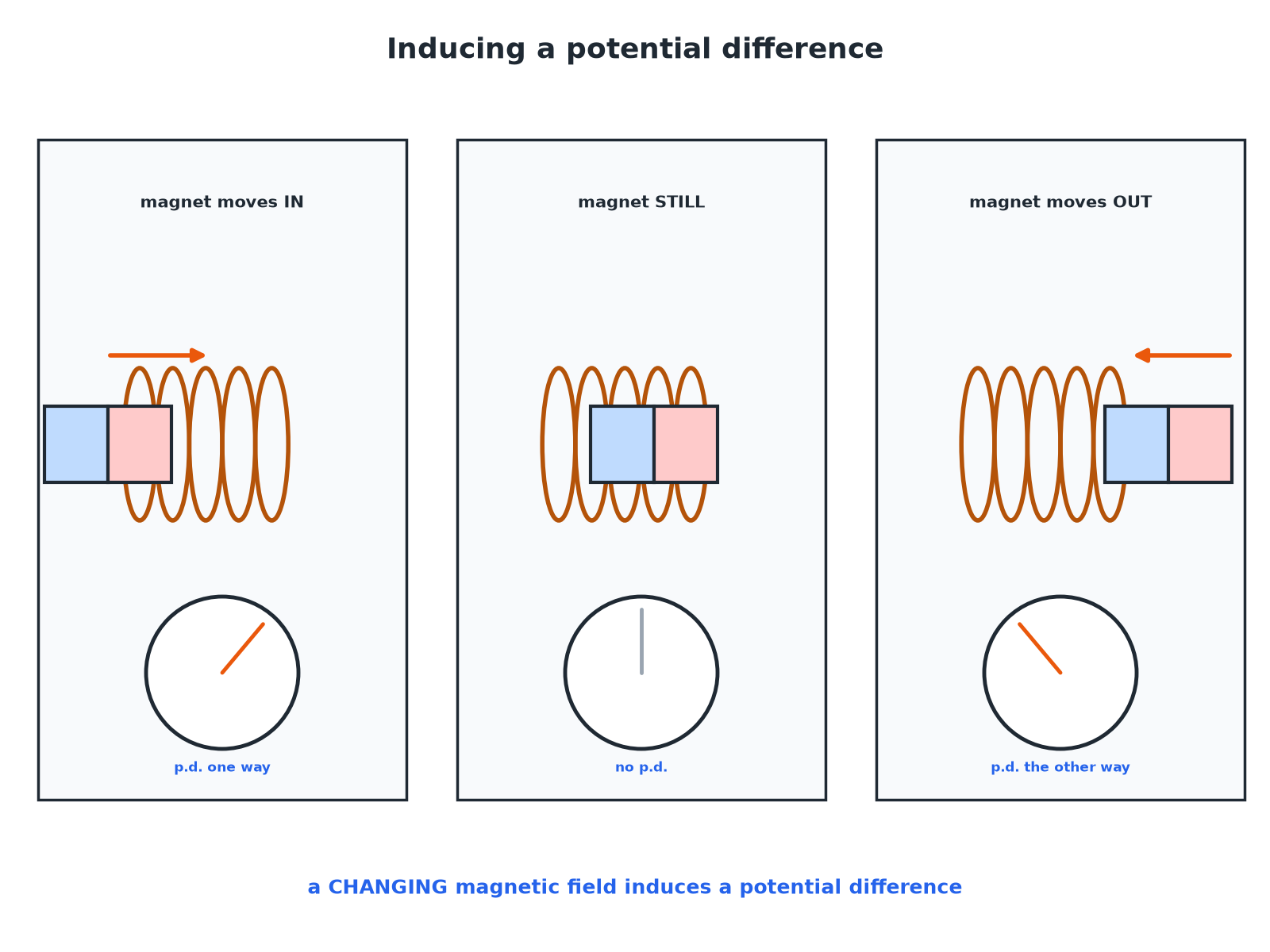
No change, no induced potential difference.
What Changes the Induced p.d.
Learn the factors.
-
Faster movement of the magnet
Effect on the induced potential difference: Larger
-
Stronger magnet
Effect on the induced potential difference: Larger
-
More turns on the coil
Effect on the induced potential difference: Larger
-
Reverse the movement
Effect on the induced potential difference: Direction of p.d. reverses
-
Reverse the magnet
Effect on the induced potential difference: Direction of p.d. reverses
-
Magnet stationary
Effect on the induced potential difference: No induced p.d.
Why Does a Current Flow?
Explain why a current is produced when a magnet is moved into a coil connected in a circuit.
Show the solutionHide the solution
- 1 Magnetic field changes As the magnet moves in, the field through the coil changes
- 2 p.d. induced A potential difference is induced across the coil
- 3 Complete circuit The induced p.d. makes a current flow
AnswerA changing field induces a p.d., and a current in a complete circuit.
Direction of the Induced Current
Higher tier.
-
Its own field
The induced current produces a magnetic field of its own.
-
Opposes the change
This field opposes the change that produced it.
-
Energy
You have to do work to push the magnet in.
-
Conservation
That work is what gets transferred to electrical energy.
Magnet in a Coil
Push a bar magnet into a coil connected to a galvanometer. Record the deflection: slowly, quickly, out, stationary. What do you notice?
1. Keep the coil the same.
A good answer shows: Faster gives a bigger deflection; out reverses it; stationary gives zero.
Can I...?
- 1State the generator effect.
- 2Say what induces a p.d.
- 3Say when a current flows.
- 4List ways to increase it.
- 5Reverse the direction.
- 6Explain no movement, no p.d.
- 7Explain the opposing field.
- 8Link to energy.
Summary & Exam Focus
- A changing magnetic field induces a potential difference.
- Bigger with faster movement, stronger magnet, more turns.
- No movement gives no p.d.
- Reversing the movement reverses the p.d.
Exam focus
State two ways of increasing the potential difference induced in a coil. (2 marks) (2 marks)
Faster movement, stronger magnet, more turns.
Key terms
The vocabulary this lesson expects you to use. Each one is linked from the first place it appears above.
- Generator effect
- The induction of a potential difference across a conductor when the magnetic field changes or the conductor moves in a magnetic field.
- Induced potential difference
- A p.d. produced by the generator effect.
- Induced current
- A current produced in a complete circuit by an induced p.d.
- Coil
- Loops of wire.
- Flux
- The magnetic field passing through a coil.
- Galvanometer
- A sensitive meter that shows small currents.
Practice questions
Have a go at each one before you open its answer.
-
Question 1 State 2 marks
A magnet is pushed into a coil of wire connected to a voltmeter. State two ways of increasing the reading on the voltmeter.
Show answerHide answer
Model answer
Move the magnet faster. Use a stronger magnet. Use more turns on the coil. (any two)
Mark scheme
- One way — 1 mark
- Another way — 1 mark
-
Question 2 Explain 3 marks
A student holds a bar magnet still inside a coil of wire connected to a voltmeter. The voltmeter reads zero. Explain why and what they should do to get a reading.
Show answerHide answer
Model answer
There is no change in the magnetic field through the coil so no potential difference is induced. They should move the magnet in or out of the coil.
Mark scheme
- No change in field — 1 mark
- No p.d. induced — 1 mark
- Move the magnet — 1 mark
-
Question 3 Describe 3 marks
Describe what happens to the reading on the voltmeter when the magnet is pulled out of the coil at the same speed as it was pushed in.
Show answerHide answer
Model answer
The voltmeter shows a reading of the same size but in the opposite direction (reversed polarity).
Mark scheme
- A reading is shown — 1 mark
- Same size — 1 mark
- Opposite direction — 1 mark
-
Question 4 Explain 3 marks
Explain why a current flows when a magnet is moved into a coil that is part of a complete circuit.
Show answerHide answer
Model answer
The movement of the magnet changes the field through the coil, which induces a potential difference. Because the circuit is complete, the p.d. makes a current flow.
Mark scheme
- Changing field through the coil — 1 mark
- p.d. induced — 1 mark
- Complete circuit so current flows — 1 mark
-
Question 5 Explain 3 marks
Explain why it is harder to push a magnet into a coil connected in a complete circuit than into a coil that is not connected.
Show answerHide answer
Model answer
The induced current produces a magnetic field that opposes the change (the magnet's motion), so work must be done to push the magnet in. That work is transferred to electrical energy. With no complete circuit there is no current and so no opposing force.
Mark scheme
- Induced current produces its own field — 1 mark
- Opposes the motion — 1 mark
- Work done is transferred to electrical energy — 1 mark
Quick check
-
A p.d. can be induced in a coil by...
Show answerHide answer
C: a changing magnetic field
Generator effect.
-
A stationary magnet in a coil induces...
Show answerHide answer
D: no potential difference
No change.
-
Moving the magnet faster makes the p.d...
Show answerHide answer
A: larger
Faster change.
-
Reversing the movement makes the p.d...
Show answerHide answer
B: reverse direction
Direction flips.
-
The induced current's field...
Show answerHide answer
C: opposes the change
Conservation of energy.
Downloads
Free to keep, print and annotate.
- Induced potential.pptx Built from the lesson script on 30 September 2026. View
- Induced potential - Completed Notes.docx The full notes for the lesson, to revise from. Built from the lesson script on 30 September 2026. View
- Induced potential - Exam Questions.docx Built from the lesson script on 30 September 2026. View
Something here looks wrong?
Tell us what and we will go and look. It goes to whoever writes these pages, nobody else, and we do not ask who you are — so there is nothing to sign and nothing comes back to you.