Viewing as
Teaching this? The teacher view adds 2 files, the mark schemes and the model answers.
Physics · Waves
Properties of waves
Describe waves using amplitude, wavelength, frequency and period, apply \(v = f\lambda\) and \(T = 1 \div f\), and investigate waves in a ripple tank and in a solid (Required Practical 8).
Warm-up
Answer each one, then check.
-
1
What is the unit of frequency?
Show answerHide answer
Hertz (Hz)
-
2
What is the unit of wavelength?
Show answerHide answer
Metres (m)
-
3
What is the speed of sound in air?
Show answerHide answer
About 330 m/s
-
4
What is a crest?
Show answerHide answer
The highest point of a transverse wave
-
5
What is period?
Show answerHide answer
The time for one wave to pass
Learning Objectives
- 1Define amplitude, wavelength, frequency and period.
- 2Recall and apply \(T = 1 \div f\) and \(v = f\lambda\).
- 3Identify amplitude and wavelength from diagrams.
- 4Describe methods to measure the speed of sound and of ripples, and Required Practical 8.
- 5Explain how v, f and λ change when sound passes from one medium to another (Physics only).
THE WAVE EQUATION
wave speed \(=\) frequency \(\times\) wavelength \(v = f\lambda\)
Period \(T = \dfrac{1}{f}\). \(v = f\lambda\) is given on the equation sheet. Wave speed is in m/s, frequency in Hz, wavelength in m and period in s.
Labelling a Wave
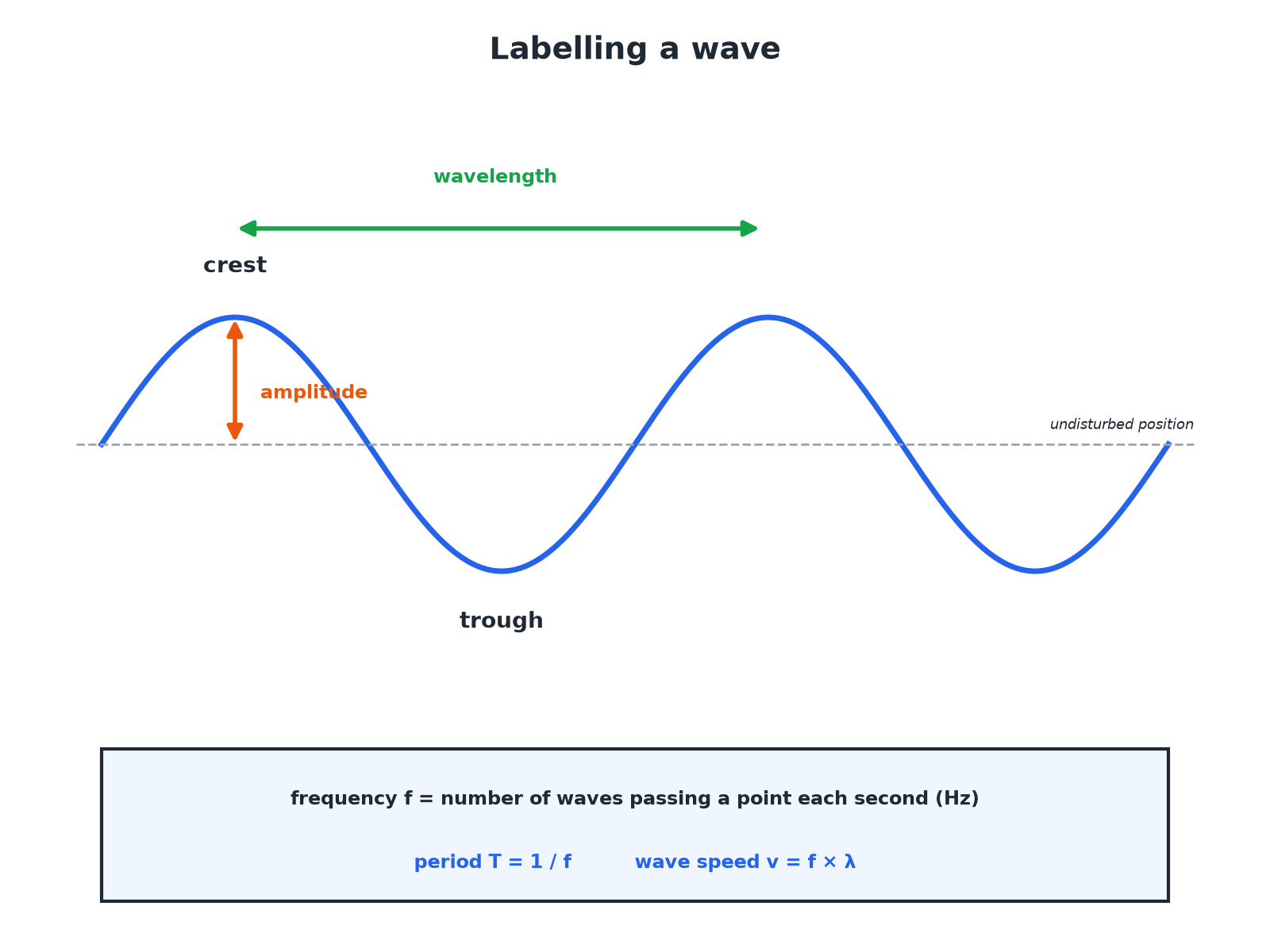
Amplitude is measured from the undisturbed position, not from trough to crest.
Required Practical 8: Waves in a Ripple Tank
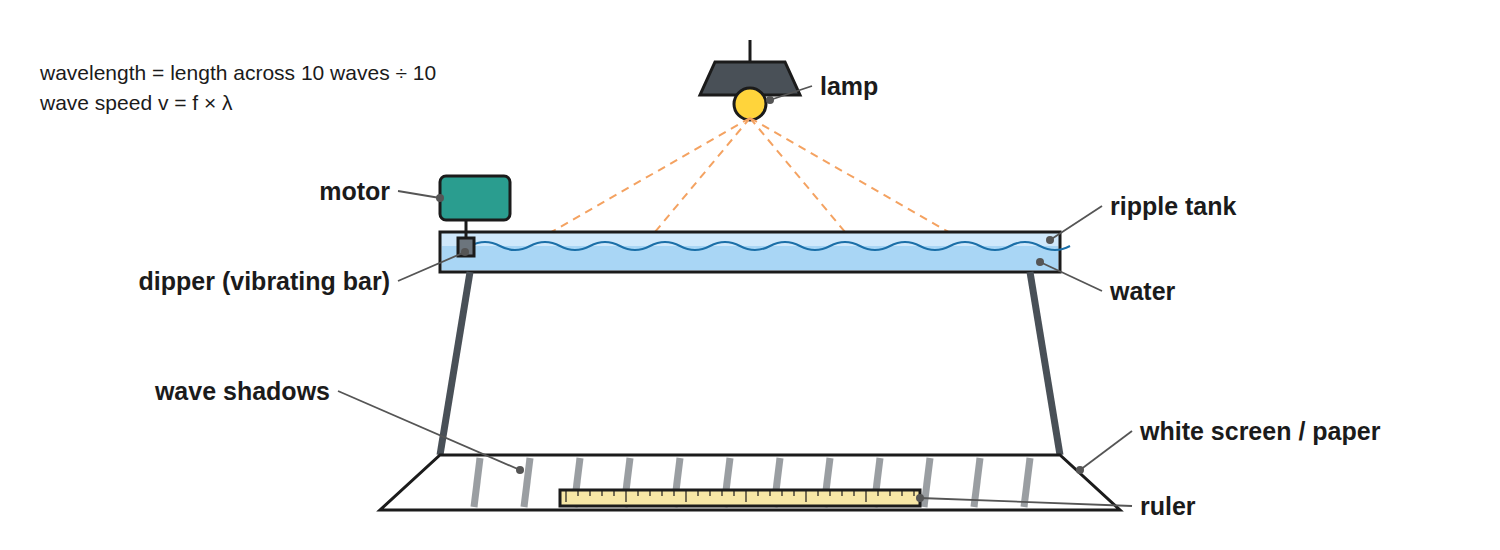
Measure the wavelength from the pattern and the frequency from the motor.
Wave Quantities
Learn the definitions and units.
-
Amplitude
Symbol: A. Unit: m. Meaning: Maximum displacement from the undisturbed position
-
Wavelength
Symbol: \(\lambda\). Unit: m. Meaning: Distance between equivalent points on adjacent waves
-
Frequency
Symbol: f. Unit: Hz. Meaning: Number of waves passing a point each second
-
Period
Symbol: T. Unit: s. Meaning: Time for one complete wave
-
Wave speed
Symbol: v. Unit: m/s. Meaning: Speed at which the wave moves or transfers energy
Using the Wave Equation
Sound waves of frequency 50 Hz travel at 330 m/s. Calculate the wavelength.
Show the solutionHide the solution
- 1 Rearrange \(\lambda = v \div f\)
- 2 Substitute \(\lambda = 330 \div 50\)
- 3 Answer \(\lambda = 6.6\) m
Answer6.6 m
Finding Speed
Water waves have a frequency of 2.0 Hz and a wavelength of 0.50 m. Calculate the wave speed.
Show the solutionHide the solution
- 1 Write the equation \(v = f\lambda\)
- 2 Substitute \(v = 2.0 \times 0.50\)
- 3 Answer \(v = 1.0\) m/s
Answer1.0 m/s
Period
A wave has a frequency of 250 Hz. Calculate the period.
Show the solutionHide the solution
- 1 Write the equation \(T = 1 \div f\)
- 2 Substitute \(T = 1 \div 250\)
- 3 Answer \(T = 0.0040\) s
Answer0.0040 s
Speed of Sound by Echo
Describe a method to measure the speed of sound in air.
Show the solutionHide the solution
- 1 Set up Stand a measured distance (for example 100 m) from a large wall and clap
- 2 Time Start a stopwatch at the clap and stop at the echo
- 3 Calculate \(v = \text{distance there and back} \div \text{time}\)
- 4 Repeat Take several readings and find a mean
AnswerSpeed = 2d ÷ t, with repeats to reduce error.
Changing Medium (Physics only)
A sound wave of frequency 500 Hz travels from air (330 m/s) into water (1500 m/s). What happens to f, v and λ?
Show the solutionHide the solution
- 1 Frequency Unchanged: it is set by the source
- 2 Speed Increases to 1500 m/s
- 3 Wavelength \(\lambda = v \div f\) increases: from 0.66 m to 3.0 m
Answerf stays the same; v and λ both increase.
Wave Sums
Ripples have a wavelength of 4.0 cm and a frequency of 5.0 Hz. Calculate the speed in m/s. What is the period?
1. Convert cm to m.
2. Use v = fλ and T = 1/f.
A good answer shows: λ = 0.040 m; v = 5.0 × 0.040 = 0.20 m/s. T = 1 ÷ 5.0 = 0.20 s.
Can I...?
- 1Define amplitude.
- 2Define wavelength.
- 3Define frequency and period.
- 4Use \(v = f\lambda\).
- 5Use \(T = 1 \div f\).
- 6Read a wave diagram.
- 7Describe measuring wave speed.
- 8Explain changes at a boundary.
Summary & Exam Focus
- \(v = f\lambda\) and \(T = 1 \div f\).
- Amplitude from the undisturbed position to a crest.
- Wavelength between equivalent points.
- Frequency stays constant when a wave changes medium.
Exam focus
Sound of frequency 50 Hz travels at 330 m/s. Calculate the wavelength. (2 marks) (2 marks)
Rearrange v = fλ.
Key terms
The vocabulary this lesson expects you to use. Each one is linked from the first place it appears above.
- Amplitude
- The maximum displacement of a point on a wave from its undisturbed position.
- Wavelength
- The distance from a point on one wave to the same point on the next wave.
- Frequency
- The number of waves passing a point each second.
- Period
- The time for one complete wave.
- Wave speed
- The speed at which energy is transferred through a medium.
- Ripple tank
- A shallow tray of water used to show wave behaviour.
Practice questions
Have a go at each one before you open its answer.
-
Question 1 Calculate 2 marks
Sound waves travel through air at 330 m/s. A sound has a frequency of 50 Hz. Calculate the wavelength of the sound waves. Use the equation: wave speed = frequency × wavelength
Show answerHide answer
Model answer
\(\lambda = 330 \div 50 = 6.6\) m
Mark scheme
- Rearranges to λ = v ÷ f — 1 mark
- 6.6 m — 1 mark
-
Question 2 Use the diagram 4 marks
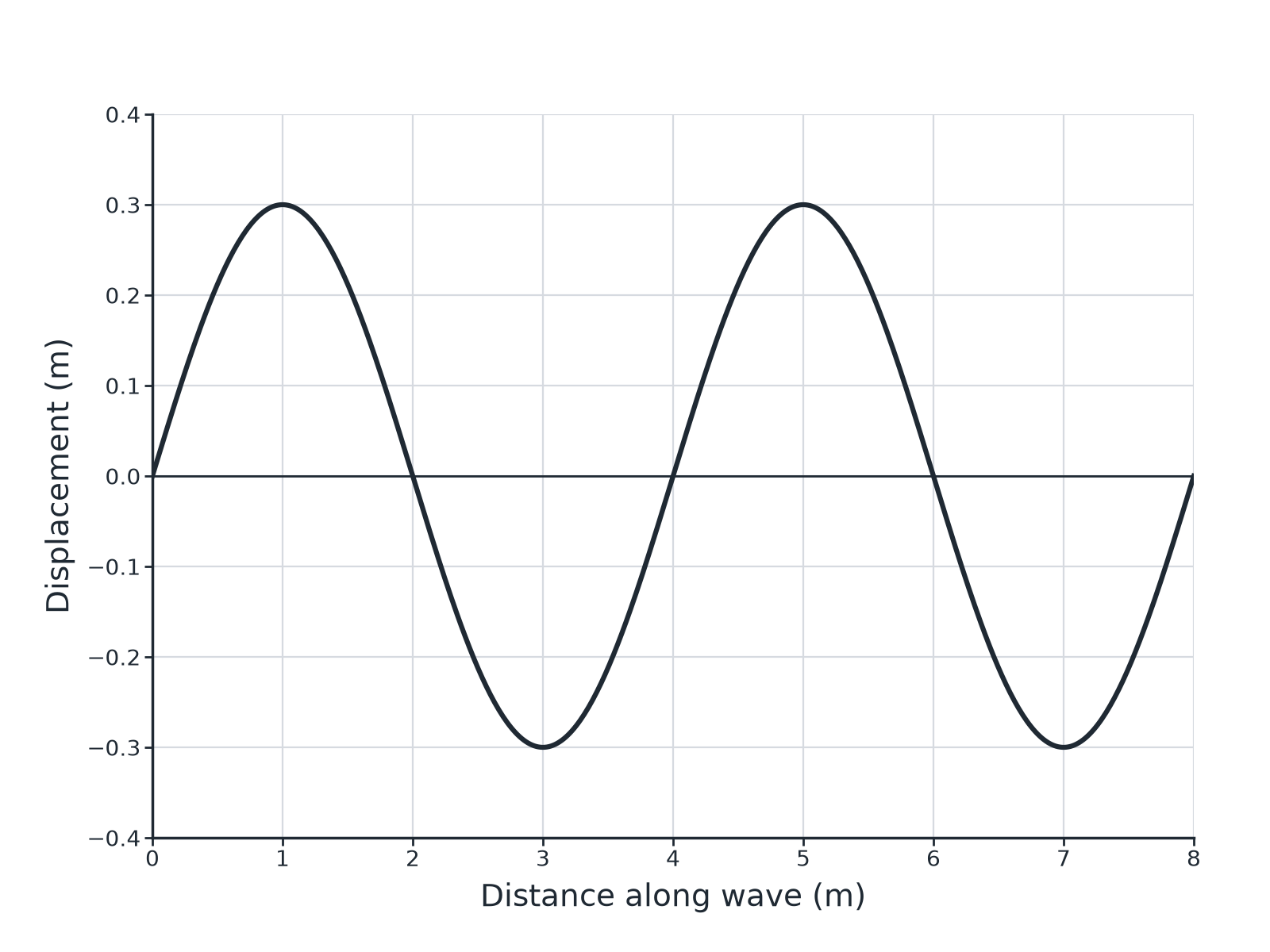
The diagram shows a water wave. (a) State the amplitude of the wave. (b) State the wavelength. (c) The wave passes a point 5 times each second. Calculate the wave speed.
Show answerHide answer
Model answer
(a) 0.30 m. (b) 4.0 m. (c) \(v = f\lambda = 5 \times 4.0 = 20\) m/s.
Mark scheme
- Amplitude 0.30 m — 1 mark
- Wavelength 4.0 m — 1 mark
- Correct substitution — 1 mark
- 20 m/s — 1 mark
-
Question 3 Calculate 2 marks
A wave has a frequency of 250 Hz. Calculate its period.
Show answerHide answer
Model answer
\(T = 1 \div f = 1 \div 250 = 0.0040\) s
Mark scheme
- Correct substitution — 1 mark
- 0.0040 s — 1 mark
-
Question 4 Describe 4 marks
Describe how you would measure the speed of sound in air using a wall and a stopwatch.
Show answerHide answer
Model answer
Stand a measured distance from a large wall. Clap and start the stopwatch; stop it when you hear the echo. The sound has travelled to the wall and back, so speed = 2 × distance ÷ time. Repeat and calculate a mean.
Mark scheme
- Measured distance to a wall — 1 mark
- Timing clap to echo — 1 mark
- Distance travelled is there and back — 1 mark
- Repeat and mean — 1 mark
-
Question 5 Explain 4 marks
A sound wave travels from air into water. Its frequency is 500 Hz. The speed of sound is 330 m/s in air and 1500 m/s in water. Explain what happens to the frequency, speed and wavelength, and calculate the wavelength in water.
Show answerHide answer
Model answer
The frequency stays the same (500 Hz). The speed increases. The wavelength increases: \(\lambda = 1500 \div 500 = 3.0\) m.
Mark scheme
- Frequency unchanged — 1 mark
- Speed increases — 1 mark
- Wavelength increases — 1 mark
- 3.0 m — 1 mark
Quick check
-
The unit of frequency is...
Show answerHide answer
C: hertz
Waves per second.
-
Wave speed is...
Show answerHide answer
D: frequency × wavelength
v = fλ.
-
A wave of frequency 10 Hz and wavelength 3 m has a speed of...
Show answerHide answer
A: 30 m/s
10 × 3.
-
The period of a 5 Hz wave is...
Show answerHide answer
B: 0.2 s
1 ÷ 5.
-
When a wave enters a new medium its...
Show answerHide answer
C: frequency stays the same
It is set by the source.
Downloads
Free to keep, print and annotate.
- Properties of waves.pptx Built from the lesson script on 30 September 2026. View
- Properties of waves - Completed Notes.docx The full notes for the lesson, to revise from. Built from the lesson script on 30 September 2026. View
- Properties of waves - Exam Questions.docx Built from the lesson script on 30 September 2026. View
Something here looks wrong?
Tell us what and we will go and look. It goes to whoever writes these pages, nobody else, and we do not ask who you are — so there is nothing to sign and nothing comes back to you.