Viewing as
Teaching this? The teacher view adds 2 files, the mark schemes and the model answers.
Physics · Waves
Visible light and colour
Explain specular and diffuse reflection, the effect of colour filters, and why objects have particular colours (Physics only).
Warm-up
Answer each one, then check.
-
1
What colours make up white light?
Show answerHide answer
The colours of the rainbow
-
2
What is reflection?
Show answerHide answer
A wave bouncing off a surface
-
3
What is absorption?
Show answerHide answer
A wave's energy being taken in by a material
-
4
What is transparent?
Show answerHide answer
Lets light pass through with no scattering
-
5
What is opaque?
Show answerHide answer
Does not let light through
Learning Objectives
- 1State that each colour of visible light has its own narrow band of wavelength and frequency.
- 2Distinguish specular reflection from diffuse reflection.
- 3Explain how colour filters work.
- 4Explain why an opaque object has a particular colour.
COLOUR
Each colour within the visible spectrum has its own narrow band of wavelength and frequency. The colour of an opaque object depends on which wavelengths it reflects most strongly.
Wavelengths that are not reflected are absorbed. If all wavelengths are reflected equally the object looks white; if all are absorbed it looks black.
Filters and Coloured Objects
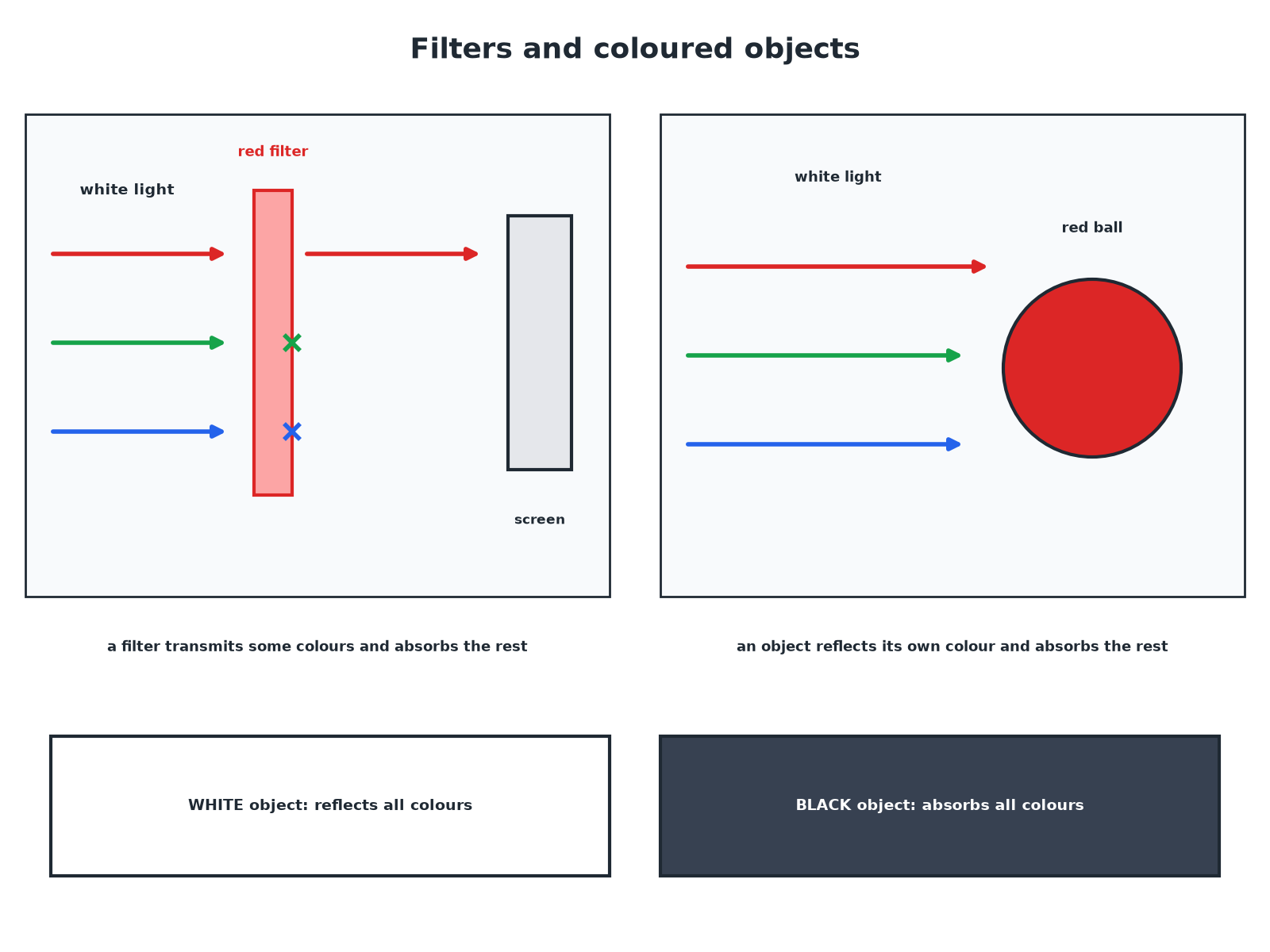
Colour comes from which wavelengths are reflected or transmitted.
Specular or Diffuse Reflection?
Specular reflection
- From a smooth surface such as a mirror.
- Reflected in a single direction.
- Forms a clear image.
Diffuse reflection
- From a rough surface such as paper.
- Scattered in many directions.
- No clear image.
Objects and Colours
What you see.
-
Red shirt
In white light: Red. Why: Reflects red, absorbs other colours
-
Green leaf
In white light: Green. Why: Reflects green, absorbs the rest
-
White paper
In white light: White. Why: Reflects all colours equally
-
Black cloth
In white light: Black. Why: Absorbs all colours
A Colour Filter
White light passes through a green filter. What colour emerges?
Show the solutionHide the solution
- 1 Filter Transmits green and absorbs the other wavelengths
- 2 Light that emerges Green
AnswerGreen light.
Two Filters
White light passes through a red filter and then a blue filter. What emerges?
Show the solutionHide the solution
- 1 Red filter Transmits only red
- 2 Blue filter Absorbs red and transmits blue
- 3 Result No light
AnswerNo light emerges (black).
Coloured Light on an Object
A red shirt is illuminated with green light only. What colour does it look?
Show the solutionHide the solution
- 1 Red shirt Reflects red but absorbs green
- 2 Green light There is no red light to reflect
- 3 Result The shirt looks black
AnswerBlack.
Key Terms
Transparent, translucent and opaque.
-
Transparent
Transmits light; you can see clearly through it.
-
Translucent
Transmits light but scatters it; you cannot see a clear image.
-
Opaque
Does not transmit light.
-
Filters
Absorb certain wavelengths and transmit others.
Predict the Colour
What colour does a blue book look in (a) white light (b) red light? What does a white page look in blue light?
1. What wavelengths does it reflect?
2. What light is available?
A good answer shows: (a) Blue. (b) Black, because it absorbs red. A white page in blue light looks blue.
Can I...?
- 1State that colours have wavelength bands.
- 2Explain specular reflection.
- 3Explain diffuse reflection.
- 4Explain filters.
- 5Explain object colour.
- 6Explain black and white.
- 7Define transparent, translucent, opaque.
- 8Predict colours under filters.
Summary & Exam Focus
- Colours: narrow bands of wavelength and frequency.
- Smooth: specular; rough: diffuse.
- Filters transmit some wavelengths and absorb others.
- Object colour from the wavelengths it reflects.
Exam focus
Explain why a red book looks red in white light. (2 marks) (2 marks)
Reflects red, absorbs other colours.
Key terms
The vocabulary this lesson expects you to use. Each one is linked from the first place it appears above.
- Specular reflection
- Reflection from a smooth surface in a single direction.
- Diffuse reflection
- Reflection from a rough surface in many directions.
- Colour filter
- Material that transmits some wavelengths and absorbs others.
- Transparent
- Lets light pass through with no scattering.
- Translucent
- Lets light through but scatters it.
- Opaque
- Does not let light through.
Practice questions
Have a go at each one before you open its answer.
-
Question 1 Explain 2 marks
A red book looks red in white light. Explain why.
Show answerHide answer
Model answer
The book reflects red light strongly and absorbs the other colours (wavelengths).
Mark scheme
- Reflects red — 1 mark
- Absorbs other colours — 1 mark
-
Question 2 Describe 2 marks
Describe the difference between specular reflection and diffuse reflection.
Show answerHide answer
Model answer
Specular reflection is from a smooth surface and goes in one direction; diffuse reflection is from a rough surface and scatters in many directions.
Mark scheme
- Specular: smooth surface, one direction — 1 mark
- Diffuse: rough surface, scattered — 1 mark
-
Question 3 Explain 3 marks
White light passes through a green filter onto a white screen. Explain what colour the screen looks. Then explain what happens if the light from the green filter goes through a red filter.
Show answerHide answer
Model answer
The green filter transmits green and absorbs the other colours, so the screen looks green. A red filter then absorbs the green light, so no light is transmitted and the screen looks black.
Mark scheme
- Green filter transmits green — 1 mark
- Screen looks green — 1 mark
- Red filter absorbs green: no light — 1 mark
-
Question 4 Explain 3 marks
A blue shirt is seen in red light. Explain why it looks black.
Show answerHide answer
Model answer
The shirt reflects blue light and absorbs other colours. Red light contains no blue, so the shirt absorbs all the red light and no light is reflected.
Mark scheme
- Shirt reflects blue — 1 mark
- Absorbs red light — 1 mark
- So no light reflected: looks black — 1 mark
-
Question 5 State 2 marks
Explain the difference between a transparent and a translucent material.
Show answerHide answer
Model answer
A transparent material transmits light without scattering so you can see clearly through it. A translucent material transmits light but scatters it, so you cannot see a clear image.
Mark scheme
- Transparent: clear view — 1 mark
- Translucent: light scattered — 1 mark
Quick check
-
Reflection from a smooth surface is called...
Show answerHide answer
D: specular
One direction.
-
A white object reflects...
Show answerHide answer
A: all colours
All wavelengths equally.
-
A black object...
Show answerHide answer
B: absorbs all colours
No reflection.
-
A green filter transmits...
Show answerHide answer
C: green light
It absorbs other colours.
-
A material that scatters the light it transmits is...
Show answerHide answer
D: translucent
You cannot see clearly through it.
Downloads
Free to keep, print and annotate.
- Visible light and colour.pptx Built from the lesson script on 30 September 2026. View
- Visible light and colour - Completed Notes.docx The full notes for the lesson, to revise from. Built from the lesson script on 30 September 2026. View
- Visible light and colour - Exam Questions.docx Built from the lesson script on 30 September 2026. View
Something here looks wrong?
Tell us what and we will go and look. It goes to whoever writes these pages, nobody else, and we do not ask who you are — so there is nothing to sign and nothing comes back to you.