Biology · Respiration and Metabolism
Aerobic and Anaerobic Respiration
Every living cell is transferring energy from glucose all the time. This lesson covers respiration as an exothermic reaction, the equations for aerobic and anaerobic respiration, and why yeast is so useful for making bread and alcoholic drinks.
Learning Objectives
- 1Describe cellular respiration as an exothermic reaction which is continuously occurring in living cells.
- 2State what organisms use the energy transferred by respiration for.
- 3Write the word and symbol equations for aerobic respiration.
- 4Compare aerobic and anaerobic respiration in terms of the need for oxygen, the products and the amount of energy transferred.
- 5Write the equations for anaerobic respiration in muscles and in plant and yeast cells, and describe fermentation.
Retrieval practice
-
1
Which type of reaction takes in energy from the surroundings?
Show answerHide answer
An endothermic reaction.
-
2
Which part of a cell is where most of the reactions of aerobic respiration take place?
Show answerHide answer
The mitochondria.
-
3
What is the word equation for photosynthesis?
Show answerHide answer
Carbon dioxide + water, in light, makes glucose + oxygen.
-
4
What is an enzyme?
Show answerHide answer
A biological catalyst that speeds up a reaction.
Energy for life
A living cell is never at rest. It is building molecules, moving substances in and out, and in many animals contracting muscle and keeping warm. All of this needs energy, and the energy is transferred from glucose by respiration. Respiration is not the same as breathing. Breathing brings oxygen to the cells, but respiration is the chemical reaction that happens inside every cell, in plants as well as animals, day and night.
Respiration is an exothermic reaction
Respiration transfers energy from glucose to the cell, and the energy that is not used is transferred to the surroundings.
-
Exothermic
An exothermic reaction transfers energy to the surroundings, often as heat. Respiration is exothermic.
-
Continuous
Respiration is continuously occurring in living cells. It supplies all of the energy needed for the processes of life.
-
Aerobic or anaerobic
Respiration can take place aerobically (using oxygen) or anaerobically (without oxygen).
-
Where
Most of the reactions of aerobic respiration take place in the mitochondria. Anaerobic respiration takes place in the cytoplasm.
What the energy is used for
Organisms need the energy transferred by respiration for three main jobs.
-
Building larger molecules
Chemical reactions that join small molecules together, such as making proteins from amino acids, need energy.
-
Movement
Muscles use energy to contract, so an animal can move. Plants also use energy, for example to transport substances.
-
Keeping warm
Mammals and birds keep their bodies at a constant temperature, and the energy they transfer helps to keep them warm.
Aerobic respiration
Aerobic respiration is the complete oxidation of glucose using oxygen, and it transfers a large amount of energy.
-
Word equation
glucose + oxygen → carbon dioxide + water
-
Symbol equation
\(C_6H_{12}O_6 + 6O_2 \rightarrow 6CO_2 + 6H_2O\)
-
What you need to know
You must recognise the symbols C₆H₁₂O₆, O₂, CO₂ and H₂O.
-
Where the reactants come from
Glucose comes from digested food, or from photosynthesis in a plant. Oxygen is taken in by breathing and carried to the cells by the blood.
-
Where the products go
Carbon dioxide is carried away and breathed out. Water is used by the cell or lost.
Three kinds of respiration
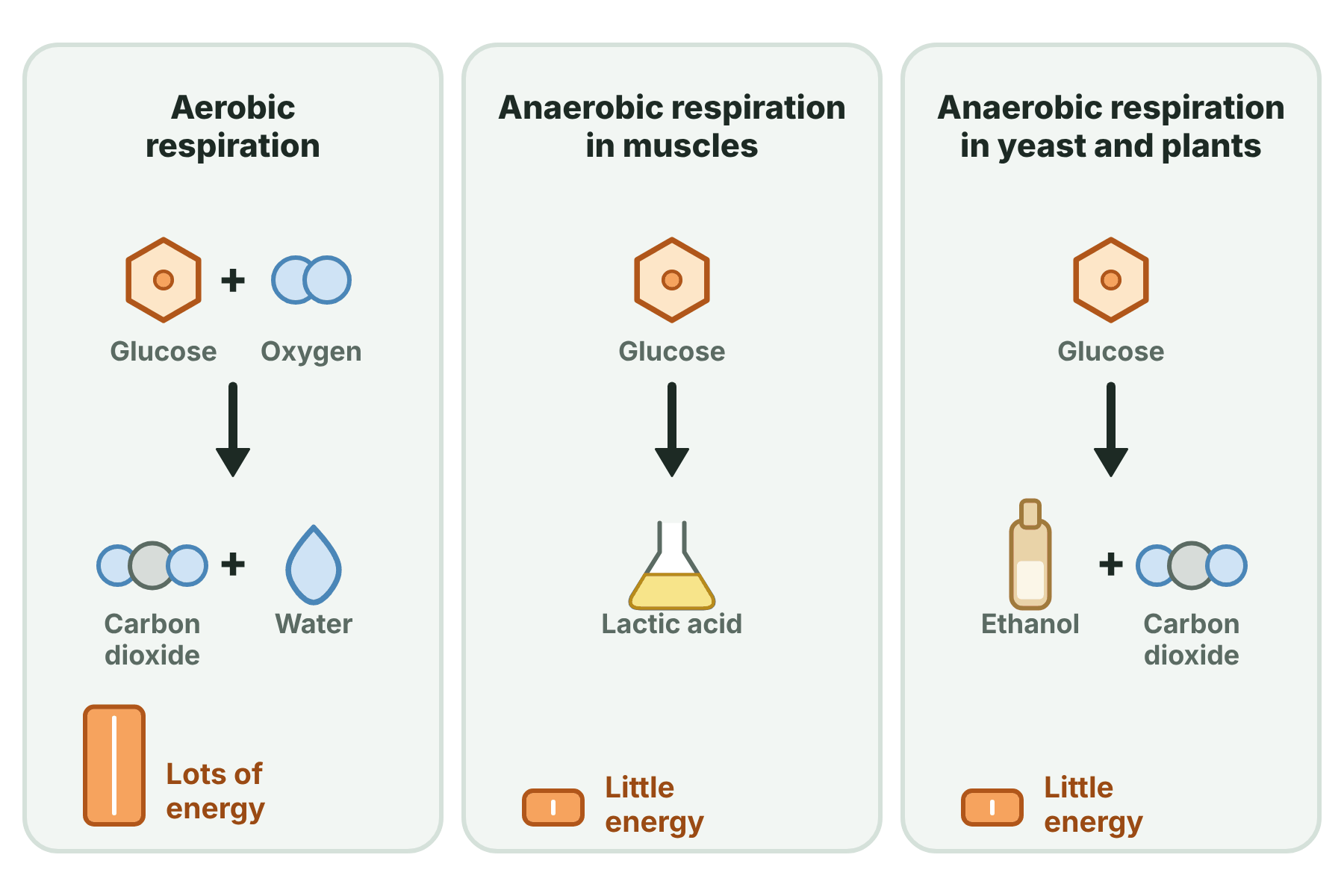
Aerobic respiration transfers much more energy than either type of anaerobic respiration.
Anaerobic respiration
Anaerobic respiration happens without oxygen. The glucose is only partly oxidised, so much less energy is transferred.
-
In muscles
glucose → lactic acid. This happens when the muscles cannot get oxygen fast enough, for example in vigorous exercise.
-
In plant and yeast cells
glucose → ethanol + carbon dioxide.
-
Much less energy
The oxidation of glucose is incomplete, so much less energy is transferred than in aerobic respiration.
-
Why it is useful
It transfers energy quickly when oxygen is not available, but it is not an efficient use of glucose.
Aerobic and anaerobic respiration in muscles
Aerobic respiration
- Needs oxygen
- Glucose is completely oxidised
- Products: carbon dioxide and water
- Transfers much more energy
- Most reactions in the mitochondria
Anaerobic respiration
- Does not need oxygen
- Glucose is only partly oxidised
- Product in muscles: lactic acid
- Transfers much less energy
- Takes place in the cytoplasm
Fermentation in yeast
Anaerobic respiration in yeast cells is called fermentation. It has great economic importance.
-
Fermentation
Yeast respires anaerobically: glucose → ethanol + carbon dioxide.
-
Bread
Carbon dioxide bubbles are trapped in the dough and make it rise. The ethanol evaporates when the bread is baked.
-
Alcoholic drinks
Yeast ferments sugar from grapes or grain. The ethanol makes the drink alcoholic and the carbon dioxide can make it fizzy.
-
Economic importance
Baking and brewing are industries that depend on fermentation.
Making bread with yeast
Bread rises because of anaerobic respiration in yeast.
-
1
Mix
Mix flour, water, sugar and yeast into a dough.
-
2
Warm
Leave the dough in a warm place so the enzymes in the yeast work quickly.
-
3
Ferment
The yeast respires anaerobically, using the sugar and releasing carbon dioxide.
-
4
Rise
The carbon dioxide forms bubbles in the dough, so it rises.
-
5
Bake
Baking kills the yeast and the ethanol evaporates, leaving a light loaf.
Case study
Why a compost heap is warm
A heap of grass cuttings and kitchen waste can feel warm, or even steam on a cold morning. The warmth comes from microorganisms in the heap. They respire, and respiration is an exothermic reaction, so energy is transferred to the surroundings as heat. The heap is warmest in the middle, where it is best insulated and where the most heat builds up.
The big idea
Respiration is the exothermic reaction that transfers energy from glucose in every living cell, using oxygen in aerobic respiration and without it in anaerobic respiration.
Respiration
Respiration
-
Exothermic
- transfers energy to the surroundings
-
Uses of energy
- building molecules
- movement
- keeping warm
-
Aerobic
- glucose + oxygen → carbon dioxide + water
- lots of energy
-
Anaerobic in muscles
- glucose → lactic acid
- little energy
-
Anaerobic in yeast and plants
- glucose → ethanol + carbon dioxide
- fermentation
Summary and exam focus
- Respiration is an exothermic reaction that is continuously occurring in living cells.
- Aerobic respiration: glucose + oxygen → carbon dioxide + water.
- Anaerobic respiration in muscles: glucose → lactic acid.
- Anaerobic respiration in plant and yeast cells: glucose → ethanol + carbon dioxide.
- Anaerobic respiration transfers much less energy because the oxidation of glucose is incomplete.
- Fermentation in yeast is used to make bread and alcoholic drinks.
Exam focus
Compare aerobic respiration and anaerobic respiration in muscles. (4 marks) (4 marks)
Cover three things for both: whether oxygen is needed, the products, and the amount of energy transferred. Say that anaerobic respiration is an incomplete oxidation of glucose, so much less energy is transferred.
Key terms
The words this lesson expects you to use. Each one is linked from the first place it appears above.
- Respiration
- The exothermic reaction in living cells that transfers energy from glucose.
- Exothermic reaction
- A reaction that transfers energy to the surroundings.
- Aerobic respiration
- Respiration that uses oxygen, and transfers a large amount of energy.
- Anaerobic respiration
- Respiration without oxygen, which transfers much less energy.
- Lactic acid
- The product of anaerobic respiration in muscles.
- Ethanol
- The alcohol made when yeast and plant cells respire anaerobically.
- Fermentation
- Anaerobic respiration in yeast cells.
- Mitochondria
- The parts of a cell where most of the reactions of aerobic respiration take place.
You've finished the notes
Check your understanding
Test yourself while it is fresh. Start with the flashcards, then try the exam questions.
Something here looks wrong?
Tell us what and we will go and look. It goes to whoever writes these pages, nobody else, and we do not ask who you are — so there is nothing to sign and nothing comes back to you.