Biology · Respiration and Metabolism
Response to Exercise
During exercise the muscles need far more energy than at rest. This lesson explains how the heart rate, breathing rate and breath volume change, what happens when the muscles cannot get enough oxygen, and for Higher tier students how lactic acid is removed and what oxygen debt means.
Learning Objectives
- 1Describe how the human body reacts to the increased demand for energy during exercise.
- 2Explain why the heart rate, breathing rate and breath volume increase during exercise.
- 3Describe how to investigate the effect of exercise on the body, and interpret the results.
- 4Explain why muscles respire anaerobically during vigorous exercise, and why they become fatigued.
- 5(Higher tier) Explain what happens to lactic acid after exercise, and what is meant by oxygen debt.
Retrieval practice
-
1
What carries oxygen in the blood?
Show answerHide answer
Haemoglobin in the red blood cells.
-
2
Which organ pumps the blood around the body?
Show answerHide answer
The heart.
-
3
Write the equation for anaerobic respiration in muscles.
Show answerHide answer
Glucose → lactic acid.
-
4
Why does anaerobic respiration transfer less energy than aerobic respiration?
Show answerHide answer
The oxidation of glucose is incomplete.
Meeting the demand
When you run, your muscles contract much more often, so they need much more energy. They get it by respiring faster, which means they need more glucose and more oxygen, and they make more carbon dioxide that has to be removed. The body reacts to this increased demand with changes to the heart and the lungs, which you can feel and measure.
How the body responds to exercise
Three changes work together to supply the muscles with more oxygenated blood.
-
Heart rate increases
The heart beats faster, so more blood is pumped to the muscles every minute.
-
Breathing rate increases
You take more breaths each minute, so more oxygen is taken in and more carbon dioxide is removed.
-
Breath volume increases
Each breath is deeper, so more air is breathed in with every breath.
-
Result
More oxygenated blood reaches the muscles, bringing the oxygen and glucose they need for aerobic respiration and taking away the carbon dioxide.
Heart rate before, during and after exercise
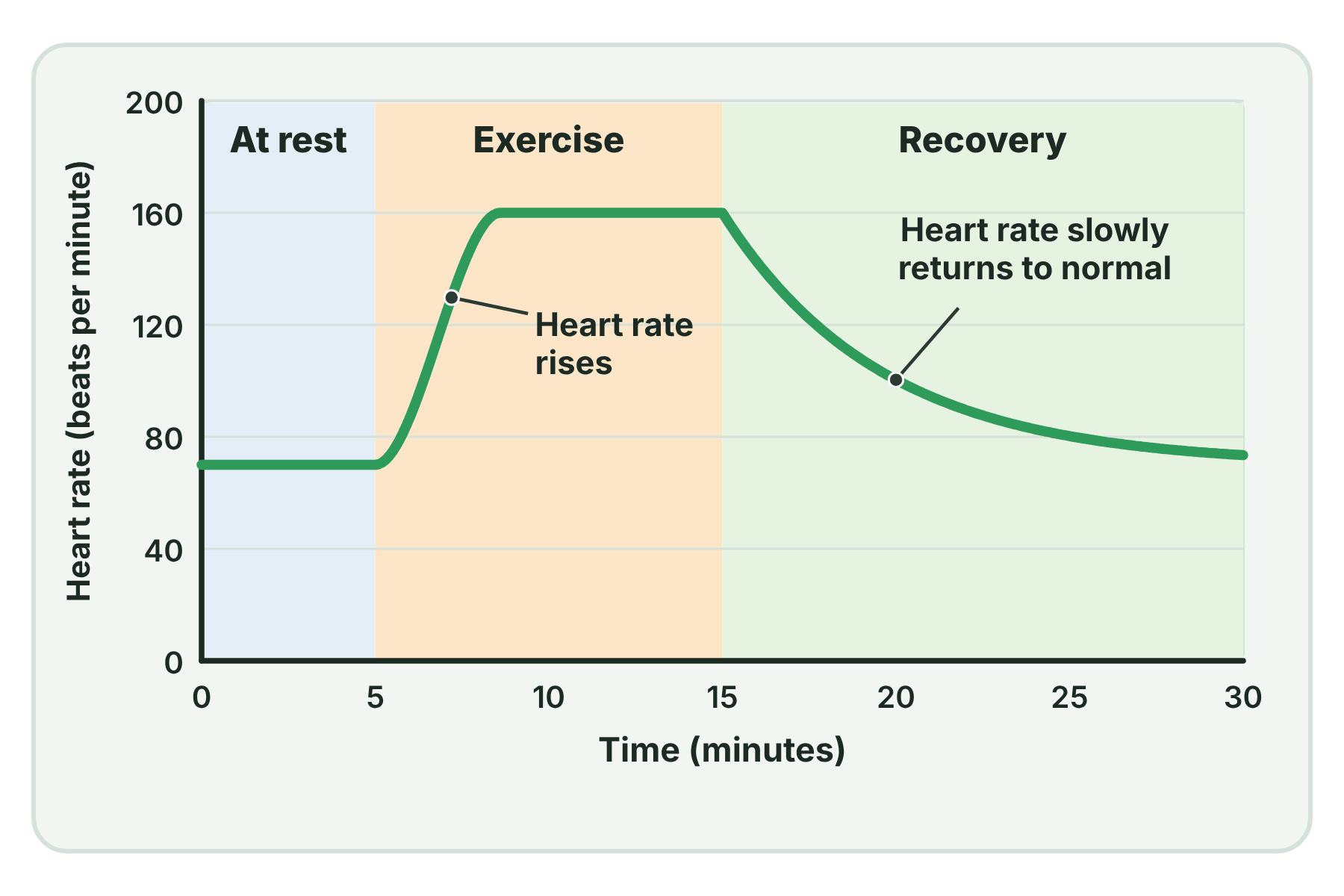
The heart rate rises when exercise starts and takes some time to return to its resting rate.
Calculating a percentage increase
A student's heart rate is 70 beats per minute at rest and 154 beats per minute during exercise. Calculate the percentage increase in heart rate.
Show the solutionHide the solution
- 1 Find the increase \(154 - 70 = 84\) beats per minute
- 2 Divide by the starting value \(84 \div 70 = 1.2\)
- 3 Multiply by 100 \(1.2 \times 100 = 120\%\)
AnswerThe heart rate increases by 120%.
Calculating the volume of air breathed each minute
At rest a person takes 14 breaths per minute and each breath is 0.5 dm³. During exercise they take 30 breaths per minute and each breath is 1.5 dm³. Calculate the volume of air breathed in each minute during exercise.
Show the solutionHide the solution
- 1 Use the equation volume per minute = breathing rate × breath volume
- 2 Substitute the values \(30 \times 1.5\)
- 3 Give the answer with its unit \(= 45\) dm³ per minute (compared with 7 dm³ per minute at rest)
AnswerThe person breathes in 45 dm³ of air each minute during exercise.
Investigating the effect of exercise on the body
A simple investigation measures how pulse rate changes with exercise and how long it takes to recover.
-
1
Rest
The person sits still, and you count their pulse for one minute to find the resting heart rate.
-
2
Exercise
They exercise for a fixed time, for example 2 minutes of stepping on and off a step.
-
3
Measure straight away
Count the pulse for 30 seconds immediately after exercise, and double it.
-
4
Measure the recovery
Take the pulse every minute until it returns to the resting rate, and record the time.
-
5
Repeat
Repeat and calculate a mean. Keep the type of exercise and its time the same each time, as control variables.
Muscle fatigue and anaerobic respiration
During vigorous exercise the heart and lungs may not be able to supply oxygen as fast as the muscles use it.
-
Anaerobic respiration
If insufficient oxygen is supplied, the muscles respire anaerobically as well.
-
Lactic acid
The incomplete oxidation of glucose causes a build up of lactic acid.
-
Oxygen debt
The build up of lactic acid creates an oxygen debt.
-
Fatigue
During long periods of vigorous activity the muscles become fatigued and stop contracting efficiently.
Gentle and vigorous exercise
Gentle exercise
- Enough oxygen reaches the muscles
- Only aerobic respiration
- Little or no lactic acid
- Can carry on for a long time
Vigorous exercise
- Oxygen cannot be supplied fast enough
- Some anaerobic respiration as well
- Lactic acid builds up
- Muscles become fatigued
Lactic acid and oxygen debt (Higher tier)
After vigorous exercise the lactic acid has to be removed, and this needs extra oxygen.
-
Removing lactic acid
Blood flowing through the muscles transports the lactic acid to the liver, where it is converted back into glucose.
-
Oxygen debt
Oxygen debt is the amount of extra oxygen the body needs after exercise to react with the accumulated lactic acid and remove it from the cells.
-
Why you keep panting
The heart rate and breathing rate stay high for a while after exercise so the oxygen debt can be repaid.
Oxygen uptake and oxygen debt (Higher tier)
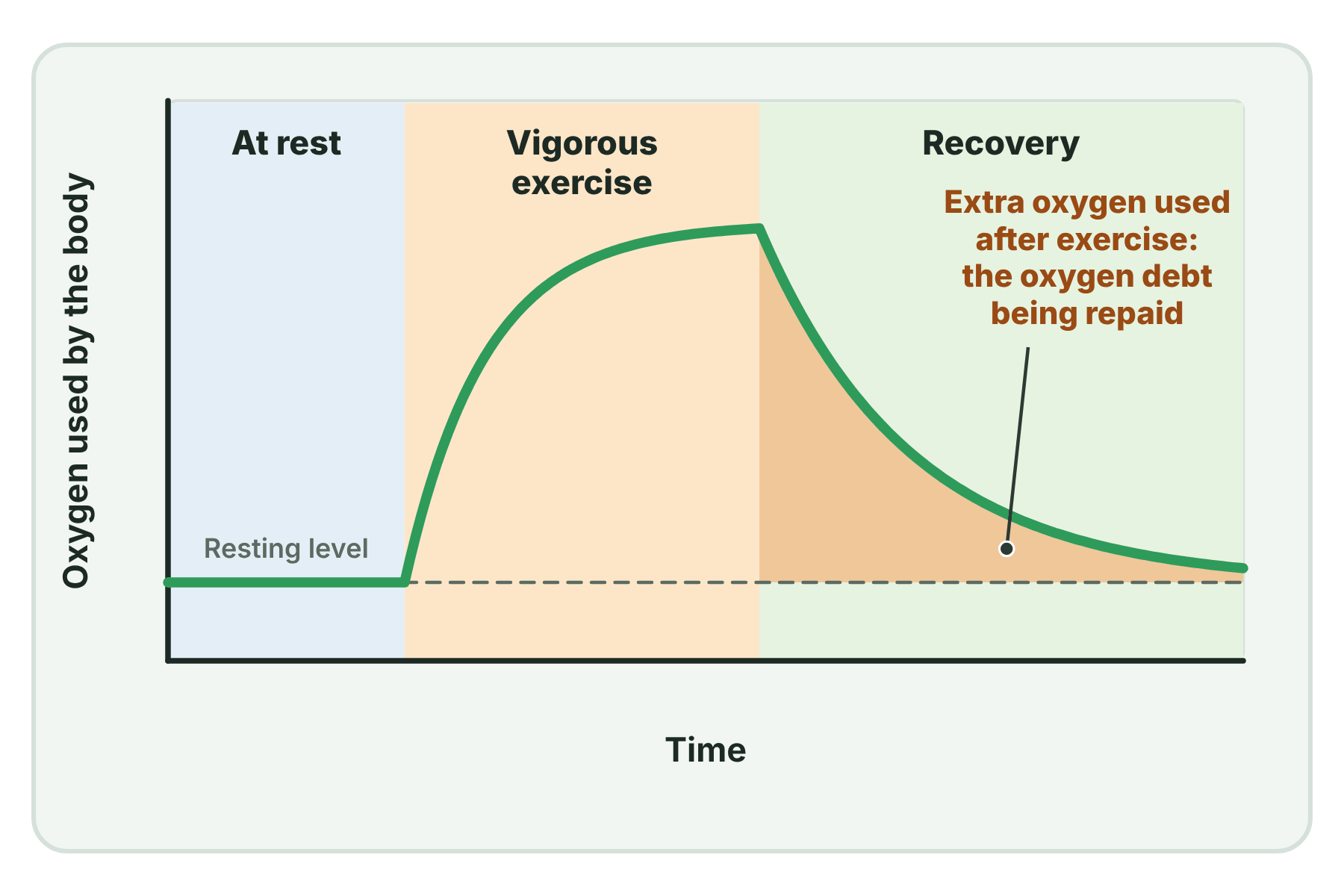
The body keeps taking in extra oxygen after exercise to repay the oxygen debt.
What happens to lactic acid (Higher tier)
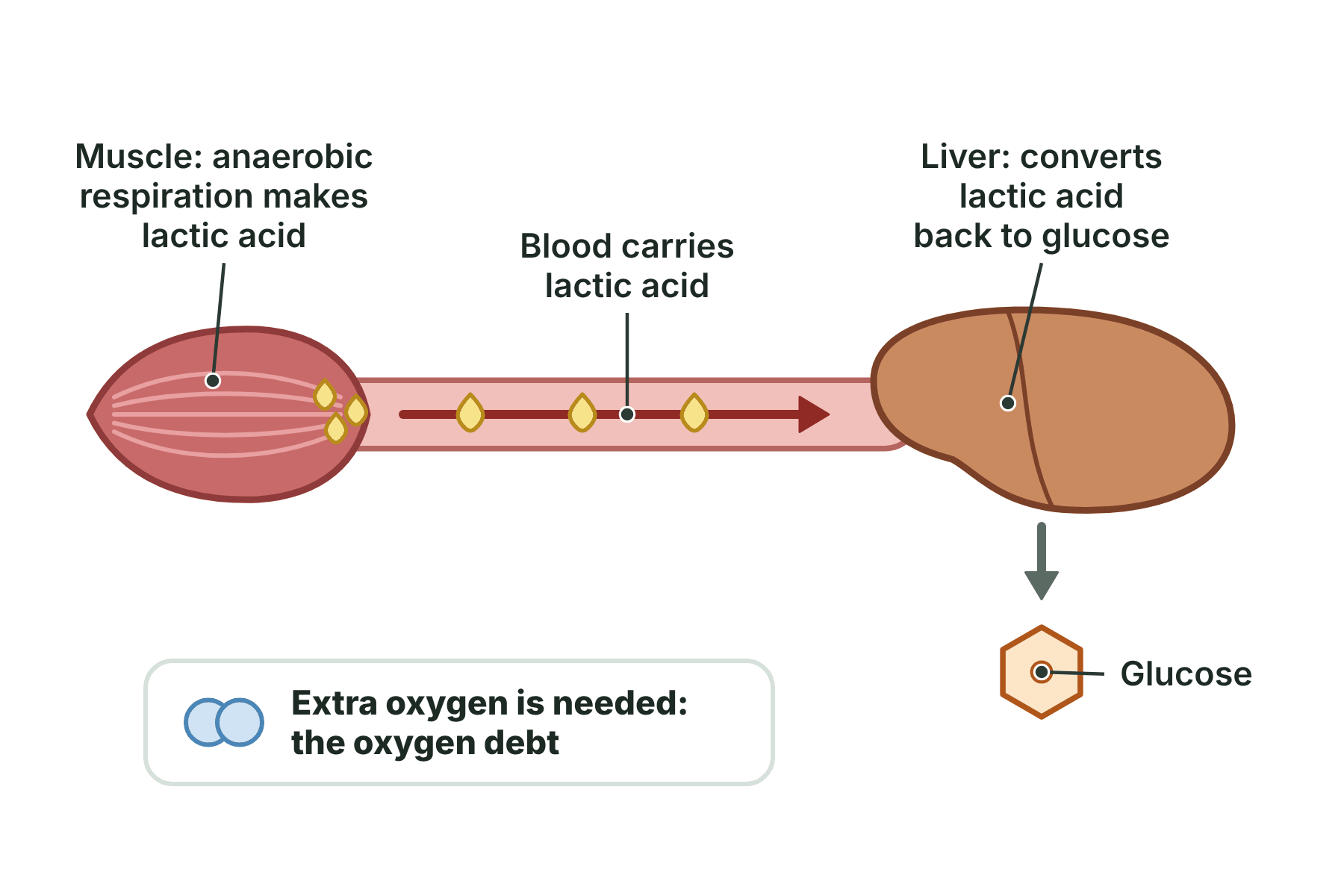
The liver converts lactic acid back into glucose, using extra oxygen.
Case study
Panting after a sprint
A sprinter crosses the finish line and bends over, breathing hard for several minutes. During the race the muscles needed energy faster than the blood could bring oxygen, so they respired anaerobically and lactic acid built up. Afterwards, the athlete keeps breathing fast and the heart keeps beating fast. For Higher tier, this is because extra oxygen is needed to react with the lactic acid and remove it, which is paying back the oxygen debt.
The big idea
During exercise the heart rate, breathing rate and breath volume increase to supply the muscles with more oxygenated blood, and if oxygen is still short the muscles respire anaerobically, build up lactic acid and become fatigued.
Response to exercise
Response to exercise
-
Heart rate
- beats faster to pump more blood to the muscles
-
Breathing
- rate and breath volume increase
-
Anaerobic respiration
- lactic acid builds up
- creating an oxygen debt
-
Fatigue
- muscles stop contracting efficiently
-
Recovery (Higher tier)
- liver converts lactic acid to glucose
- using extra oxygen
Summary and exam focus
- During exercise the muscles need more energy, so they respire faster.
- The heart rate, breathing rate and breath volume increase to supply more oxygenated blood.
- If insufficient oxygen is supplied, the muscles respire anaerobically and lactic acid builds up.
- Lactic acid creates an oxygen debt, and muscles become fatigued in long periods of vigorous activity.
- (Higher tier) The blood carries lactic acid to the liver, which converts it back to glucose.
- (Higher tier) Oxygen debt is the extra oxygen needed after exercise to remove the lactic acid.
Exam focus
Explain why the heart rate and the breathing rate increase during exercise. (4 marks) (4 marks)
Start with the muscles: they respire faster and need more oxygen and glucose, and make more carbon dioxide. Then say what the changes do: more oxygenated blood is supplied, and carbon dioxide is removed faster.
Key terms
The words this lesson expects you to use. Each one is linked from the first place it appears above.
- Heart rate
- The number of times the heart beats each minute.
- Breathing rate
- The number of breaths taken each minute.
- Breath volume
- The volume of air taken in with each breath.
- Lactic acid
- A product of anaerobic respiration in muscles.
- Muscle fatigue
- When muscles stop contracting efficiently after long periods of vigorous activity.
- Oxygen debt
- The extra oxygen the body needs after exercise to remove the lactic acid that has built up (Higher tier).
- Recovery time
- The time taken for the heart rate to return to its resting rate after exercise.
- Oxygenated blood
- Blood carrying a lot of oxygen, which is supplied to the muscles.
You've finished the notes
Check your understanding
Test yourself while it is fresh. Start with the flashcards, then try the exam questions.
Something here looks wrong?
Tell us what and we will go and look. It goes to whoever writes these pages, nobody else, and we do not ask who you are — so there is nothing to sign and nothing comes back to you.