Biology · Transport In and Out of Cells
Surface Area to Volume Ratio and Exchange Surfaces
A big organism cannot get everything it needs by diffusion through its skin. This lesson shows how to calculate surface area to volume ratio and why multicellular organisms need exchange surfaces and a transport system.
Learning Objectives
- 1Calculate and compare surface area to volume ratios.
- 2Explain why a single-celled organism has no need for a transport system but a multicellular organism does.
- 3Explain the need for exchange surfaces in terms of surface area to volume ratio.
- 4Describe how the small intestine, lungs, gills, roots and leaves are adapted for exchanging materials.
Retrieval practice
-
1
What is diffusion?
Show answerHide answer
The net movement of particles from a higher concentration to a lower concentration.
-
2
Name three factors that affect the rate of diffusion.
Show answerHide answer
The concentration gradient, the temperature and the surface area of the membrane.
-
3
What is the surface area of a cube with sides of 2 cm?
Show answerHide answer
6 faces × (2 × 2) = 24 cm².
-
4
Why do cells need to take in oxygen and glucose?
Show answerHide answer
For respiration, which releases the energy the cell needs.
Why size matters
Every cell needs oxygen and glucose, and every cell has waste to get rid of. A tiny single-celled organism can swap all of this with its surroundings by diffusion straight across its cell membrane. An organism made of millions of cells is a different problem. Most of its cells are buried deep inside, a long way from the air or the food, and the surface of the body is far too small to supply them all.
Surface area to volume ratio
To compare how well different-sized organisms can exchange materials, biologists compare the surface area with the volume.
-
Surface area
The total area of the outside of an object. Substances can only diffuse in and out across this surface.
-
Volume
The amount of space inside the object. The more volume there is, the more living material needs supplying.
-
The ratio
Surface area to volume ratio is the surface area divided by the volume. It is written as, for example, 6:1.
-
Bigger means a smaller ratio
When an object gets bigger its volume grows faster than its surface area, so its surface area to volume ratio falls.
Bigger cubes have a smaller ratio
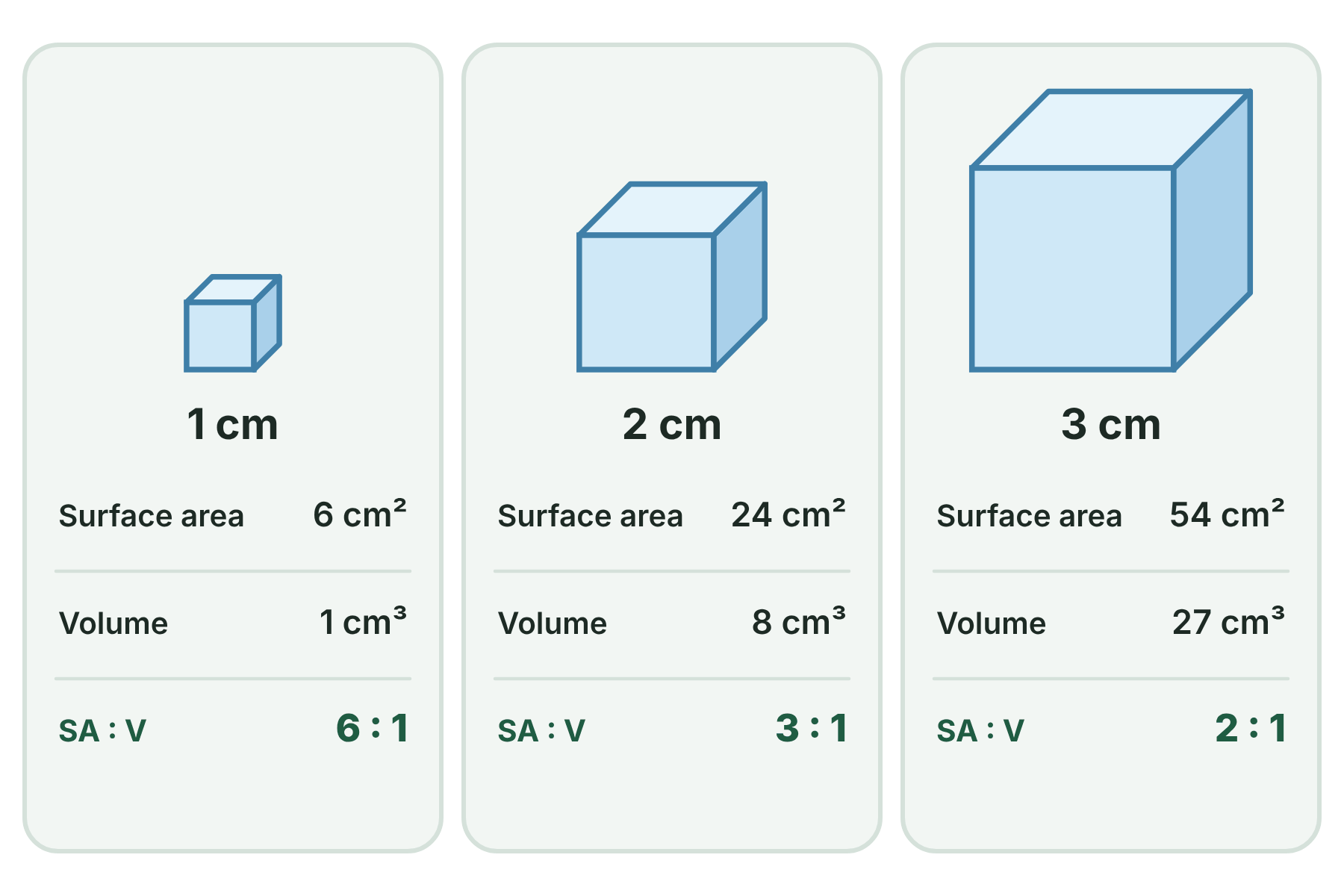
As the cube gets bigger, the ratio gets smaller.
Calculating a surface area to volume ratio
Calculate the surface area to volume ratio of a cube with sides of 3 cm.
Show the solutionHide the solution
- 1 Find the area of one face \(3 \times 3 = 9\text{ cm}^2\)
- 2 Find the surface area A cube has 6 faces, so \(6 \times 9 = 54\text{ cm}^2\)
- 3 Find the volume \(3 \times 3 \times 3 = 27\text{ cm}^3\)
- 4 Divide the surface area by the volume \(54 \div 27 = 2\), so the ratio is 2:1
AnswerThe ratio is 2:1.
Comparing two ratios
A cube with sides of 1 cm and a cube with sides of 4 cm are compared. How many times bigger is the surface area to volume ratio of the small cube?
Show the solutionHide the solution
- 1 Small cube Surface area \(6 \times 1 = 6\text{ cm}^2\), volume \(1\text{ cm}^3\), ratio 6:1.
- 2 Large cube Surface area \(6 \times 16 = 96\text{ cm}^2\), volume \(64\text{ cm}^3\), ratio \(96 \div 64 = 1.5\), so 1.5:1.
- 3 Compare \(6 \div 1.5 = 4\). The smaller cube has a ratio four times bigger.
AnswerThe small cube's ratio is 4 times bigger.
Single-celled and multicellular organisms
Single-celled organism
- Large surface area to volume ratio
- Substances diffuse across the cell surface fast enough to meet all its needs
- Every part of the cell is close to the outside
- No transport system or special exchange surface needed
Multicellular organism
- Small surface area to volume ratio
- The body surface alone could not supply the cells deep inside
- Diffusion over such long distances is far too slow
- Needs specialised exchange surfaces and a transport system
What makes a good exchange surface
The organs that swap materials with the outside world share the same four features. The first two work for both plants and animals.
-
A large surface area
More of the surface is available, so more particles can cross at once. Folding and branching packs a large area into a small space.
-
A thin membrane
A short diffusion path means particles only have to travel a tiny distance.
-
An efficient blood supply (animals)
Blood carries substances away as fast as they arrive, which keeps the concentration gradient steep.
-
Ventilation (animals, for gas exchange)
Breathing keeps fresh air moving over the surface, which also keeps the concentration gradient steep.
A gas exchange surface in the lung
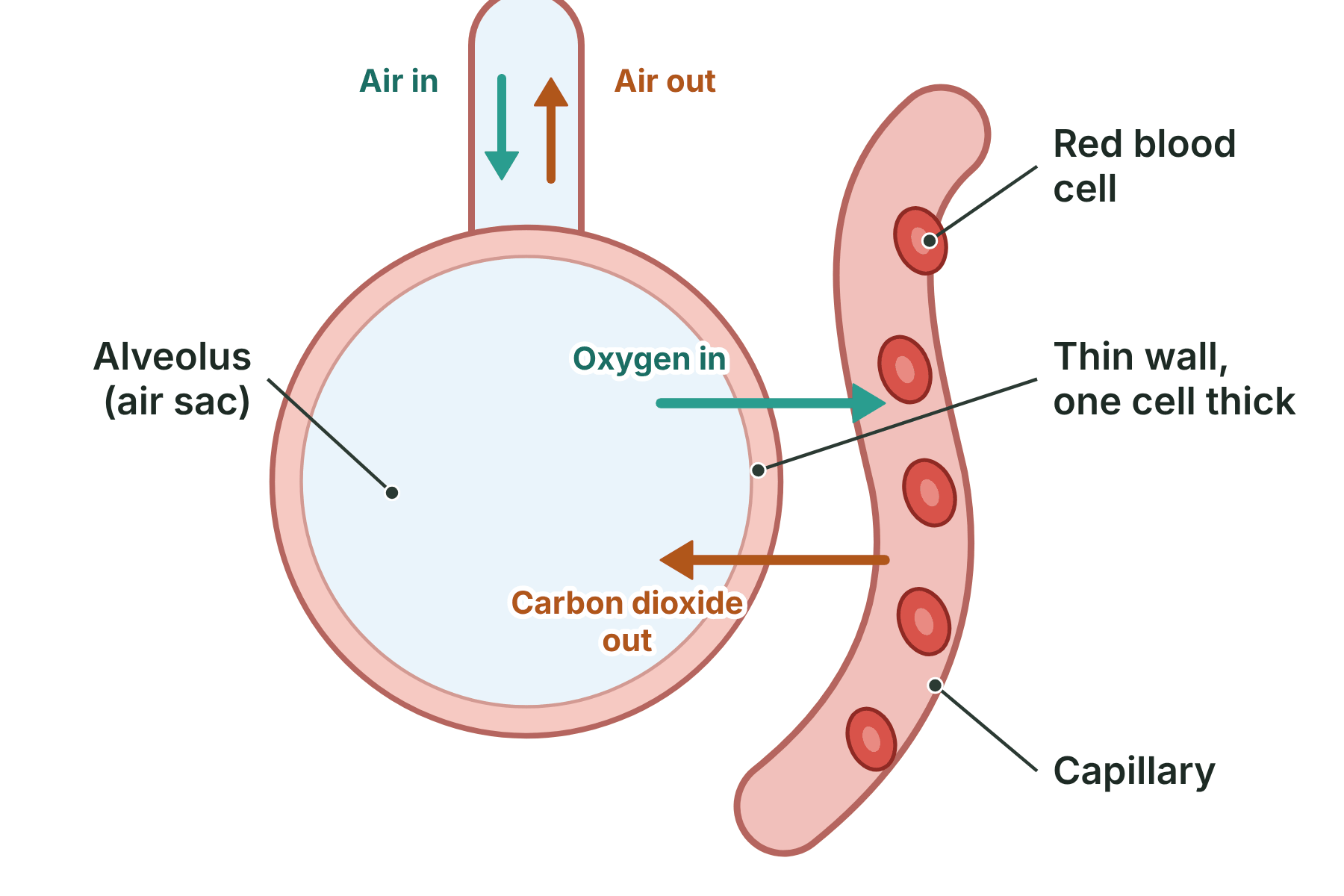
A thin wall, a rich blood supply and breathing make the alveolus a very effective exchange surface.
Exchange surfaces in animals
Each of these organs has a large surface area and a thin wall, and each one has a way of keeping the concentration gradient steep.
-
Small intestine
The inner wall is covered with millions of tiny finger-like villi, which give a huge surface area for absorbing digested food. Each villus has a thin wall and a rich blood supply that carries the absorbed food away.
-
Lungs
Millions of tiny air sacs called alveoli give a very large surface area. Each alveolus has a wall one cell thick and is wrapped in capillaries, and breathing ventilates the lungs.
-
Gills in fish
Each gill is made of many thin gill filaments covered in folds, which give a large surface area. The filaments have a thin surface and a rich blood supply, and water flowing over them keeps the gradient steep.
Exchange surfaces in plants
Plants do not need a blood supply, but their roots and leaves are adapted in the same way.
-
Roots
Each root hair cell has a long, thin extension that sticks out into the soil. This gives a large surface area for taking up water and mineral ions.
-
Leaves
A leaf is flat and thin, so gases only have a short distance to diffuse. Air spaces between the cells inside give a large surface area, and tiny holes called stomata let carbon dioxide in and oxygen out.
Four exchange surfaces
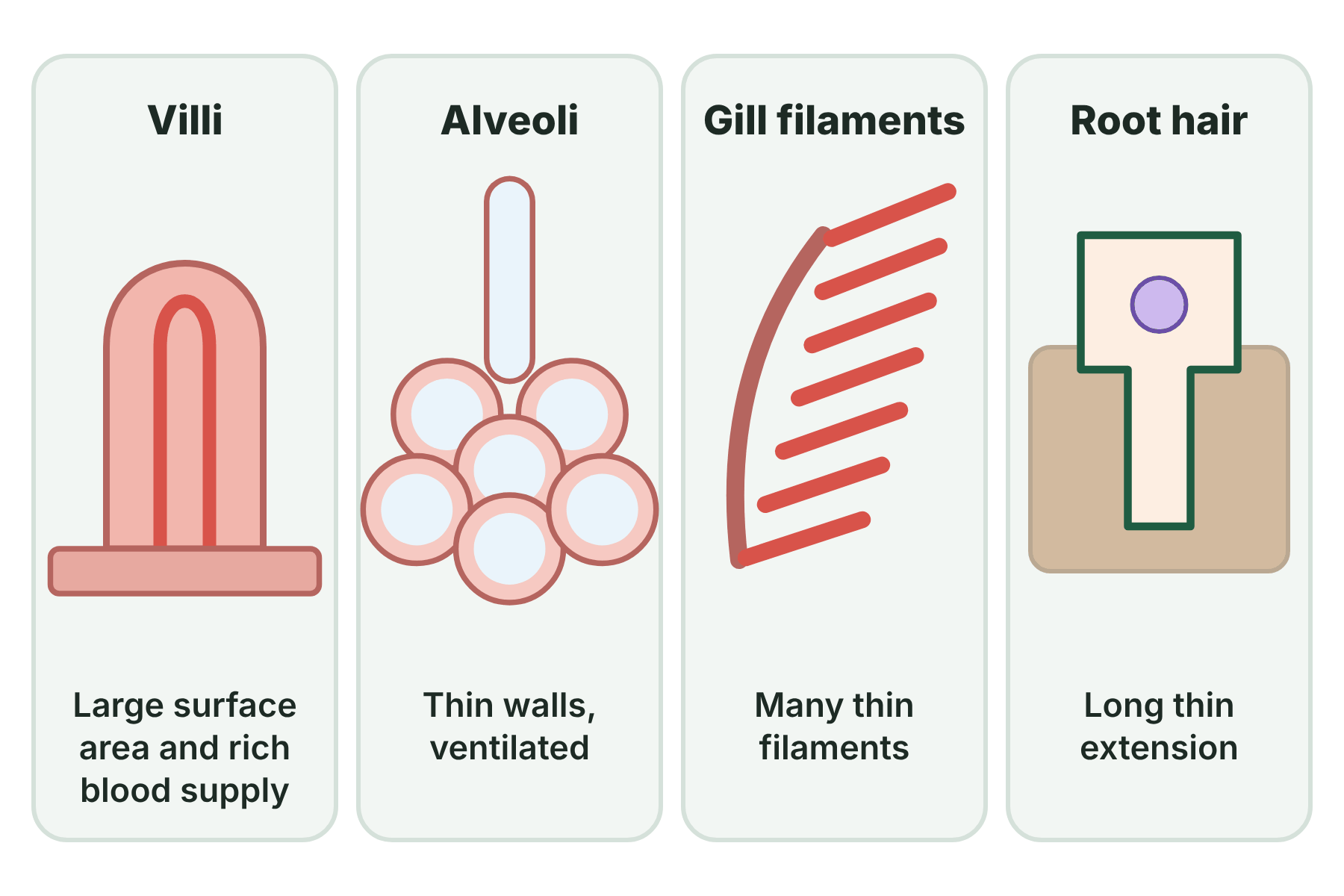
Exchange surfaces in animals and plants all have a large surface area.
Case study
The alveoli, a huge surface in a small space
Each lung is packed with millions of alveoli. If all the alveoli of an adult were opened out flat, they would cover an area of roughly 70 m², about the size of half a badminton court. Folding a surface up into millions of tiny air sacs is how a large exchange surface fits inside a chest. It is the same trick that the villi use in the small intestine.
The big idea
A big organism has a small surface area compared with its volume, so it needs exchange surfaces and a transport system.
Exchange surfaces
Exchange surfaces
-
Ratio
- surface area ÷ volume
- falls as size increases
-
Single-celled
- large ratio
- diffusion is enough
-
Multicellular
- small ratio
- needs exchange surfaces and a transport system
-
Good exchange surface
- large area
- thin
- blood supply
- ventilated
-
Animals
- small intestine
- lungs
- gills
-
Plants
- roots
- leaves
Summary and exam focus
- Surface area to volume ratio is the surface area divided by the volume.
- The bigger an organism is, the smaller its surface area to volume ratio.
- Single-celled organisms can exchange everything by diffusion across their surface.
- Multicellular organisms need exchange surfaces and a transport system.
- A good exchange surface is large, thin, has a good blood supply and is ventilated.
Exam focus
Explain how the structure of the alveoli makes them good for gas exchange. (4 marks) (4 marks)
Name a feature, then say why it helps. "Thin walls" earns nothing on its own. "Thin walls, so the diffusion path is short" earns the mark. Use all four features: area, thin wall, blood supply and ventilation.
Key terms
The words this lesson expects you to use. Each one is linked from the first place it appears above.
- Surface area to volume ratio
- The surface area of an object divided by its volume. It gets smaller as the object gets bigger.
- Surface area
- The total area of the outside of an object.
- Volume
- The amount of space inside an object.
- Exchange surface
- A surface specialised for swapping substances with the surroundings, such as the lungs or the small intestine.
- Diffusion path
- The distance particles have to travel to cross an exchange surface. A thin surface gives a short path.
- Villi
- Tiny finger-like folds in the lining of the small intestine that increase its surface area.
- Alveoli
- The tiny air sacs of the lungs, where oxygen and carbon dioxide are exchanged with the blood.
- Gill
- The gas exchange organ of a fish, made of many thin filaments.
- Ventilation
- Moving air or water over an exchange surface, so that the concentration gradient stays steep.
You've finished the notes
Check your understanding
Test yourself while it is fresh. Start with the flashcards, then try the exam questions.
Something here looks wrong?
Tell us what and we will go and look. It goes to whoever writes these pages, nobody else, and we do not ask who you are — so there is nothing to sign and nothing comes back to you.