Biology · Genetic Inheritance
Genes, Alleles and Genetic Terms
Why do you look like your family but not exactly like them? This lesson is for both Combined Science and separate Biology. It sets out the vocabulary of inheritance: gamete, chromosome, gene, allele, dominant, recessive, homozygous, heterozygous, genotype and phenotype, and shows that most characteristics depend on many genes.
Learning Objectives
- 1Explain the terms gamete, chromosome, gene, allele, dominant, recessive, homozygous, heterozygous, genotype and phenotype.
- 2Describe how a dominant allele and a recessive allele are expressed.
- 3Work out a phenotype from a genotype, and say whether a genotype is homozygous or heterozygous.
- 4Explain why most characteristics are controlled by many genes rather than a single gene.
Retrieval practice
-
1
What is a gene?
Show answerHide answer
A small section of DNA on a chromosome that codes for a particular sequence of amino acids, to make a specific protein.
-
2
How many chromosomes are in a human body cell?
Show answerHide answer
46, in 23 pairs.
-
3
What is a gamete?
Show answerHide answer
A sex cell: a sperm or an egg in animals.
-
4
What process makes gametes?
Show answerHide answer
Meiosis.
Why offspring are not identical copies
Every child gets half of its chromosomes from each parent, so it carries two copies of every gene, one from the mother and one from the father. The two copies are not always the same. This lesson gives you the words geneticists use to describe those copies and the characteristics they produce, because every genetics question in the exam is written in this language.
The vocabulary of inheritance
These four words describe the genetic material, from the smallest unit to the sex cell.
-
Gamete
A sex cell: a sperm cell or an egg cell in animals. A gamete carries one copy of each chromosome, so one copy of each gene.
-
Chromosome
A long molecule of DNA in the nucleus that carries many genes. Human body cells have 23 pairs, so each gene is present twice.
-
Gene
A small section of DNA on a chromosome. It codes for a particular protein and so helps to control a characteristic, such as fur colour in mice.
-
Allele
A different form of the same gene. A gene for fur colour might have an allele for black fur and an allele for brown fur.
Dominant and recessive alleles
A body cell has two alleles of each gene, one on each chromosome of a pair. Which one shows depends on whether it is dominant or recessive.
-
Dominant allele
A dominant allele is always expressed, even if only one copy is present. It is written as a capital letter, such as B.
-
Recessive allele
A recessive allele is only expressed if two copies are present, so there is no dominant allele. It is written as the lower case of the same letter, such as b.
-
Same letter
The two forms of one gene use the same letter, in capital and in lower case, so you can see at once that they are alleles of the same gene.
-
Not about strength
Dominant does not mean stronger or more common. It only means that the allele shows when it is present.
Homozygous and heterozygous
The two alleles of a gene can be the same or different.
-
Homozygous
The two alleles are the same. BB is homozygous dominant and bb is homozygous recessive. Zygous refers to the zygote, the first cell of a new organism.
-
Heterozygous
The two alleles are different, for example Bb. The dominant allele is expressed, and the recessive allele is hidden.
-
Remember the prefix
Homo means the same and hetero means different.
Homozygous and heterozygous chromosome pairs
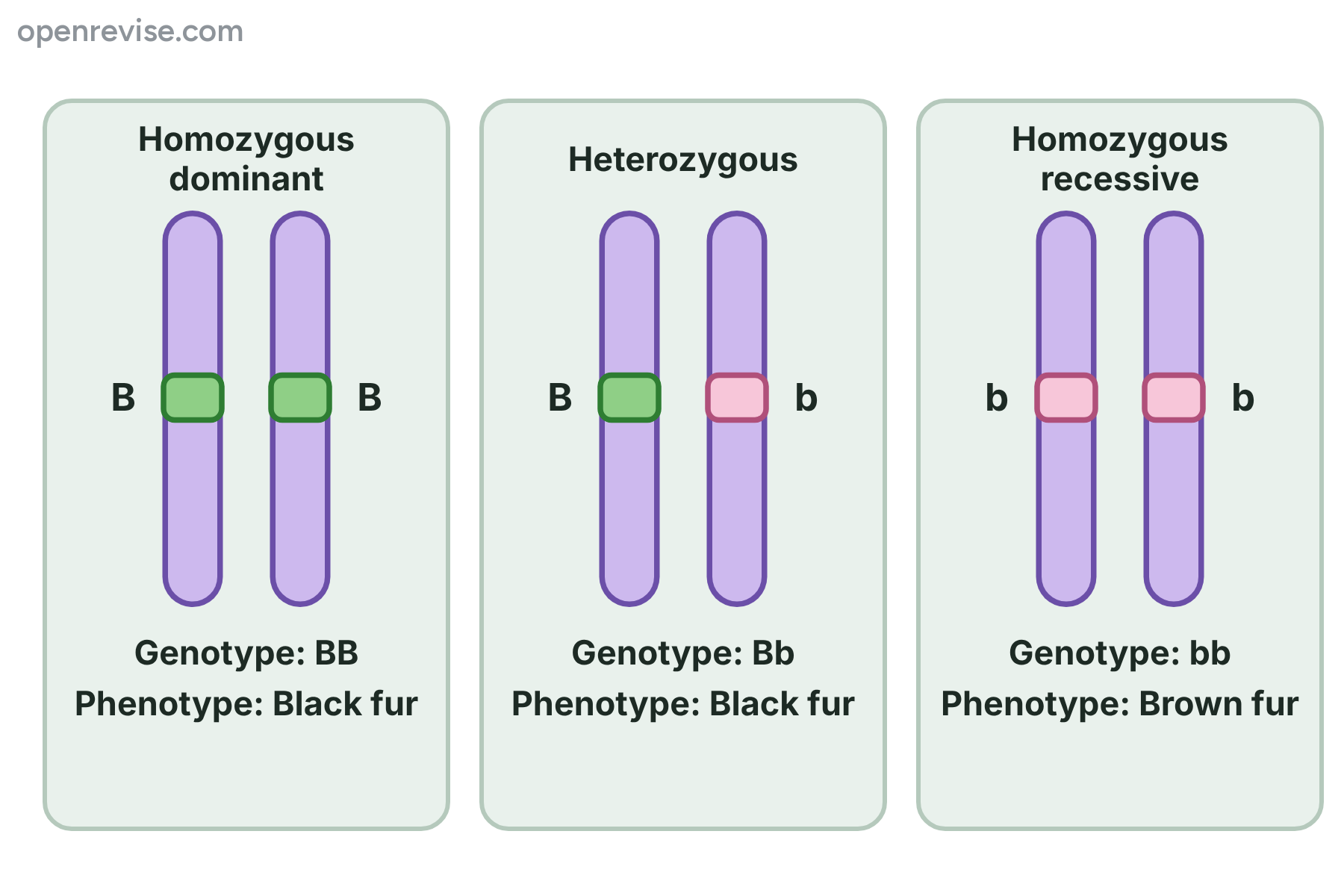
The two alleles of a gene sit at the same position on a pair of chromosomes.
Homozygous or heterozygous?
Homozygous
- The two alleles are the same
- BB (dominant) or bb (recessive)
- Only one kind of gamete can be made
- Organism is true breeding for that characteristic
Heterozygous
- The two alleles are different
- Bb
- Two kinds of gamete can be made, B and b
- The dominant allele is expressed and the recessive is hidden
Genotype and phenotype
Genotype is what is in the cells. Phenotype is what you can see or measure.
-
Genotype
The combination of alleles that an organism has, written as letters such as Bb. The alleles operate at a molecular level, by coding for proteins.
-
Phenotype
The characteristic that is expressed, such as black fur. It is the result of the genotype working with the environment.
-
Several genotypes, one phenotype
BB and Bb are different genotypes but give the same phenotype (black fur), because B is dominant.
-
Only one way for a recessive
A recessive phenotype can only come from one genotype, the homozygous recessive bb.
Working out the phenotype from a genotype
In mice, the allele for black fur (B) is dominant to the allele for brown fur (b). State the phenotype of mice with the genotypes BB, Bb and bb, and say whether each genotype is homozygous or heterozygous.
Show the solutionHide the solution
- 1 Identify the dominant allele B is dominant, so one B is enough for black fur
- 2 BB Two dominant alleles, so black fur. Both alleles are the same, so it is homozygous
- 3 Bb One dominant allele, so black fur. The alleles are different, so it is heterozygous
- 4 bb No dominant allele, so the recessive allele is expressed: brown fur. Both alleles are the same, so it is homozygous
AnswerBB is black and homozygous. Bb is black and heterozygous. bb is brown and homozygous.
One gene or many genes?
Some characteristics are controlled by a single gene, but they are the exception.
-
Single gene characteristics
Fur colour in mice and red-green colour blindness in humans are controlled by a single gene, so each has a simple pattern of inheritance.
-
Most characteristics
Most characteristics, such as height, skin colour and intelligence, result from many genes interacting rather than a single gene.
-
Genes and environment
Even for one gene, the phenotype can be affected by the environment. A plant with the genes for tallness will still be short if it has too little light and too few minerals.
-
Why it matters in the exam
You can only predict simple ratios for single gene characteristics. For most features, a cross cannot predict the offspring so neatly.
Case study
Red-green colour blindness
Red-green colour blindness is a single gene characteristic in humans. The allele that causes it is recessive and is carried on the X chromosome, which is why it is more common in males, who have only one X chromosome. A person with the condition has difficulty telling red from green because of how the cells in the eye respond to colour. It is an example of a characteristic where one gene has a big effect.
The big idea
Genotype plus environment gives phenotype, and a dominant allele shows even when only one copy is present.
Genetic terms
Genetic terms
-
Gamete
- sex cell
- one copy of each gene
- sperm and egg
-
Gene and allele
- gene is a section of DNA
- alleles are its different forms
-
Dominant and recessive
- dominant always expressed
- recessive needs two copies
-
Homozygous and heterozygous
- same alleles
- different alleles
-
Genotype and phenotype
- alleles present
- characteristic expressed
-
Many genes
- most characteristics
- plus the environment
Summary and exam focus
- A gene has different forms called alleles, and a gamete carries one allele of each gene.
- A dominant allele is always expressed, and a recessive allele is only expressed if two copies are present.
- Alleles that are the same are homozygous and alleles that are different are heterozygous.
- The genotype is the alleles present and the phenotype is the characteristic expressed.
- Most characteristics are controlled by many genes, not a single gene.
Exam focus
In cats, the allele for short fur (S) is dominant to the allele for long fur (s). Explain why a cat with the genotype Ss has short fur, and state the term that describes this genotype. (3 marks) (3 marks)
Use the key words in the right place. Say that S is dominant, so it is expressed even when only one copy is present, and that the long fur allele is recessive so it is not expressed. Then name the genotype as heterozygous. Do not just say that short is stronger.
Key terms
The words this lesson expects you to use. Each one is linked from the first place it appears above.
- Gamete
- A sex cell, such as a sperm cell or egg cell, that carries one copy of each gene.
- Chromosome
- A long molecule of DNA in the nucleus that carries many genes.
- Gene
- A small section of DNA on a chromosome that codes for a particular protein.
- Allele
- A different form of the same gene.
- Dominant
- An allele that is always expressed, even if only one copy is present.
- Recessive
- An allele that is only expressed if two copies are present.
- Homozygous
- Having two identical alleles of a gene.
- Heterozygous
- Having two different alleles of a gene.
- Genotype
- The combination of alleles that an organism has.
- Phenotype
- The characteristic that is expressed, which results from the genotype and the environment.
You've finished the notes
Check your understanding
Test yourself while it is fresh. Start with the flashcards, then try the exam questions.
Something here looks wrong?
Tell us what and we will go and look. It goes to whoever writes these pages, nobody else, and we do not ask who you are — so there is nothing to sign and nothing comes back to you.