Biology · Genetic Inheritance
Single Gene Crosses and Punnett Squares
A Punnett square is the exam's standard way to predict what offspring a pair of parents can have. This lesson is for both Combined Science and separate Biology. It shows how to complete a Punnett square and turn it into ratios, fractions and percentages, and, for Higher tier students, how to construct a cross from scratch and use probability.
Learning Objectives
- 1Explain how the alleles in two parents' gametes combine at fertilisation to give the genotypes of the offspring.
- 2Complete a Punnett square diagram and extract and interpret the information in it.
- 3Use direct proportion and simple ratios to express the outcome of a genetic cross, as a ratio, fraction or percentage.
- 4(Higher tier) Construct a genetic cross by Punnett square and use it, with the theory of probability, to make predictions.
Retrieval practice
-
1
What is a heterozygous genotype?
Show answerHide answer
One with two different alleles of the gene, such as Bb.
-
2
How many alleles of a gene does a gamete carry?
Show answerHide answer
One.
-
3
Which genotype is needed for a recessive phenotype?
Show answerHide answer
Homozygous recessive, such as bb.
-
4
What is the difference between genotype and phenotype?
Show answerHide answer
Genotype is the alleles present. Phenotype is the characteristic that is expressed.
Predicting the offspring
Each parent passes on one allele of the gene in each gamete, and which gamete fertilises which is a matter of chance. A Punnett square lists every possible combination, so you can see the genotypes and phenotypes the offspring could have and how likely each one is. It predicts probabilities only. It does not say exactly what will happen in a real family or litter.
Completing a Punnett square
Follow the same steps every time, and show each one in the exam.
-
1
Write the parents' genotypes
For example Bb and Bb, with B for black fur (dominant) and b for brown fur (recessive).
-
2
Write the gametes
Each gamete has one allele from each parent. A parent Bb makes gametes B and b. Write one parent's gametes across the top and the other's down the side.
-
3
Fill in the squares
Copy the allele from the top and the allele from the side into each square to give the offspring genotype. Write the dominant allele first, so Bb not bB.
-
4
Read off the phenotypes
Use the rule that the dominant allele is expressed, so BB and Bb are black and bb is brown.
-
5
Give the result
Count the squares to give the ratio, fraction or percentage that the question asks for.
A cross between two heterozygous mice
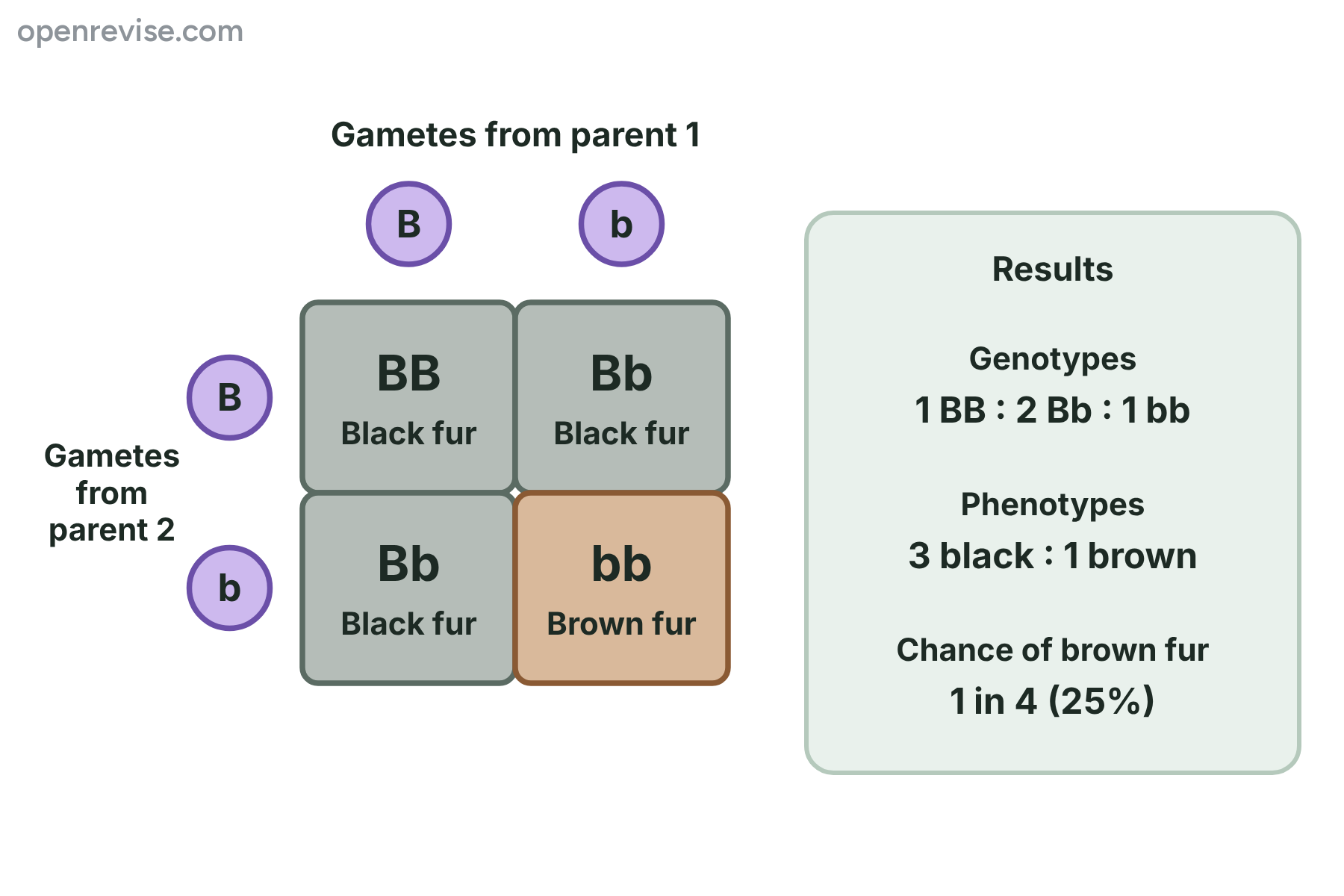
Two heterozygous parents give a 3 to 1 ratio of the dominant to the recessive phenotype.
Two heterozygous parents
Two black mice both have the genotype Bb. Black fur (B) is dominant to brown fur (b). Use a Punnett square to give the ratio of black mice to brown mice among their offspring, and the percentage chance that an offspring is brown.
Show the solutionHide the solution
- 1 Write the gametes Each parent makes gametes B and b
- 2 Fill in the four squares BB, Bb, Bb and bb
- 3 Give the phenotypes BB, Bb and Bb are black and bb is brown
- 4 Count 3 black to 1 brown, so a ratio of 3 : 1
- 5 Give the chance of brown \(\frac{1}{4} = 0.25 = 25\%\)
AnswerThe ratio of black to brown is 3 : 1, so there is a 25% chance that an offspring is brown.
A heterozygous parent and a homozygous recessive parent
A black mouse with the genotype Bb is crossed with a brown mouse. Give the ratio of black to brown offspring.
Show the solutionHide the solution
- 1 Write the parents' genotypes The black mouse is Bb. The brown mouse must be bb, because brown is recessive
- 2 Write the gametes Bb gives B and b. bb gives b and b
- 3 Fill in the four squares Bb, Bb, bb and bb
- 4 Give the phenotypes Two squares are black (Bb) and two are brown (bb)
- 5 Give the ratio 2 : 2, which simplifies to 1 : 1, or 50% black and 50% brown
AnswerThe ratio of black to brown is 1 : 1, so half of the offspring are expected to be brown.
Ratios, fractions and percentages
The same result can be written in several ways, and the exam asks for each of them.
-
Ratio
Compare the numbers of each outcome, such as 3 black to 1 brown, written 3 : 1. Always simplify, so 2 : 2 becomes 1 : 1.
-
Fraction
The number of squares for the outcome out of the total number of squares. One brown square out of four is \(\frac{1}{4}\).
-
Percentage
Multiply the fraction by 100. One in four is 25%.
-
Probability
A chance written between 0 and 1, so one in four is 0.25. Certain is 1 and impossible is 0.
What a Punnett square does and does not tell you
A Punnett square gives probabilities, not guarantees.
-
Chance
Each fertilisation is a separate chance event, so a 3 to 1 ratio is what you expect over a large number of offspring.
-
Small families
A litter of four mice from two Bb parents might be two brown and two black, or all black. The ratio is only an average.
-
No memory
Each fertilisation is independent. If a couple already has three children with a recessive condition, the chance of the next one is still the same as it was for the first.
-
Single gene only
A Punnett square only works for a characteristic controlled by a single gene.
Constructing a cross and using probability (Higher tier)
Higher tier questions often give you the phenotypes, not the genotypes, and ask you to build the cross yourself.
-
Work out the genotypes
A recessive phenotype must be homozygous recessive. A dominant phenotype is BB or Bb, so you may need other clues, such as the offspring, to decide.
-
Use the offspring to find the parents
If two black parents have a brown offspring, each parent must carry a b allele, so both are Bb.
-
Probability of one outcome
The chance of an outcome is the number of squares showing it divided by the total number of squares.
-
Probability of two in a row
The chance of two independent events is found by multiplying. The chance that two offspring are both brown is \(\frac{1}{4} \times \frac{1}{4} = \frac{1}{16}\).
Finding a parent's genotype (Higher tier)
A black mouse is crossed with a brown mouse. Half of the offspring are black and half are brown. Use a Punnett square to work out the genotype of the black parent.
Show the solutionHide the solution
- 1 Write the genotype of the brown parent Brown is recessive, so the brown mouse is bb and can only give b gametes
- 2 Think about the offspring The brown offspring are bb, so each got a b from the brown parent and a b from the black parent
- 3 The black parent has a b allele A black mouse with a b allele has the genotype Bb
- 4 Check with a Punnett square Bb crossed with bb gives Bb, Bb, bb, bb, which is 1 black : 1 brown, matching the result
AnswerThe black parent is heterozygous, Bb.
Two common crosses
Bb x Bb
- Gametes B, b and B, b
- Offspring 1 BB : 2 Bb : 1 bb
- 3 show the dominant phenotype to 1 recessive
- 25% chance of the recessive phenotype
Bb x bb
- Gametes B, b and b, b
- Offspring 2 Bb : 2 bb
- 1 dominant phenotype to 1 recessive
- 50% chance of the recessive phenotype
The big idea
A Punnett square shows every possible combination of gametes, so it predicts how likely each outcome is, not what will actually happen.
Single gene crosses
Single gene crosses
-
Steps
- genotypes
- gametes
- squares
- phenotypes
- result
-
Results
- ratio
- fraction
- percentage
-
Bb x Bb
- 3 : 1
- 25% recessive
-
Bb x bb
- 1 : 1
- 50% recessive
-
Chance
- each fertilisation independent
- ratio is an average
-
Higher tier
- build the cross
- find parents' genotypes
- multiply probabilities
Summary and exam focus
- Each gamete carries one allele of the gene, and fertilisation combines two gametes.
- A Punnett square shows all the possible genotypes of the offspring.
- The result can be given as a ratio, a fraction or a percentage.
- Two heterozygous parents give a 3 : 1 ratio of the dominant to the recessive phenotype.
- A Punnett square gives probabilities, and each fertilisation is independent.
- (Higher tier) You must be able to construct the cross yourself and use probability to make predictions.
Exam focus
In pea plants, the allele for tall stems (T) is dominant to the allele for short stems (t). Two heterozygous tall plants are crossed. Draw a Punnett square for this cross and give the ratio of tall to short offspring. (4 marks) (4 marks)
Write the parents' genotypes first (Tt and Tt), then the gametes around the square. Fill in all four squares, label the phenotype of each, and finish with the ratio in its simplest form. Marks are for the gametes, the squares, the phenotypes and the ratio.
Key terms
The words this lesson expects you to use. Each one is linked from the first place it appears above.
- Punnett square
- A diagram that shows all the possible combinations of gametes in a genetic cross.
- Genetic cross
- A mating between two parents, used to predict the genotypes and phenotypes of the offspring.
- Gamete
- A sex cell that carries one allele of each gene.
- Fertilisation
- The joining of a male gamete and a female gamete.
- Offspring
- The young produced in a cross.
- Ratio
- A comparison of two numbers, such as 3 : 1.
- Probability
- The chance of something happening, written from 0 to 1, or as a fraction or percentage.
- Carrier
- A person who has one copy of a recessive allele and does not have the disorder.
You've finished the notes
Check your understanding
Test yourself while it is fresh. Start with the flashcards, then try the exam questions.
Something here looks wrong?
Tell us what and we will go and look. It goes to whoever writes these pages, nobody else, and we do not ask who you are — so there is nothing to sign and nothing comes back to you.