Biology · Homeostasis and the Nervous System
The Brain
The brain controls almost everything that you do. This lesson is for separate Biology. It covers the structure and functions of the main regions of the brain, and for Higher tier students the difficulties of investigating brain function and of treating damage to the nervous system.
Learning Objectives
- 1Identify the cerebral cortex, cerebellum and medulla on a diagram of the brain, and describe their functions.
- 2(Higher tier) Explain some of the difficulties of investigating brain function, including ethical issues.
- 3(Higher tier) Explain some of the limitations in treating damage and disease in the brain and other parts of the nervous system.
- 4(Higher tier) Evaluate the benefits and risks of procedures carried out on the brain and nervous system.
Retrieval practice
-
1
What is the central nervous system?
Show answerHide answer
The brain and the spinal cord.
-
2
What is a hormone?
Show answerHide answer
A chemical messenger carried in the blood.
-
3
What controls the heart rate and the breathing rate?
Show answerHide answer
The brain.
-
4
What is a neurone?
Show answerHide answer
A nerve cell that carries electrical impulses.
The control centre
The brain is about 1.4 kg of soft tissue made of billions of neurones, protected by the skull. It receives impulses from receptors, makes decisions, stores memories, controls movement and keeps the body's internal conditions steady. Different regions have different jobs, and damage to a region can cause a loss of the matching function.
Regions of the brain
The brain has three main regions that you need to know, and each one controls different functions.
-
Cerebral cortex
The large, wrinkled outer layer of the brain, divided into two halves. It controls consciousness, intelligence, memory and language, and the voluntary movements, and it receives information from the senses.
-
Cerebellum
At the back, below the cerebral cortex. It coordinates movement and keeps balance and posture.
-
Medulla
At the base of the brain, joined to the spinal cord. It controls automatic actions that keep you alive, such as the heart rate and breathing.
The regions of the brain
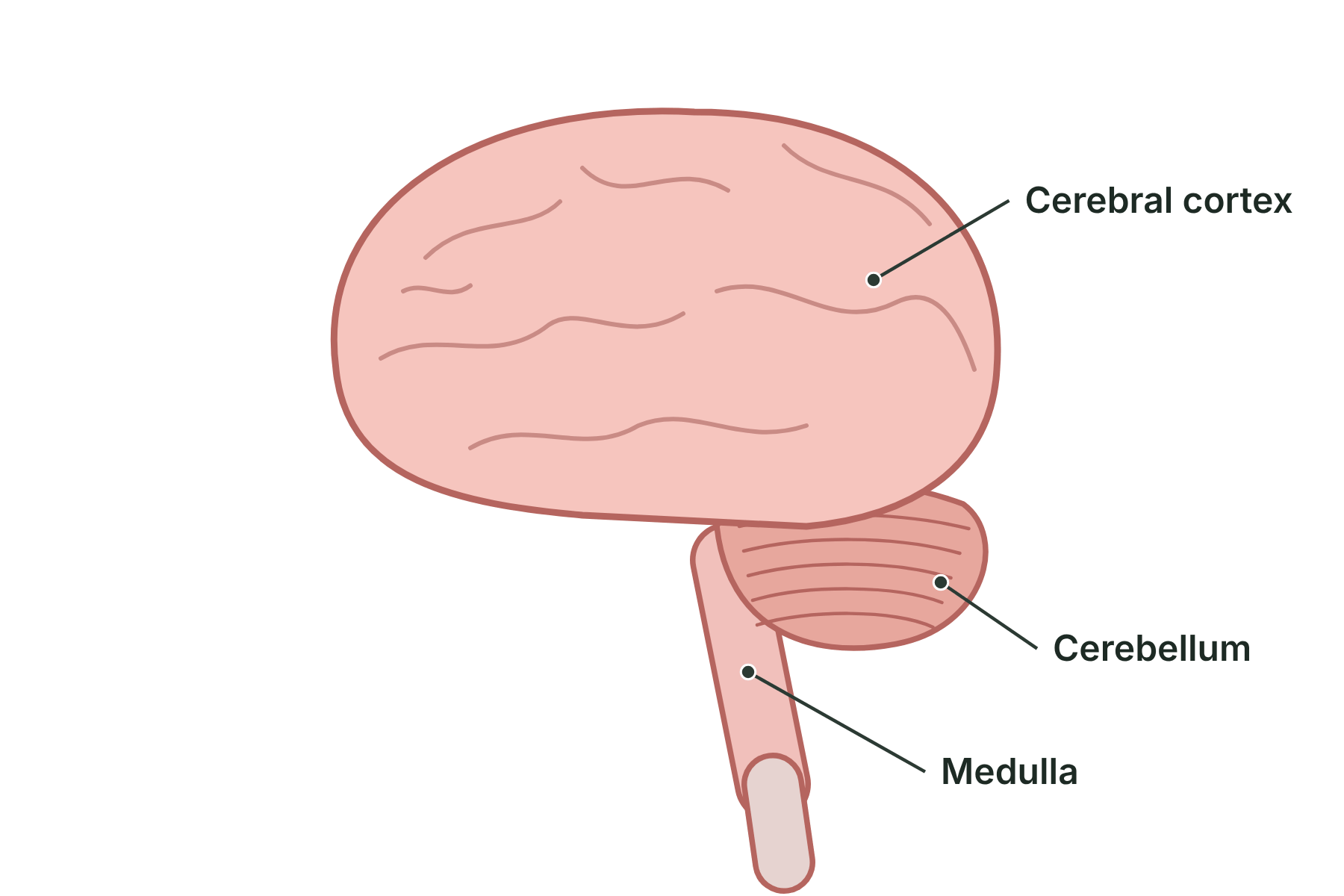
Each region of the brain has its own job.
What each region controls
Thinking and movement
- Cerebral cortex: conscious thought, memory, language, voluntary movement
- Cerebellum: coordination of movement and balance
Keeping the body going
- Medulla: heart rate and breathing
Investigating the brain (Higher tier)
The brain is hard to study, and what we know has been built up from several different kinds of evidence.
-
Case studies
Studying people with brain damage from injury or stroke shows which functions are lost, but every injury is different and it is hard to be sure which region is responsible.
-
Scans
MRI and similar scans show which regions are active during a task. They are safe, but they show activity, not exactly what each cell is doing.
-
Stimulation
Electrical stimulation of parts of the brain during surgery shows what they control, but it can only be done on patients having surgery.
-
Difficulties
The brain is complex, protected inside the skull, and has billions of connected neurones. It is difficult to reach, and experiments on healthy people or on animals raise ethical issues.
Treating damage to the nervous system (Higher tier)
Damage to the brain and the rest of the nervous system is hard to treat.
-
Limited repair
Neurones in the brain and spinal cord have a very limited ability to repair themselves, so damage is often permanent.
-
Irreversible damage
A stroke or a head injury can destroy neurones, or damage the tissue around them, and the lost functions may not return.
-
Difficult access
Parts of the brain are deep inside the skull, so operating is risky and can cause more damage to surrounding tissue.
-
Spinal injuries
If the spinal cord is cut, impulses cannot cross the injury, and the person can lose movement and feeling below it.
-
Benefits and risks
A procedure such as removing a tumour can save a life or restore a function, but surgery in the brain risks damaging healthy tissue and losing other functions. A doctor and the patient have to weigh up the benefits and the risks.
Case study
Phineas Gage (Higher tier)
In 1848 an iron rod passed through the front of the head of a railway worker called Phineas Gage. He survived, but people who knew him said his personality was changed. The case was one of the first pieces of evidence that the front of the brain has a role in personality. It also shows the problems with evidence from a single case: nobody could measure exactly what was damaged, or how Gage was before.
The big idea
The brain is divided into regions with different functions, and its complexity, the ethical limits on studying it and the very limited repair of nerve tissue make brain research and treatment difficult.
The brain
The brain
-
Cerebral cortex
- thought
- memory
- language
- voluntary movement
-
Cerebellum
- coordination and balance
-
Medulla
- heart rate and breathing
Summary and exam focus
- The cerebral cortex controls conscious thought, memory, language and voluntary movement.
- The cerebellum coordinates movement and balance.
- The medulla controls the heart rate and breathing.
- (Higher tier) The brain is hard to investigate because it is complex, difficult to reach and ethical issues limit experiments.
- (Higher tier) Damage to nerve tissue is hard to treat because neurones repair poorly and the damage is often irreversible.
Exam focus
Describe the functions of the cerebral cortex, the cerebellum and the medulla. (3 marks) (3 marks)
Give one clear function for each region: the cerebral cortex controls consciousness, intelligence, memory and language, the cerebellum coordinates movement and balance, and the medulla controls heart rate and breathing.
Key terms
The words this lesson expects you to use. Each one is linked from the first place it appears above.
- Cerebral cortex
- The largest part of the brain, which controls thought, memory, language and voluntary movement.
- Cerebellum
- The part of the brain that coordinates movement and balance.
- Medulla
- The part of the brain that controls the heart rate and breathing.
- Case study
- A detailed study of one person or a small group.
- MRI scan
- A scan that shows which regions of the brain are active.
- Spinal cord
- The column of nervous tissue that joins the brain to the body.
You've finished the notes
Check your understanding
Test yourself while it is fresh. Start with the flashcards, then try the exam questions.
Something here looks wrong?
Tell us what and we will go and look. It goes to whoever writes these pages, nobody else, and we do not ask who you are — so there is nothing to sign and nothing comes back to you.