Exam questions · Biology · Homeostasis and the Nervous System
The Brain
- 8 exam questions
- 23 marks
- 5 quick checks
-
1 State [1 mark]
State the part of the brain that controls the heart rate and breathing.
Show answerHide answer
Model answer
The medulla.
Mark scheme
- Medulla — 1 mark
-
2 Name [3 marks]
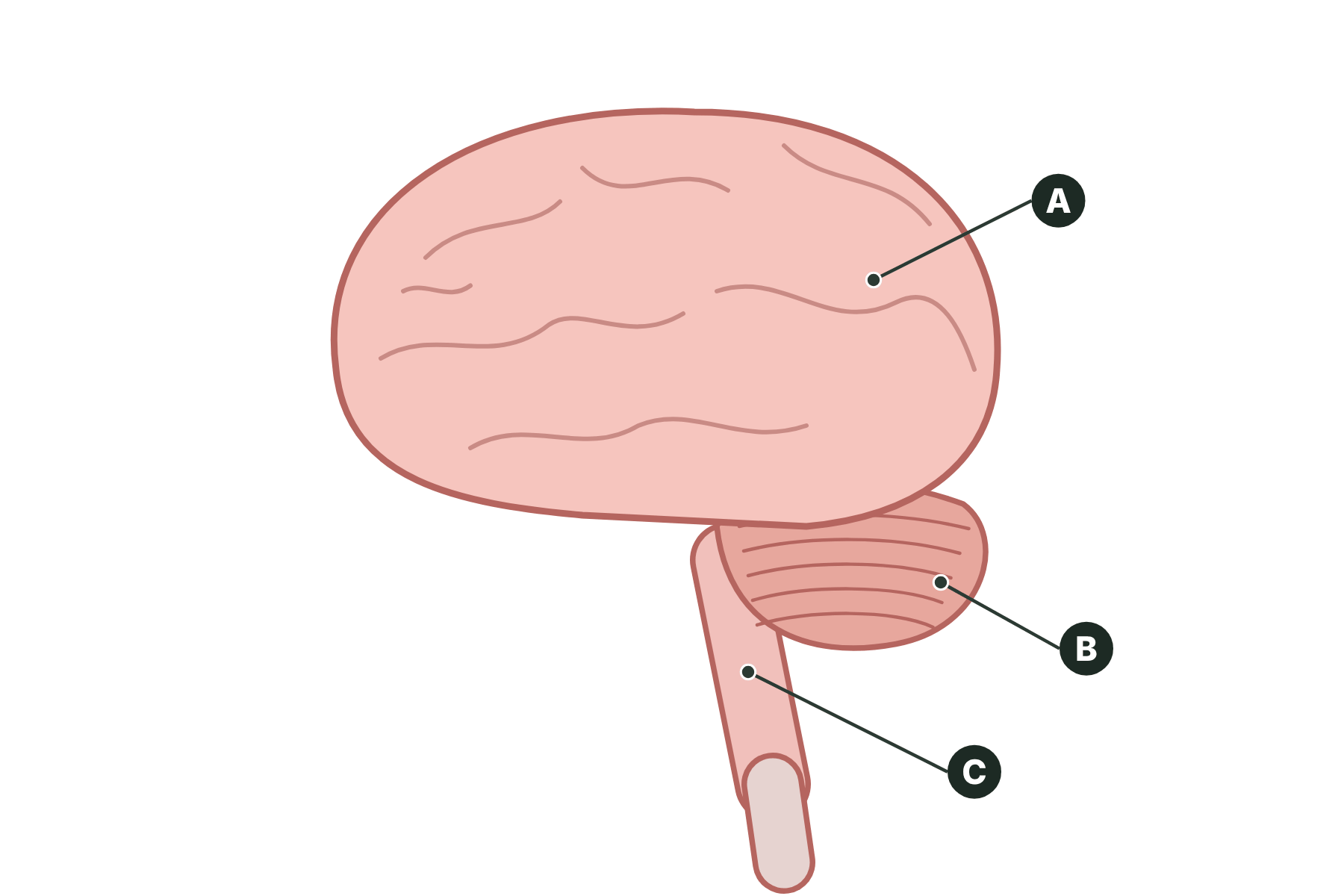
Figure 1 shows a section through the brain. Name the parts shown at A, B and C.
Show answerHide answer
Model answer
A is the cerebral cortex. B is the cerebellum. C is the medulla.
Mark scheme
- A: cerebral cortex — 1 mark
- B: cerebellum — 1 mark
- C: medulla — 1 mark
-
3 Describe [3 marks]
Describe the functions of the cerebral cortex, the cerebellum and the medulla.
Show answerHide answer
Model answer
The cerebral cortex controls consciousness, intelligence, memory and language. The cerebellum coordinates movement and balance. The medulla controls the heart rate and breathing.
Mark scheme
- Cerebral cortex: consciousness, intelligence, memory or language — 1 mark
- Cerebellum: coordination and balance — 1 mark
- Medulla: heart rate and breathing — 1 mark
-
4 Explain [3 marks]
A person has a stroke that damages their cerebellum. Suggest and explain one problem the person might have.
Show answerHide answer
Model answer
The person may have difficulty with coordination and balance. The cerebellum coordinates movement and keeps balance, so with damage their movements may be clumsy and they may fall over.
Mark scheme
- Problem with coordination or balance — 1 mark
- The cerebellum coordinates movement and balance — 1 mark
- Movements are clumsy / they may fall — 1 mark
-
5 Explain [3 marks]
Explain why it is difficult to investigate the functions of different parts of the brain.
Show answerHide answer
Model answer
The brain is very complex, with billions of connected neurones. It is protected inside the skull and hard to reach. There are also ethical issues in doing experiments on people or animals, so much of the evidence comes from case studies of damaged brains, where each injury is different.
Mark scheme
- The brain is complex — 1 mark
- It is hard to reach — 1 mark
- Ethical issues limit experiments — 1 mark
-
6 Explain [3 marks]
Explain why it is hard to treat a person who has damage to the brain or to the spinal cord.
Show answerHide answer
Model answer
Neurones in the brain and spinal cord have a very limited ability to repair themselves, so the damage is often irreversible. Some parts are difficult to access, and surgery can damage the surrounding tissue. A cut spinal cord stops impulses crossing the injury.
Mark scheme
- Limited ability to repair nervous tissue — 1 mark
- Damage may be irreversible / surrounding tissue damaged — 1 mark
- Difficult to access parts of the nervous system — 1 mark
-
7 Evaluate [4 marks]
A doctor studies a patient who has damage to one region of the brain and has lost the ability to speak. Evaluate how far this case study shows that this region controls speech.
Show answerHide answer
Model answer
It suggests that the region has a role in speech, because the function was lost when it was damaged. However, it is only one patient, and every injury is different. The damage may extend beyond the region, or other regions may be involved, so more evidence from other patients and from scans is needed.
Mark scheme
- It suggests a link between the region and speech — 1 mark
- Only one patient / every injury is different — 1 mark
- Damage may be wider or other regions involved — 1 mark
- More evidence needed, such as more patients or scans — 1 mark
-
8 Evaluate [3 marks]
A surgeon suggests removing a tumour that is pressing on part of a patient's brain. Evaluate the benefits and the risks of the operation.
Show answerHide answer
Model answer
The operation could save the patient's life and could restore functions that the tumour is affecting. However, the brain is delicate and hard to reach, and the operation could damage healthy tissue and cause a loss of other functions, such as movement or speech. The doctor and the patient have to weigh up the benefit against the risk.
Mark scheme
- Benefit: could save life or restore function — 1 mark
- Risk: damage to healthy tissue / loss of other functions — 1 mark
- A conclusion that weighs up benefit against risk — 1 mark
Quick check
-
1
Which part of the brain coordinates movement and balance?
Show answerHide answer
B: The cerebellum
The cerebellum coordinates movement and balance.
-
2
Which part of the brain controls breathing?
Show answerHide answer
C: The medulla
The medulla controls breathing and heart rate.
-
3
Which part of the brain is responsible for conscious thought and memory?
Show answerHide answer
B: The cerebral cortex
The cerebral cortex controls conscious thought, memory, language and voluntary movement.
-
4
Why is it hard to repair a damaged brain?
Show answerHide answer
A: Neurones repair poorly
Neurones in the brain and spinal cord have a very limited ability to repair themselves.
-
5
Which of these is a limitation of a case study of brain damage?
Show answerHide answer
D: Each injury is different
Every injury is different, and the damage is hard to measure exactly.