Biology · Plant Hormones
Auxins, Phototropism and Gravitropism
A plant has no nerves, but it still grows towards the light and sends its roots down into the soil. This lesson is for separate Biology only: Trilogy students do not need it. It covers how plant hormones coordinate and control growth, and how unequal distributions of auxin cause phototropism and gravitropism (also called geotropism).
Learning Objectives
- 1Describe how plants produce hormones to coordinate and control growth and their responses to light and gravity.
- 2Describe phototropism and gravitropism (geotropism).
- 3Explain how unequal distributions of auxin cause unequal growth rates in plant roots and shoots.
- 4Explain why these responses are important to the survival of a plant.
Retrieval practice
-
1
What is a hormone?
Show answerHide answer
A chemical messenger, made in one place and carried to a target, where it has an effect.
-
2
Why do plants need light?
Show answerHide answer
For photosynthesis.
-
3
What do roots take in from the soil?
Show answerHide answer
Water and mineral ions.
-
4
What is meant by a stimulus?
Show answerHide answer
A change in the environment that is detected by an organism.
Hormones in plants
Animals have a nervous system and glands, but plants have neither. They still have to respond to their environment, and they do so using hormones. Plant hormones are chemicals that are made in the plant and that coordinate and control growth and responses. A shoot grows towards light, which is phototropism, and a root grows down in response to gravity, which is gravitropism, or geotropism. Compared with animals, plants respond slowly, because hormones travel slowly and growth takes time. The response of a plant to a stimulus in one direction, by growing, is called a tropism.
What are auxins?
Auxins are the plant hormones that control the growth responses to light and gravity.
-
Where they are made
Auxins are made in the tips of shoots and roots, where cells are dividing and growing.
-
How they move
They spread through the plant, from the tip to the area just behind it, where the cells grow by getting longer.
-
Cell elongation
In a shoot, auxin makes cells grow longer, which is called elongation. A cell with more auxin elongates more than a cell with less.
-
Unequal distribution
If auxin is not spread evenly, one side of the shoot or root grows faster than the other. The stem or root then bends towards the side that is growing less quickly.
Phototropism
Phototropism is a growth response to light. Shoots show positive phototropism, because they grow towards the light.
-
Light from one side
The tip of the shoot detects light that comes from one side.
-
Auxin moves
The auxin in the tip moves to the shaded side, so there is more auxin on the shaded side than on the lit side.
-
Unequal growth
The cells on the shaded side elongate faster than the cells on the lit side.
-
The shoot bends
The shoot bends towards the light, because the shaded side is longer.
-
Why it matters
The leaves are held in the best position to absorb light for photosynthesis.
Auxin and phototropism
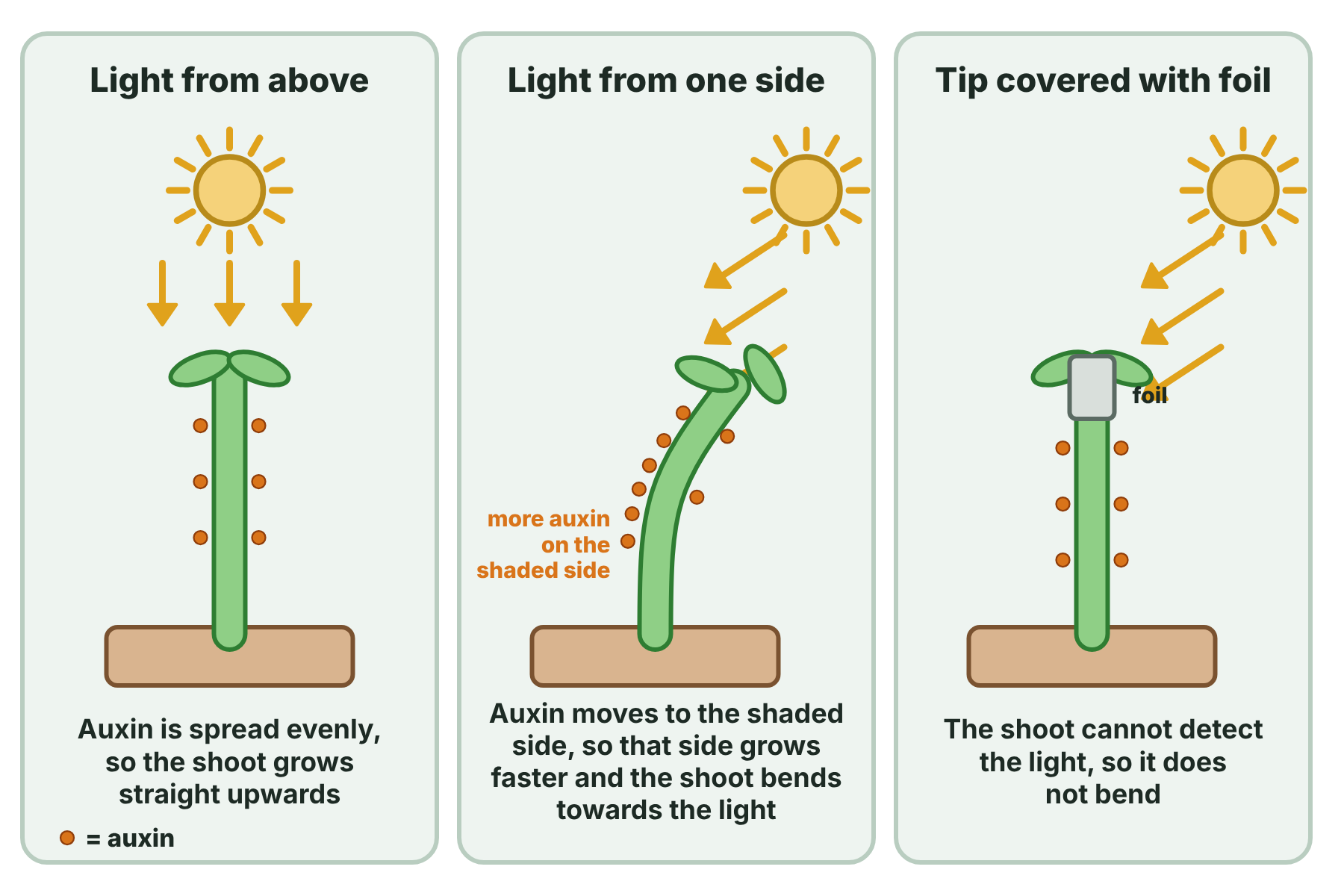
More auxin on the shaded side makes that side grow faster, so the shoot bends towards the light.
Gravitropism (geotropism)
Gravitropism is a growth response to gravity. It is different in shoots and in roots.
-
Auxin collects on the lower side
When a seedling lies on its side, gravity makes auxin collect on the lower side of the shoot and of the root.
-
In the shoot
The extra auxin makes the lower cells grow faster, so the shoot bends upwards. The shoot shows negative gravitropism, because it grows away from gravity.
-
In the root
The extra auxin slows down the growth of the lower cells in a root, so the upper side grows faster, and the root bends downwards. The root shows positive gravitropism, because it grows in the direction of gravity.
-
Why it matters
The root grows down to get water and mineral ions, and to anchor the plant, and the shoot grows up to reach the light.
Auxin and gravitropism
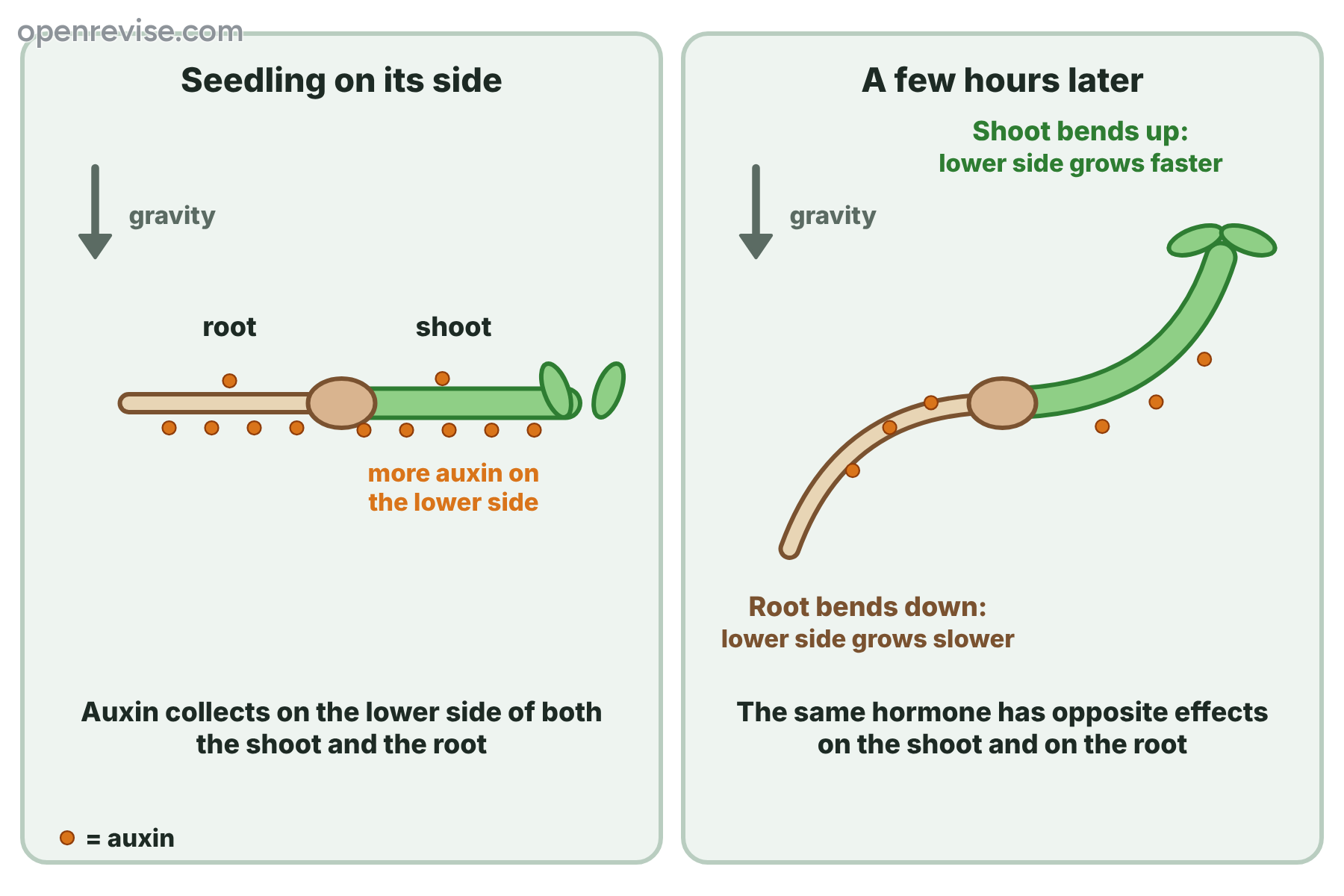
The same hormone, auxin, makes a shoot grow up and a root grow down.
Shoots and roots
A shoot
- Positive phototropism: grows towards light
- Negative gravitropism: grows away from gravity
- Auxin on one side speeds up growth on that side
- Holds the leaves in the light
A root
- Not usually affected by the direction of light
- Positive gravitropism: grows in the direction of gravity
- Auxin on one side slows growth on that side
- Anchors the plant and finds water
Plant responses and animal responses
Plant hormones and animal hormones are both chemical messengers, but the responses are different.
-
Speed
A plant responds in hours or days, because growth is slow. A reflex in an animal takes a fraction of a second.
-
What changes
A plant changes the direction of its growth. An animal changes its behaviour.
-
No glands
Plants do not have endocrine glands, so hormones are made in cells in the growing regions.
-
Permanent
A bend in a plant stem stays for good, because the cells have grown.
Measuring the unequal growth
A student measured the length of the cells on the two sides of a bent shoot. On the lit side, the mean cell length was 40 micrometres. On the shaded side, the mean cell length was 55 micrometres. Calculate the percentage by which the cells on the shaded side were longer, and explain the result.
Show the solutionHide the solution
- 1 Find the difference \(55 - 40 = 15\) micrometres.
- 2 Divide by the lit side \(15 \div 40 = 0.375\).
- 3 Convert \(0.375 \times 100 = 37.5\%\) longer.
- 4 Explain More auxin on the shaded side means more elongation there, so the longer side is on the outside of the bend.
AnswerThe shaded cells were 37.5% longer. This is because auxin moved to the shaded side, where it made the cells elongate more, so the shoot bent towards the light.
Case study
Darwin and the canary grass
In 1880 Charles Darwin and his son Francis studied how young canary grass shoots grow towards a window. They found that the shoots bent towards the light, but that they did not bend if the tip of the shoot was covered with a thin cap of foil, or if the tip was cut off. They guessed that the tip made something that was carried to the part below, and which affected its growth. Later scientists found that this was auxin. Darwin's experiments are a good example of how a scientist changes one factor, covering the tip, and uses a control to find out what is responsible.
Summary and exam focus
- Plants produce hormones, called auxins, to coordinate and control growth.
- Phototropism is a response to light, and gravitropism (geotropism) is a response to gravity.
- Unequal distribution of auxin causes unequal growth rates in roots and shoots.
- In a shoot, auxin makes cells elongate. In a root, it slows growth.
- These responses help the plant to get light, water and minerals.
Exam focus
Explain how unequal distribution of auxin causes the shoot of a seedling to grow towards the light, and the root to grow downwards. (6 marks) (6 marks)
For the shoot, say that auxin moves to the shaded side, where it makes the cells elongate faster, so the shoot bends towards the light. For the root, say that auxin collects on the lower side, where it slows growth, so the root bends down, and say that the same hormone has opposite effects.
Key terms
The words this lesson expects you to use. Each one is linked from the first place it appears above.
- Plant hormone
- A chemical that is made in a plant, and coordinates and controls its growth and responses.
- Auxin
- A plant hormone that controls the elongation of cells in shoots and roots.
- Phototropism
- A growth response to the direction of light.
- Gravitropism
- A growth response to gravity, which is also called geotropism.
- Elongation
- The growth of a cell by getting longer.
- Tropism
- A directional growth response of a plant to a stimulus.
- Stimulus
- A change in the environment that an organism detects.
- Positive tropism
- Growth towards the stimulus.
- Negative tropism
- Growth away from the stimulus.
You've finished the notes
Check your understanding
Test yourself while it is fresh. Start with the flashcards, then try the exam questions.
Something here looks wrong?
Tell us what and we will go and look. It goes to whoever writes these pages, nobody else, and we do not ask who you are — so there is nothing to sign and nothing comes back to you.