Biology · Plant Hormones
Investigating Plant Responses
You can see a plant respond to light or to gravity within days, with a tray of seedlings. This lesson is for separate Biology only: Trilogy students do not need it. It covers required practical 8, investigating the effect of light or gravity on the growth of newly germinated seedlings, and shows how to record the results both as length measurements and as labelled biological drawings.
Learning Objectives
- 1Describe a method to investigate the effect of light or gravity on the growth of newly germinated seedlings.
- 2Identify the independent, dependent and control variables, and explain the controls.
- 3Record the results as length measurements and as careful, labelled biological drawings.
- 4Evaluate the method, and suggest how to improve the accuracy, repeatability and validity of the results.
Retrieval practice
-
1
What is phototropism?
Show answerHide answer
A growth response of a plant to light.
-
2
What is the independent variable in an investigation?
Show answerHide answer
The variable that you change.
-
3
What does repeatable mean?
Show answerHide answer
The same person gets similar results when they repeat the investigation.
-
4
What does reproducible mean?
Show answerHide answer
Different people, or different methods, give similar results.
Required practical 8
The investigation tests a prediction, or hypothesis, which could be that the shoots of seedlings grow towards a light, and that the roots grow towards gravity. Newly germinated seedlings of cress, mustard or wheat are used because they grow quickly, and a response can be seen in a few days. The specification lists AT 1, 3, 4 and 7 as the apparatus and techniques skills that this practical covers, and it also gives opportunities to develop working scientifically and maths skills. The results must be recorded both as length measurements and as careful, labelled biological drawings, to show the effects.
A method for light
The independent variable is the direction of the light.
-
Sow
Sow the same number of cress or mustard seeds on damp paper or compost in each of three pots or trays, and let them germinate until the seedlings are about 1 cm tall.
-
Tray A
Put it in a box that has a hole cut in one side, with a lamp or a window at that side, so that light comes from one direction.
-
Tray B
Put it where light comes from above, or from all sides, so there is no difference between the sides.
-
Tray C
Put it in a light-proof box in the dark.
-
Measure
After 3 to 5 days, measure the length of each shoot in millimetres, with a ruler, and note which way it has grown. Measure the angle of any bend with a protractor.
-
Draw
Make a labelled biological drawing of a typical seedling in each tray.
A method for gravity
The independent variable is the direction of gravity relative to the seedling.
-
Sow
Place seeds on damp cotton wool or filter paper in a petri dish, or in a transparent container, and tape the lid on. Keep them in the dark so that light does not affect them.
-
Dish A
Stand it upright.
-
Dish B
Stand it on its side, or turn it through 90 degrees.
-
Dish C
Fix it to a clinostat, which turns the dish slowly, so that gravity acts evenly on all sides.
-
Measure and draw
After 2 to 4 days measure the length of each root and shoot, and the angle that they have turned, and make a labelled drawing of one seedling from each dish.
-
Result
In dish B the roots curve down and the shoots curve up. In dish C there is no consistent direction.
Set-ups for required practical 8
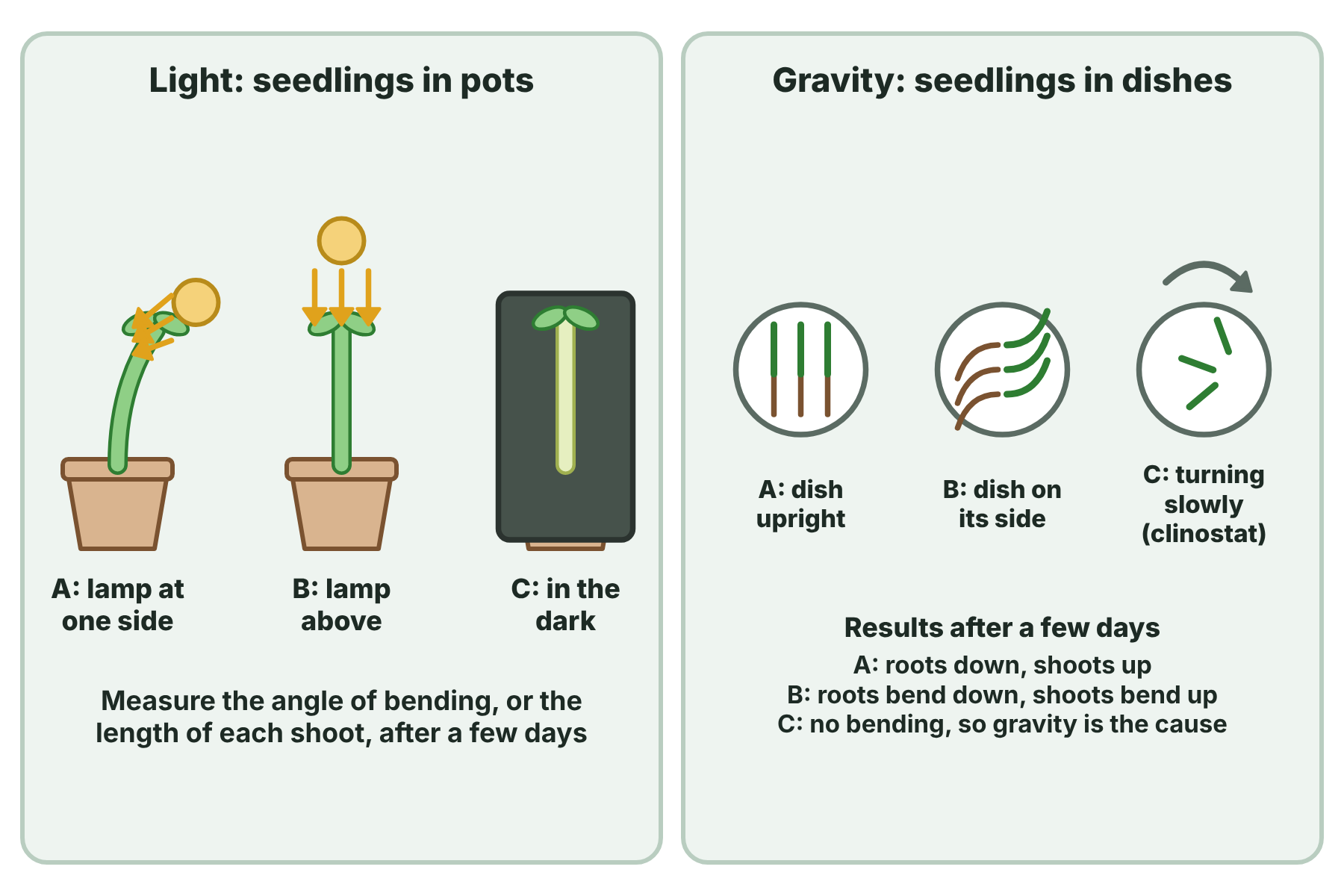
Changing the direction of the light or of gravity shows that these are the stimuli for the bending.
Variables and controls
A fair test changes only one variable, and keeps the others the same.
-
Independent variable
The direction of the light, or of gravity.
-
Dependent variable
The length of the shoots or roots, and the direction and the angle of growth.
-
Control variables
The type and the age of the seeds, the number of seedlings, the volume of water, the temperature, the size of the container, the distance from the lamp, and the time.
-
Controls
The tray with light from above, the tray in the dark and the clinostat show that the bending is a response to the stimulus.
-
Safety
Wash hands after handling the damp seeds and the soil, as mould and bacteria can grow in them. Keep the lamp and the electrical equipment away from water.
Recording results: measurements and drawings
The specification asks for both numbers and careful drawings.
-
Length measurements
Use a ruler with a resolution of 1 mm, and record the lengths in a table with units in the column headings. Repeat for each seedling, then calculate the mean length for each condition.
-
Drawings
Draw large, using a sharp pencil, with clear single lines and no shading. Label the shoot, the root and the direction of the light or of gravity, and show the scale or the magnification.
-
Photographs
A photograph taken at the same distance, with a ruler in view, is a useful record, and can be measured later.
-
Table
Use a table with columns for each condition, with several seedlings in each, and a column for the mean.
Evaluating the method
Several things affect how good the results are.
-
Accuracy
The results are accurate if they are close to the true value. A ruler with a resolution of 1 mm limits the accuracy of a measurement of a small seedling.
-
Repeatable and reproducible
The results are repeatable if the same person gets similar means when repeating the investigation, and reproducible if other people get similar results.
-
Valid
The investigation is valid if it measures what it is meant to. It is not valid if there are uncontrolled variables, such as light getting into the dark box, or the lamp warming the seedlings.
-
Sample size
The more seedlings that are used, the smaller the effect of an unusual one.
-
Improvements
Use a cool lamp, block off other light, use more seedlings, and use a protractor and photographs rather than judging a bend by eye.
Calculating mean shoot lengths
After 4 days the lengths of five shoots in the dark were 42, 45, 40, 44 and 44 mm. The lengths of five shoots in the light were 28, 30, 27, 31 and 29 mm. Calculate the mean length in each condition, and explain what the results show.
Show the solutionHide the solution
- 1 Dark \((42 + 45 + 40 + 44 + 44) \div 5 = 215 \div 5 = 43\) mm.
- 2 Light \((28 + 30 + 27 + 31 + 29) \div 5 = 145 \div 5 = 29\) mm.
- 3 Difference \(43 - 29 = 14\) mm longer in the dark.
- 4 Interpret Seedlings in the dark grow quickly to find the light, and they are long and pale, because they do not make chlorophyll.
AnswerThe mean in the dark was 43 mm and in the light was 29 mm. The shoots in the dark grew much longer, because the plant grows quickly towards light, but it has no light to stop it, so it grows long and thin.
Case study
Plants in space
On the International Space Station there is almost no gravity. Scientists have grown plants there, including lettuce and radishes, to find out how they respond. Without gravity the roots and shoots do not know which way is up, so they do not all grow in the right direction, and light can be used to guide them. A clinostat is a device that has a similar effect on Earth, by turning the seedlings slowly, so that gravity acts on every side equally. The research is useful for planning the growing of food on long space missions.
Summary and exam focus
- Required practical 8 investigates the effect of light or gravity on the growth of newly germinated seedlings.
- The independent variable is the direction of the light, or of gravity.
- Results are recorded as length measurements and as labelled biological drawings.
- Controls and many seedlings make the results valid, repeatable and reproducible.
- A clinostat shows that gravity is the cause of the bending.
Exam focus
Describe a method that you could use to investigate the effect of light from one direction on the growth of newly germinated seedlings. Include the variables you would control. (6 marks) (6 marks)
Describe the number of identical seedlings, the three conditions, light from one side, from above, and none, and what you would measure, such as the length and angle of bending. Name at least two control variables, and say that you would repeat it and find a mean.
Key terms
The words this lesson expects you to use. Each one is linked from the first place it appears above.
- Hypothesis
- A testable explanation or prediction that can be tested by an investigation.
- Clinostat
- A device that turns seedlings slowly, so that gravity acts on all sides equally.
- Resolution
- The smallest change in a quantity that an instrument can detect.
- Accurate
- A result is accurate if it is close to the true value.
- Repeatable
- The same person gets similar results when the investigation is repeated.
- Reproducible
- Other people, or other methods, give similar results.
- Valid
- A valid investigation measures what it is meant to measure.
- Control variable
- A variable that is kept the same.
- Biological drawing
- A large, accurate, labelled line drawing of a specimen.
You've finished the notes
Check your understanding
Test yourself while it is fresh. Start with the flashcards, then try the exam questions.
Something here looks wrong?
Tell us what and we will go and look. It goes to whoever writes these pages, nobody else, and we do not ask who you are — so there is nothing to sign and nothing comes back to you.