Biology · Plant Hormones
Use of Plant Hormones (Higher tier)
Farmers, gardeners and food companies use plant hormones to control how plants grow. This lesson is for separate Biology only, and for the Higher tier only: Trilogy and Foundation students do not need it. It covers the effects of some plant hormones, and the different ways in which people use them to control plant growth in agriculture, horticulture and the food industry.
Learning Objectives
- 1(Higher tier) Describe the effects of auxins, gibberellins and ethene.
- 2(Higher tier) Describe the uses of auxins as weed killers, as rooting powders and in tissue culture.
- 3(Higher tier) Describe the use of ethene in the food industry, and the uses of gibberellins.
- 4(Higher tier) Explain how the use of weed killers can affect biodiversity.
Retrieval practice
-
1
What does auxin do in a shoot?
Show answerHide answer
Makes the cells elongate.
-
2
What do gibberellins do to seeds?
Show answerHide answer
They are important in initiating germination.
-
3
What does ethene do to fruit?
Show answerHide answer
Controls ripening.
-
4
What is biodiversity?
Show answerHide answer
The variety of all the different species of organisms on Earth, or within an ecosystem.
Hormones at work
Plant growth hormones are used in agriculture and horticulture, which is the growing of crops, and the care of gardens. People use the natural hormones and also synthetic chemicals that act like them. The hormones are cheap, and they allow growers to control when plants grow, flower and fruit, and to kill weeds. The effects of some of these uses on the environment, for instance the use of hormones as weed killers, must be thought about, because they can affect the biodiversity of an area.
Uses of auxins
The specification lists three uses of auxins.
-
As weed killers
A synthetic auxin is sprayed on a lawn or a cereal field. Weeds with broad leaves absorb the auxin, and grow too quickly and die. The grass or the crop, which has narrow leaves, is not harmed. This makes the weed killer selective.
-
As rooting powders
The cut end of a cutting is dipped into a powder containing auxin, which makes it produce roots quickly. A grower can make many new plants that are clones of the parent plant.
-
For promoting growth in tissue culture
Small pieces of plant tissue are grown on a jelly in sterile conditions. Auxin is added to the jelly to make the cells divide and grow into new plants, which makes it possible to grow thousands of identical plants from a small piece of tissue.
Uses of ethene
Ethene is used in the food industry.
-
Controlling ripening
Ethene is used to control the ripening of fruit during storage and transport.
-
Picked unripe
Fruit such as bananas is picked while it is green and firm, because it is less easily damaged on the long journey.
-
Ripened on demand
At its destination the fruit is exposed to ethene, so that it all ripens at the same time and is ready for sale.
-
Delaying ripening
To make fruit last longer, it is kept in cold stores where the ethene is removed from the air.
Uses of gibberellins
The specification lists three uses of gibberellins.
-
To end seed dormancy
Dormant seeds treated with gibberellin germinate, so that all the seeds in a crop start growing at the same time.
-
To promote flowering
Gibberellins can bring on the flowering of a plant, so the grower can have plants that flower at the time that people buy them.
-
To increase fruit size
Spraying fruit with gibberellins can make the fruit bigger, which can be sold for more money.
Uses of plant hormones
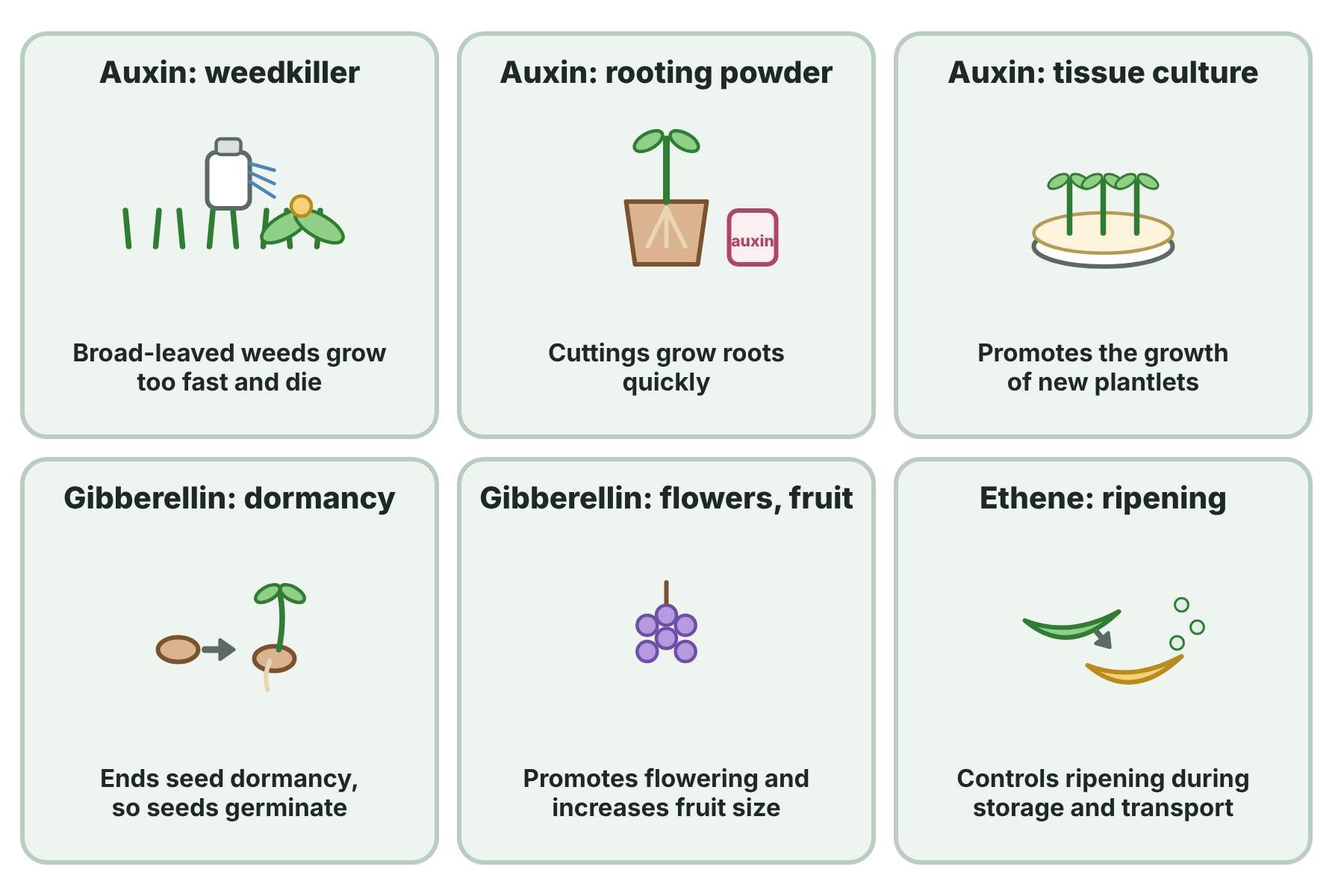
Auxins, gibberellins and ethene are used to control the growth, flowering and ripening of crops.
Weed killers and biodiversity
Using a hormone to kill weeds has effects far beyond one field.
-
Weeds are wild plants
Many of the plants that are killed support insects, such as butterflies and bees, and birds that feed on the insects or their seeds.
-
Fewer species
If all broad-leaved plants are killed, the number of different species falls, so there is less biodiversity.
-
Runoff
Rain can wash a weed killer into streams and ponds, where it may harm water plants and animals.
-
Benefits
A weed killer gives a larger yield of the crop, and so helps to produce more food, which is needed for the human population.
-
Balance
Farmers can keep field margins and hedgerows, and use spot treatment, to reduce the harm.
Advantages and disadvantages
Advantages of plant hormones
- Higher and more even yields of crops
- Fruit can be transported without damage, and ripened when needed
- Many identical plants can be grown quickly
- Planned flowering and germination
Disadvantages
- Weed killers can reduce biodiversity
- Chemicals may wash into streams
- Cost of chemicals and equipment
- Some people are concerned about food produced using chemicals
Evaluating the increase in fruit size
Gibberellin was sprayed on 50 grape bunches. The mean mass of a bunch was 420 g. The mean mass of a bunch in a control group, which was not sprayed, was 350 g. Calculate the percentage increase in mean mass caused by the gibberellin.
Show the solutionHide the solution
- 1 Find the increase \(420 - 350 = 70\) g.
- 2 Divide by the control \(70 \div 350 = 0.2\).
- 3 Convert \(0.2 \times 100 = 20\%\).
- 4 Evaluate The benefit has to be set against the cost of the gibberellin, and any effect on the taste.
AnswerThe mean mass increased by 20%. The gibberellin made the fruit bigger, which is an advantage for the grower, who can sell the grapes for more.
Case study
Cloning plants with tissue culture
Orchids are valuable plants that are very slow to grow from seed. Growers use tissue culture to make them more quickly. A tiny piece of the plant is cut off, and placed in a sterile jar on a jelly that contains nutrients. Auxin is added to the jelly, which makes the cells divide and grow into small plants. Each of these can be divided again, so that thousands of identical orchids can be made in a few months, all with the features of the parent plant that the grower wants, such as the colour of the flower. The cells are kept sterile to prevent the growth of bacteria and fungi.
Summary and exam focus
- Auxins are used as weed killers, as rooting powders and in tissue culture.
- Ethene is used to control the ripening of fruit during storage and transport.
- Gibberellins are used to end seed dormancy, promote flowering and increase fruit size.
- Weed killers can reduce biodiversity, and may wash into streams.
- Growers have to balance the benefits against the costs and the effects on the environment.
Exam focus
Describe the ways in which people use auxins, gibberellins and ethene to control plant growth, and explain the effect that a weed killer could have on biodiversity. (6 marks) (6 marks)
Give the uses in the specification: auxins as weed killers, rooting powders and in tissue culture, ethene to control ripening in storage and transport, and gibberellins to end seed dormancy, promote flowering and increase fruit size. For biodiversity say that killing weeds removes food and habitats of insects and birds.
Key terms
The words this lesson expects you to use. Each one is linked from the first place it appears above.
- Agriculture
- The growing of crops and the rearing of animals on a large scale.
- Horticulture
- The growing of fruit, vegetables, flowers and ornamental plants.
- Weed killer
- A chemical that kills weeds.
- Rooting powder
- A powder that contains auxin, which makes cuttings grow roots.
- Tissue culture
- The growing of new plants from small pieces of plant tissue, in sterile conditions.
- Clone
- A genetically identical copy.
- Biodiversity
- The variety of different species in an ecosystem.
- Selective
- Acting on some things but not on others.
- Dormancy
- A resting state, in which a seed does not germinate.
You've finished the notes
Check your understanding
Test yourself while it is fresh. Start with the flashcards, then try the exam questions.
Something here looks wrong?
Tell us what and we will go and look. It goes to whoever writes these pages, nobody else, and we do not ask who you are — so there is nothing to sign and nothing comes back to you.