Biology · Plant Hormones
Gibberellins and Ethene (Higher tier)
Auxin is not the only plant hormone. This lesson is for separate Biology only, and for the Higher tier only: Trilogy and Foundation students do not need it. It covers gibberellins, which are important in initiating seed germination, and ethene, which controls cell division and the ripening of fruits.
Learning Objectives
- 1(Higher tier) Describe the importance of gibberellins in initiating seed germination.
- 2(Higher tier) Describe how ethene controls cell division and the ripening of fruits.
- 3(Higher tier) Compare the roles of auxins, gibberellins and ethene in a plant.
- 4(Higher tier) Interpret data on the effects of plant hormones on germination and ripening.
Retrieval practice
-
1
What is a plant hormone?
Show answerHide answer
A chemical that is made in a plant to coordinate and control growth and responses.
-
2
What is germination?
Show answerHide answer
The start of the growth of a seed into a seedling.
-
3
What does auxin do in a shoot?
Show answerHide answer
Makes the cells elongate.
-
4
What is a seed?
Show answerHide answer
A structure that contains the embryo of a new plant and a store of food.
More plant hormones
Auxins are not the only plant hormones. Gibberellins and ethene are two others which have important effects, and which are used commercially. The specification says that you should know what they do, but it does not require you to know how they work, so the mechanisms of how gibberellins and ethene act are not required. Each of these hormones is made in the plant, and moves from where it is made to where it has its effect, and the effect depends on the type of cell and on the amount of the hormone.
Gibberellins and germination
Gibberellins are important in starting seed germination.
-
Dormancy
Many seeds are dormant, which means that they are in a resting state, and do not grow even if there is some water and warmth. Dormancy stops a seed from germinating at the wrong time of year.
-
Gibberellins start growth
When conditions are right, gibberellins are made in the seed, and they start the process of germination. The seed absorbs water, and the embryo begins to grow into a root and a shoot.
-
Other effects
Gibberellins also stimulate the growth of stems, and the formation of flowers.
-
Not required
The details of how the gibberellins work in the seed are not required.
Ethene and ripening
Ethene is a gas that is made by the cells of plants, and it controls ripening and cell division.
-
A gas
Ethene is made by many fruits as they ripen, and it moves through the air between the fruits.
-
Ripening
It makes the fruit ripen. The fruit becomes softer, sweeter and changes colour, so that animals eat it, and carry the seeds to a new place.
-
Spreads
A ripe fruit that is next to unripe fruit will make the unripe fruit ripen, which is why one bad apple can spoil the rest.
-
Cell division
Ethene also controls cell division, which is important in the growth of the plant and of the fruits.
-
Not required
The details of how ethene works are not required.
What gibberellins and ethene do
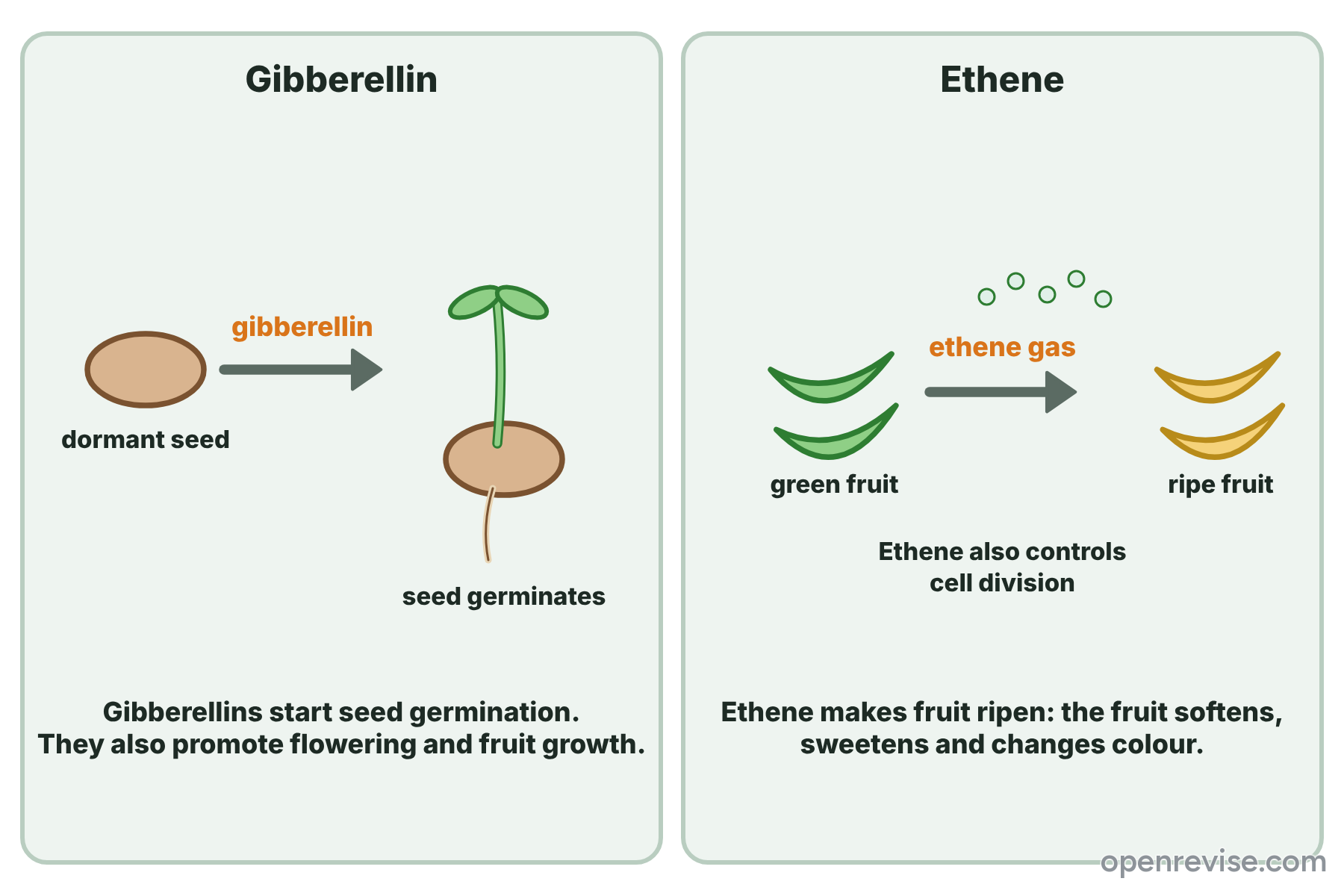
Gibberellins start germination, and ethene makes fruit ripen and controls cell division.
Comparing three plant hormones
Auxins and gibberellins
- Auxins: made in the tips, make shoot cells elongate
- Auxins: cause phototropism and gravitropism
- Gibberellins: important in starting seed germination
- Gibberellins: also stimulate stem growth and flowering
Ethene
- A gas, so it can move through the air
- Controls the ripening of fruits
- Controls cell division
- Made by ripe fruit, so it spreads between fruits
Interpreting data on hormones
Data from experiments help to show what a hormone does.
-
Germination data
If more seeds germinate with gibberellin than without it, and the seeds are otherwise treated the same, the gibberellin is probably responsible.
-
Ripening data
If fruit in a bag with ethene ripens in fewer days than fruit in air, ethene makes fruit ripen faster.
-
Controls
The experiment must have a control, in which the hormone is left out, and the same type, age and number of seeds or fruit.
-
Cause
Several repeats in the results, a clear difference and a controlled test give good evidence that the hormone is the cause.
Interpreting a germination experiment
In an experiment, 100 dormant seeds were soaked in water, and 100 were soaked in a solution of gibberellin. After 10 days, 12 of the first group and 78 of the second had germinated. Calculate the percentage of each group that germinated and describe what the data show.
Show the solutionHide the solution
- 1 Water \(12 \div 100 \times 100 = 12\%\).
- 2 Gibberellin \(78 \div 100 \times 100 = 78\%\).
- 3 Difference \(78 - 12 = 66\) percentage points more.
- 4 Conclude The seeds in water are the control, and show that few would have germinated without the gibberellin.
Answer12% of the seeds in water and 78% of the seeds in gibberellin germinated. The gibberellin made many more seeds germinate, which supports the idea that gibberellins are important in starting germination.
Case study
One bad apple
Anyone who has kept fruit in a bowl will know that one overripe fruit can quickly spoil the others. This is because the ripe fruit gives off ethene gas. Ethene makes the fruit near it ripen faster, and so they make more ethene themselves, which speeds up ripening even more. Fruit that is stored for a long time, for example apples in warehouses, is kept cold, and in air with very little ethene, so that it ripens slowly and lasts through the winter. The idea is also used by people who place an unripe avocado in a bag with a ripe banana to make it ripen faster.
Summary and exam focus
- Gibberellins are important in initiating seed germination.
- Ethene controls cell division and the ripening of fruits.
- Ethene is a gas, so it spreads between fruits.
- The mechanisms of how gibberellins and ethene work are not required.
- Experiments with controls show what a hormone does.
Exam focus
Describe the roles of gibberellins and ethene in plants, and explain why a ripe banana can cause unripe fruit to ripen. (4 marks) (4 marks)
Say that gibberellins are important in initiating seed germination, and that ethene controls cell division and the ripening of fruits. Then say that ethene is a gas made by ripening fruit, which spreads to nearby fruit and makes it ripen. You do not need to know how they work.
Key terms
The words this lesson expects you to use. Each one is linked from the first place it appears above.
- Gibberellin
- A plant hormone that is important in starting the germination of seeds.
- Ethene
- A plant hormone, which is a gas, that controls cell division and the ripening of fruits.
- Germination
- The start of growth of a seed into a seedling.
- Dormant
- In a resting state, and not growing.
- Ripening
- The changes that make fruit soft, sweet and coloured.
- Embryo
- The young plant inside a seed.
- Cell division
- A process in which one cell divides to make two.
- Mechanism
- The way in which something works.
- Control
- A test in which the factor being investigated is left out, for comparison.
You've finished the notes
Check your understanding
Test yourself while it is fresh. Start with the flashcards, then try the exam questions.
Something here looks wrong?
Tell us what and we will go and look. It goes to whoever writes these pages, nobody else, and we do not ask who you are — so there is nothing to sign and nothing comes back to you.