Biology · Reproduction and Meiosis
Sexual and Asexual Reproduction
Some organisms need a partner to reproduce, and others can reproduce alone. This lesson covers the difference between sexual and asexual reproduction, and between the two types of cell division, mitosis and meiosis, that are involved.
Learning Objectives
- 1Describe sexual reproduction as the joining (fusion) of male and female gametes, and name the gametes in animals and in flowering plants.
- 2Describe asexual reproduction as involving one parent, no gametes, and only mitosis.
- 3Explain that sexual reproduction mixes genetic information and gives variety in the offspring, and that asexual reproduction gives genetically identical clones.
- 4Explain that meiosis leads to non-identical cells being formed, while mitosis leads to identical cells being formed.
Retrieval practice
-
1
What is mitosis?
Show answerHide answer
A type of cell division in which a cell divides to form two genetically identical cells.
-
2
What is a chromosome?
Show answerHide answer
A structure in the nucleus that carries genes, and is made of DNA.
-
3
What is a gene?
Show answerHide answer
A small section of DNA on a chromosome that codes for a protein.
-
4
Why do cells divide by mitosis?
Show answerHide answer
For growth, and to replace damaged cells.
Two ways of reproducing
Reproduction makes new individuals of the same species. Sexual reproduction involves two parents, which each make special sex cells called gametes. Asexual reproduction involves just one parent. The way in which the cells divide is different in each case, and so are the offspring. In sexual reproduction, the offspring are different from each other and from the parents, but in asexual reproduction they are identical to the parent.
Sexual reproduction
Sexual reproduction involves the joining, or fusion, of a male gamete and a female gamete.
-
Gametes in animals
They are the sperm cells, which are the male gametes, and the egg cells, which are the female gametes.
-
Gametes in flowering plants
They are the pollen cells, which are the male gametes, and the egg cells, which are in the ovules.
-
Meiosis
The gametes are made by a type of cell division called meiosis, in the reproductive organs.
-
Fertilisation
When a male gamete fuses with a female gamete, the nucleus of each joins, and a new cell is formed, which has genetic information from both parents.
-
Mixing
There is a mixing of the genetic information, so the offspring are genetically different from each parent, and from each other. This leads to variety.
Asexual reproduction
Asexual reproduction involves only one parent, and no fusion of gametes.
-
One parent
The offspring have all of their genetic information from the one parent.
-
Only mitosis
The cells of the parent divide by mitosis, so the cells made are identical.
-
No mixing
There is no mixing of genetic information.
-
Clones
The offspring are genetically identical to each other and to the parent. They are called clones.
Asexual and sexual reproduction
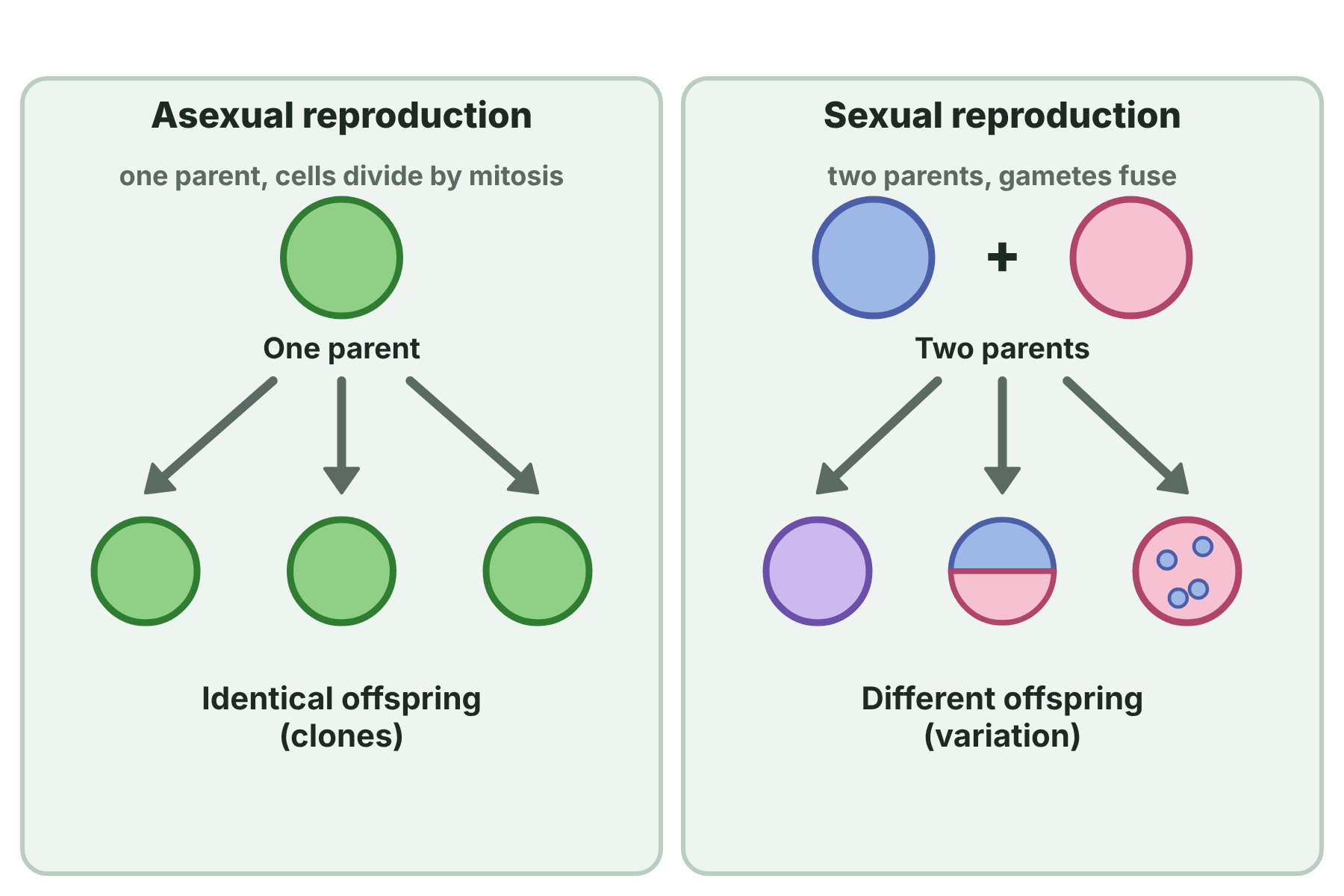
Asexual reproduction gives identical clones, and sexual reproduction gives variety.
Mitosis and meiosis compared
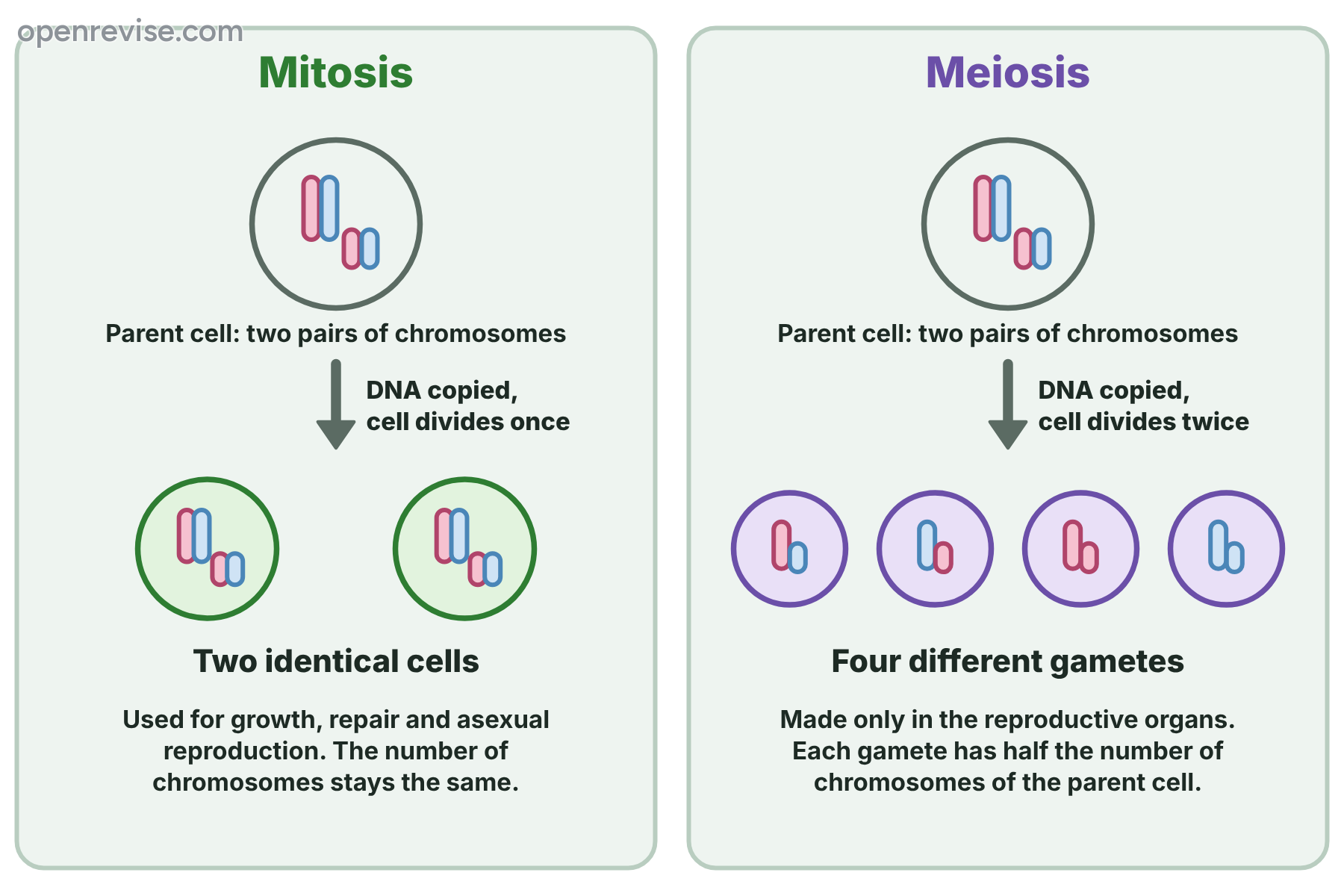
Mitosis makes identical cells, and meiosis makes non-identical gametes.
Sexual and asexual reproduction
Sexual reproduction
- Two parents
- Gametes, made by meiosis, fuse
- Genetic information is mixed
- Offspring show variety
Asexual reproduction
- One parent
- No gametes, and only mitosis
- No mixing of genetic information
- Offspring are identical clones
Mitosis and meiosis
Mitosis
- Forms genetically identical cells
- One division, making two cells
- Used for growth and repair, and in asexual reproduction
- Full number of chromosomes in each cell
Meiosis
- Forms non-identical cells
- Two divisions, making four cells
- Used to make gametes, in the reproductive organs
- Half the number of chromosomes in each cell
Deciding the type of reproduction
A gardener cuts a branch from a shrub, plants it, and it grows into a new shrub. A second plant is grown from a seed that was made when pollen fertilised an egg cell. Name the type of reproduction in each case, and compare the offspring with the parent.
Show the solutionHide the solution
- 1 The cutting One parent, no gametes, and cells divide by mitosis, so it is asexual.
- 2 The seed Pollen and egg cells, which are male and female gametes, fuse, so it is sexual.
- 3 Genetic information The cutting has the same genes as the parent. The seedling has genes from both parents.
- 4 Variation Only the sexual method gives variety in the offspring.
AnswerThe cutting is asexual reproduction, so the new plant is a genetically identical clone of the parent. The seed is sexual reproduction, so the new plant has a mixture of genetic information from two parents, and is different from each of them.
Case study
The banana that could vanish
The bananas that are sold in most shops are all one variety, called Cavendish. The plants are grown by asexual reproduction, from suckers that grow from the parent plant, so they are all clones, with exactly the same genes. This is useful for growers, because every plant gives the same fruit. But because there is no variation, a disease that can kill one plant can kill them all, and a fungal disease called Panama disease is already spreading in banana plantations. The earlier variety, called Gros Michel, was almost wiped out by an earlier form of the same disease in the 1950s. It shows the risk of growing a crop of clones.
Summary and exam focus
- Sexual reproduction involves the fusion of male and female gametes.
- In animals the gametes are sperm and egg cells, and in flowering plants they are pollen and egg cells.
- Asexual reproduction involves one parent, and mitosis only.
- Sexual reproduction gives variety, and asexual reproduction gives clones.
- Meiosis forms non-identical cells, and mitosis forms identical cells.
Exam focus
Compare sexual reproduction and asexual reproduction. (4 marks) (4 marks)
Compare like with like: number of parents, how the cells divide, whether genetic information is mixed, and whether the offspring are identical or varied.
Key terms
The words this lesson expects you to use. Each one is linked from the first place it appears above.
- Sexual reproduction
- Reproduction that involves the fusion of male and female gametes.
- Asexual reproduction
- Reproduction that involves one parent, and no fusion of gametes.
- Gamete
- A sex cell, such as a sperm cell or an egg cell.
- Fertilisation
- The fusion of the nuclei of a male gamete and a female gamete.
- Mitosis
- Cell division that forms two genetically identical cells.
- Meiosis
- Cell division that forms gametes, which are genetically different.
- Clone
- An organism that is genetically identical to its parent.
- Variation
- Differences between individuals in a population.
- Pollen
- The male gametes of flowering plants.
You've finished the notes
Check your understanding
Test yourself while it is fresh. Start with the flashcards, then try the exam questions.
Something here looks wrong?
Tell us what and we will go and look. It goes to whoever writes these pages, nobody else, and we do not ask who you are — so there is nothing to sign and nothing comes back to you.