Biology · Culturing Microorganisms and Developing Medicines
Aseptic Technique and Culturing Microorganisms
To study bacteria safely, or to grow them for medicine and food, scientists must keep unwanted microorganisms out and keep the wanted ones in. This lesson is for separate Biology only: Combined Science students do not need it. It explains how microorganisms are cultured in the laboratory using aseptic technique.
Learning Objectives
- 1Explain why microorganisms are cultured in the laboratory, and what a culture medium contains.
- 2Explain how an autoclave is used to make sterile growth medium and petri dishes.
- 3Describe how a sterile inoculating loop is used to transfer microorganisms.
- 4Explain why petri dishes and culture vials are kept covered, and why cultures in school are incubated at a lower temperature.
Retrieval practice
-
1
How do bacteria reproduce?
Show answerHide answer
By binary fission, where one cell divides into two.
-
2
What is a pathogen?
Show answerHide answer
A microorganism that causes disease.
-
3
What is the name of a group of identical cells grown from one cell?
Show answerHide answer
A colony, or a clone.
-
4
Why do enzymes stop working at high temperatures?
Show answerHide answer
The shape of the active site changes, so they are denatured.
Why grow microorganisms?
A single bacterium is far too small to see or study. Given food, warmth and moisture, though, it can divide to make millions of copies in a day, and the group of cells becomes big enough to see and test. Scientists culture microorganisms to identify the bacteria that cause an infection, to find out which antibiotics will kill them, to test new medicines, and to make useful products such as insulin and yoghurt. Culturing in a school or hospital laboratory is only safe if the right microorganisms grow, and no others, and that is why it needs aseptic technique. Aseptic means free from contamination by unwanted microorganisms.
The culture medium
Microorganisms need a supply of food, and the culture medium provides it.
-
Nutrient broth
A liquid with all the nutrients that microorganisms need, including carbohydrates as an energy source, proteins or amino acids, minerals and vitamins.
-
Agar jelly
The same nutrients are mixed with agar, a jelly made from seaweed, which sets to a firm surface. Most microorganisms cannot digest agar, so it does not get used up.
-
Petri dishes
Agar is usually poured into a shallow, round, lidded dish called a petri dish, so that the colonies grow on the surface and can be seen and counted.
-
Temperature and oxygen
Microorganisms grow best when kept warm, and with a supply of oxygen for those that respire aerobically.
Making the equipment sterile
All of the equipment and the medium must have no living microorganisms on it at the start, which means they must be sterile.
-
The autoclave
An autoclave is like a large pressure cooker. It uses steam under pressure to heat the contents to about 121 °C for 15 to 20 minutes, which kills all microorganisms, including bacterial spores that survive boiling.
-
Growth medium
The agar and broth are sterilised in the autoclave before use, and are poured into petri dishes while still molten, close to a Bunsen flame, so that air currents carry microorganisms away.
-
Petri dishes
Glass dishes are sterilised in the autoclave. Plastic dishes are supplied pre-sterilised, in sealed packs, and are not heated because they would melt.
-
Surfaces and hands
The bench is wiped with disinfectant, and hands are washed before and after work.
Aseptic technique step by step
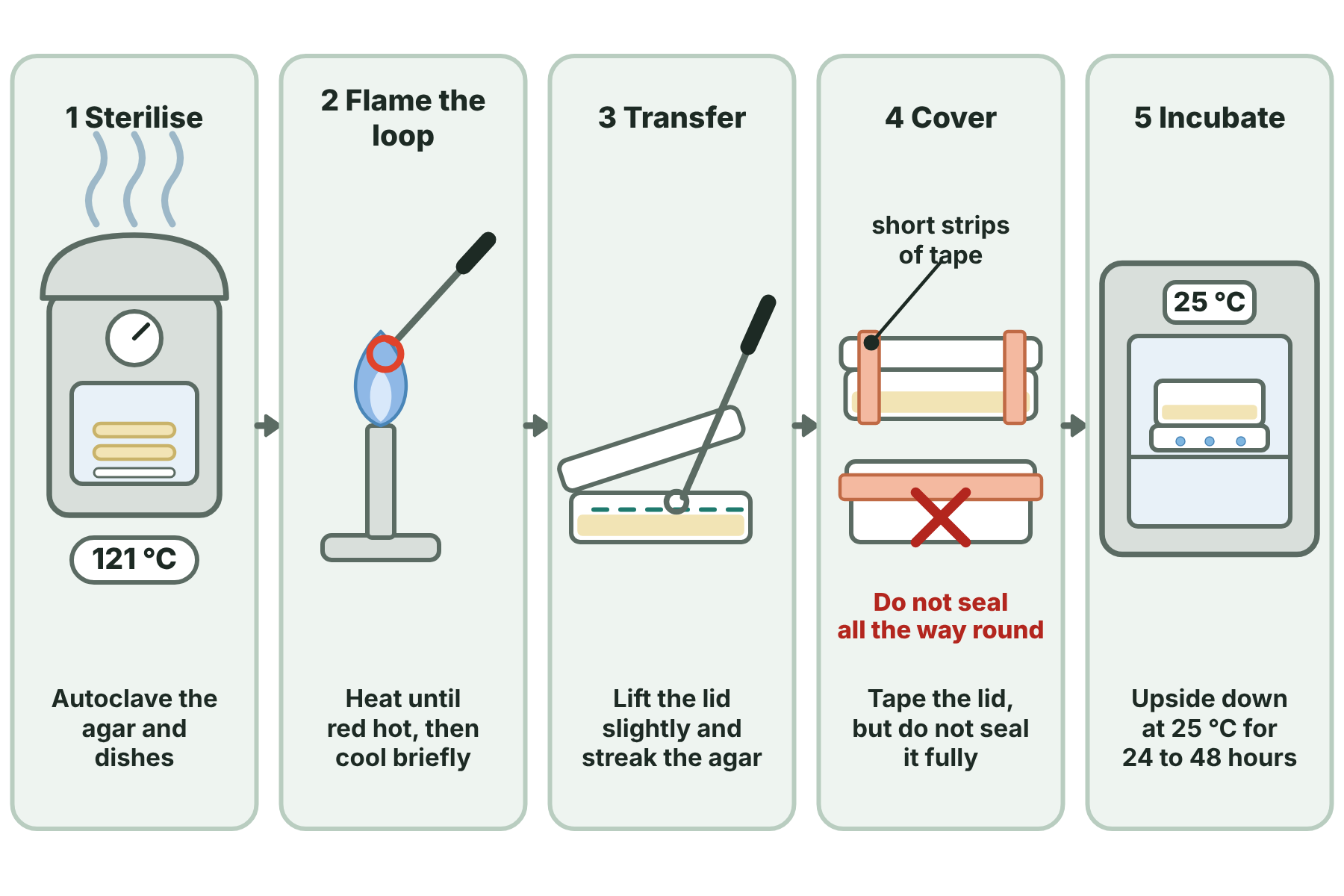
Each step keeps unwanted microorganisms out of the culture, and wanted ones in.
Transferring microorganisms with an inoculating loop
An inoculating loop is a wire with a small loop at the end, used to pick up a few cells and spread them on the agar.
-
Sterilise the loop
The loop is held in a Bunsen flame until it is red hot, to kill any microorganisms on it.
-
Let it cool
It is held in the air near the flame for a few seconds, because a hot loop would kill the microorganisms it is meant to transfer. It must not touch anything while it cools.
-
Take the sample
The neck of the culture bottle is passed through the flame, which makes air flow out and carries away stray microorganisms. The loop is dipped in the culture.
-
Inoculate the plate
The lid of the petri dish is lifted only as much as needed, and the loop is drawn gently across the agar, without cutting into it. The lid is replaced straight away.
-
Sterilise again
The loop is flamed again after use, so that no living cells are left on it.
Covering and incubating the dishes
Once the plate is inoculated, it has to be protected and given the right conditions to grow.
-
Tape the lid
The lid is fixed on with two or four short strips of adhesive tape. It is not sealed all the way round, so that oxygen can still get in. Without oxygen, dangerous anaerobic bacteria might grow.
-
Label and invert
The base is labelled, and the dish is stored upside down, so that drops of condensation fall onto the lid and not onto the agar.
-
Incubate at a low temperature
In schools, the dishes are kept at no more than 25 °C. This is warm enough for growth but too cool for most human pathogens, which grow best at body temperature, 37 °C.
-
Industry
In hospitals and industry, cultures are incubated at 37 °C or higher for faster growth, but under strict safety rules.
-
Disposal
After use the dishes are autoclaved before they are thrown away, without the lid being opened.
Why each precaution is taken
Keeping unwanted microorganisms out
- Sterilising medium and dishes in an autoclave
- Flaming the loop and the neck of the bottle
- Keeping lids on, and opening them as little as possible
- Working near a Bunsen flame
Keeping the culture safe
- Taping the lid, but not sealing it completely
- Incubating at 25 °C or below in schools
- Never opening a dish with a culture inside
- Autoclaving dishes before disposal
How fast do bacteria multiply?
A bacterium divides by binary fission every 20 minutes. Calculate the number of bacteria after 2 hours, starting with one cell, and explain why contamination can ruin an experiment.
Show the solutionHide the solution
- 1 Find the number of divisions 2 hours is 120 minutes, and \(120 \div 20 = 6\) divisions.
- 2 Double each time \(2^6 = 64\) bacteria.
- 3 Explain the risk One stray cell of another species grows at the same rate, so the culture would soon contain a mixture, and the results would be wrong.
AnswerThere are 64 bacteria after 2 hours. A contaminant can double as quickly, so it would spread over the plate and could outgrow or mix with the bacteria being studied.
Case study
How Alexander Fleming found penicillin
In 1928 Alexander Fleming returned from holiday to find that a petri dish of Staphylococcus bacteria in his laboratory had been contaminated by a mould. Around the mould there was a clear zone in which the bacteria had not grown. He worked out that the mould, Penicillium, was making a substance that killed bacteria. A contaminant had ruined his culture, but it also led to the first antibiotic. Today, better aseptic technique means that contamination is far less likely, and a contaminated dish is usually thrown away.
Summary and exam focus
- Microorganisms are cultured on nutrient broth or agar jelly.
- An autoclave uses steam at about 121 °C to sterilise the medium and equipment.
- Inoculating loops are flamed to red hot, and cooled, before and after use.
- Lids are kept on, and taped, but not sealed completely.
- Schools incubate at 25 °C or below, to avoid growing human pathogens.
Exam focus
Describe how you would use aseptic technique to transfer bacteria from a broth culture onto an agar plate, and explain why the lid of the dish is taped on but not sealed completely. (6 marks) (6 marks)
Put the steps in order: sterile agar and dish, flame the loop until red hot and cool it, flame the bottle neck, lift the lid only a little, streak, replace the lid, tape and invert. Explain the tape by saying that oxygen must get in, to stop anaerobic pathogens growing, while the lid stays on to stop microorganisms getting in or out.
Key terms
The words this lesson expects you to use. Each one is linked from the first place it appears above.
- Culture
- A population of microorganisms grown on purpose in a laboratory.
- Aseptic technique
- Methods that prevent contamination by unwanted microorganisms.
- Sterile
- Free from all living microorganisms.
- Autoclave
- An appliance that uses steam under pressure, at about 121 °C, to sterilise equipment.
- Agar
- A jelly made from seaweed, used to make a solid growth medium.
- Inoculate
- To put microorganisms onto or into a culture medium.
- Inoculating loop
- A wire loop used to transfer microorganisms.
- Contamination
- The presence of unwanted microorganisms.
- Incubate
- To keep a culture at a controlled temperature so that it grows.
You've finished the notes
Check your understanding
Test yourself while it is fresh. Start with the flashcards, then try the exam questions.
Something here looks wrong?
Tell us what and we will go and look. It goes to whoever writes these pages, nobody else, and we do not ask who you are — so there is nothing to sign and nothing comes back to you.