Biology · Culturing Microorganisms and Developing Medicines
Investigating Antiseptics, Antibiotics and Plant Extracts
How can you tell whether a chemical stops bacteria growing? This lesson is for separate Biology only: Combined Science students do not need it. It covers the core practical on antiseptics, antibiotics and plant extracts, and shows how to calculate the cross-sectional area of a clear zone using \(\pi r^2\).
Learning Objectives
- 1Describe the method for investigating the effect of antiseptics, antibiotics and plant extracts on bacterial growth.
- 2Explain the use of controls and the precautions that keep the investigation safe.
- 3Calculate the cross-sectional area of a clear zone, or of a bacterial culture, using \(\pi r^2\).
- 4Analyse results to compare how effective different substances are, and evaluate the method.
Retrieval practice
-
1
What is an antibiotic?
Show answerHide answer
A drug that kills bacteria, or stops them reproducing, inside the body.
-
2
What does aseptic mean?
Show answerHide answer
Free from contamination by unwanted microorganisms.
-
3
What is a control in an experiment?
Show answerHide answer
A comparison, where the factor being tested is left out.
-
4
What is the formula for the area of a circle?
Show answerHide answer
\(\pi r^2\), where r is the radius.
Testing what stops bacteria
Many substances can kill bacteria or stop them growing. Antiseptics, such as the chemicals in mouthwash and wipes, are used on skin and surfaces. Antibiotics, such as penicillin, are medicines that are taken to treat infections. Plants make chemicals that protect them from microorganisms, and some may have a use as medicines. In this core practical you test several of these on a culture of bacteria, to find out which of them is the best at stopping the growth of bacteria. The effect is measured by the size of the clear area, called a zone of inhibition, that forms around a disc soaked in the substance.
The method
The investigation uses aseptic technique throughout, and is carried out on agar plates that have been poured in advance.
-
Prepare the lawn
Use a sterile pipette to put a small volume of a bacterial broth culture on a sterile agar plate, and spread it evenly over the whole surface with a sterile spreader. The bacteria form a continuous layer, called a lawn.
-
Add the discs
With sterile forceps, place small discs of filter paper soaked in each test substance on the agar, spaced well apart. One disc is soaked in sterile water, or the solvent that is used, as a control.
-
Seal the dish
Tape the lid on with short strips of tape, label the base with the substances, and invert it.
-
Incubate
Incubate for 24 to 48 hours at 25 °C.
-
Measure
Measure the diameter of each clear zone with a ruler, through the base of the dish, without opening it.
Zones of inhibition on an agar plate
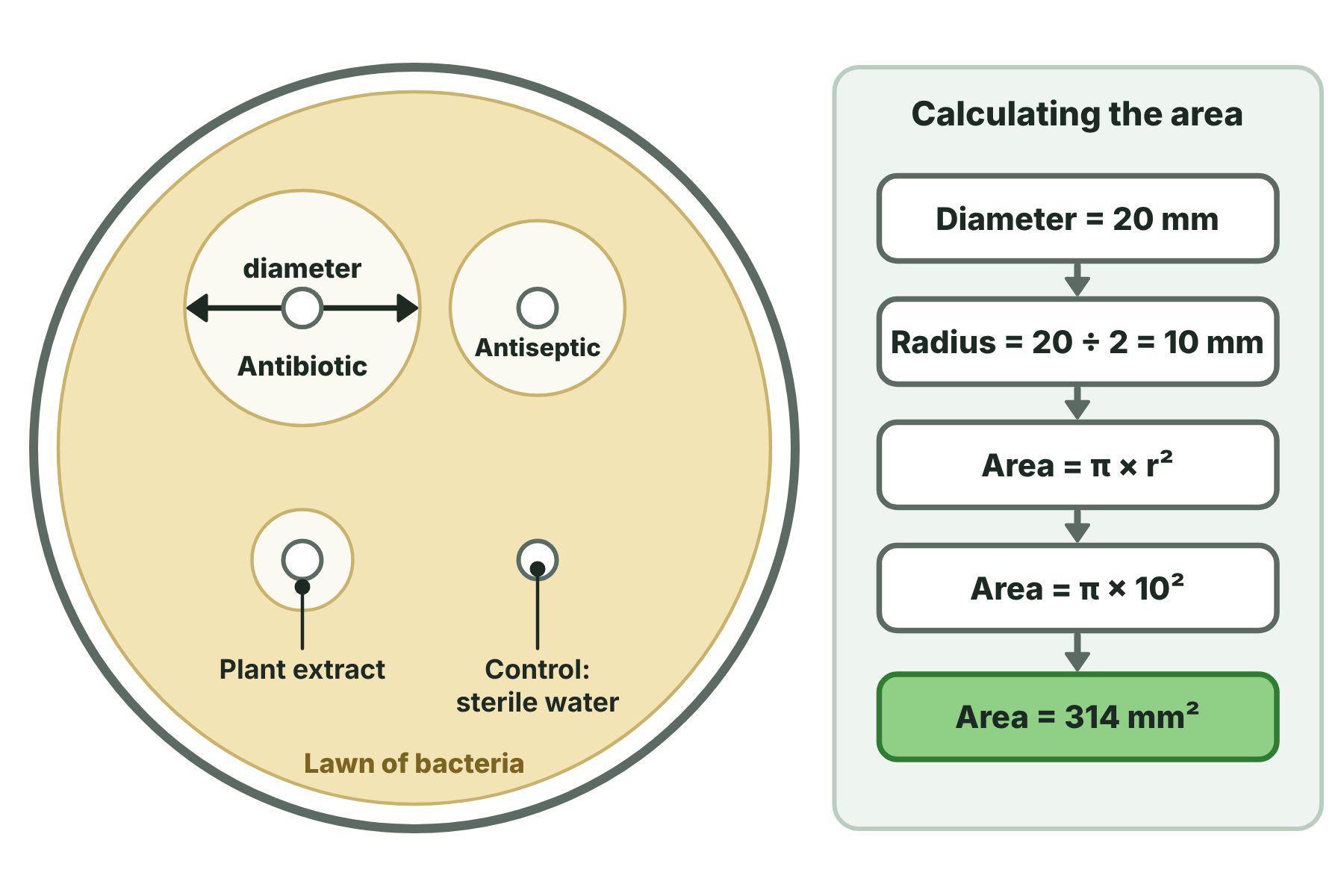
A bigger clear zone means that more bacteria were killed or stopped from growing.
Variables and controls
To make the test fair, only one thing should change, and everything else must be kept the same.
-
Independent variable
The substance on the disc, or its concentration.
-
Dependent variable
The size of the clear zone, measured as a diameter, and converted to an area.
-
Control variables
The type of bacteria, the volume and age of the culture, the type of agar and its depth, the size of the discs, the volume and concentration of each substance, the incubation temperature and the time.
-
Negative control
A disc of sterile water, or of the solvent used to dissolve the plant extract. It should have no zone, which shows that any zone seen is due to the test substance.
-
Repeats
The test is repeated, usually at least three times, so that a mean can be calculated and anomalies spotted.
Staying safe
Bacteria can be harmful, so the work is risk assessed.
-
Use safe bacteria
Schools use harmless strains of bacteria, and not known human pathogens.
-
Keep dishes closed
The lids stay on and taped, and the dishes are not opened after incubation.
-
Flames
Alcohol is flammable, so any ethanol used in the extracts must be kept away from the Bunsen flame.
-
Hygiene
Wash hands, wipe benches with disinfectant, and report any spills.
-
Disposal
Dishes are autoclaved before being thrown away.
Measuring and calculating the area
A clear zone is round, so its area is that of a circle, and it is a better measure of the effect than a diameter, because the area shows how much of the culture was affected.
-
Measure the diameter
Read the widest distance across the clear zone to the nearest millimetre. If it is an odd shape, take two diameters at right angles, and find the mean.
-
Find the radius
The radius is half of the diameter.
-
Use the formula
Cross-sectional area \(= \pi r^2\), using \(\pi = 3.14\) or the button on a calculator. The unit is mm squared.
-
Colonies and cultures
The same formula gives the area of a round colony of bacteria, or the area of the agar that has been cleared of them.
Calculating the area of a clear zone
A clear zone around an antibiotic disc has a diameter of 16 mm. Calculate its cross-sectional area, to 3 significant figures.
Show the solutionHide the solution
- 1 Radius \(16 \div 2 = 8\) mm.
- 2 Substitute Area \(= \pi \times 8^2 = \pi \times 64\).
- 3 Calculate \(\pi \times 64 = 201.06\), which is 201 mm squared to 3 significant figures.
AnswerThe area is 201 mm squared (3 s.f.).
Comparing two antibiotics
Antibiotic A produced a clear zone of diameter 24 mm and antibiotic B produced a zone of diameter 12 mm. Calculate the area of each zone, and say how many times larger the area of A is than that of B.
Show the solutionHide the solution
- 1 Zone A Radius 12 mm, so area \(= \pi \times 12^2 = \pi \times 144 = 452\) mm squared.
- 2 Zone B Radius 6 mm, so area \(= \pi \times 6^2 = \pi \times 36 = 113\) mm squared.
- 3 Compare \(452 \div 113 = 4\). Doubling the diameter makes the area four times as large.
AnswerA has an area of 452 mm squared and B has an area of 113 mm squared, so the zone around A has 4 times the area of that around B.
Using repeats to find a mean
Three repeats of a garlic extract gave clear zones of diameter 14 mm, 16 mm and 15 mm. Calculate the mean area.
Show the solutionHide the solution
- 1 Mean diameter \((14 + 16 + 15) \div 3 = 15\) mm.
- 2 Radius \(15 \div 2 = 7.5\) mm.
- 3 Area \(\pi \times 7.5^2 = \pi \times 56.25 = 177\) mm squared.
AnswerThe mean diameter is 15 mm, so the mean area is 177 mm squared.
Antiseptics and antibiotics
Antiseptics
- Used on the skin and surfaces
- Kill many types of microorganism
- Can damage human cells, so are not taken as medicines
- Examples include hand gel and the chemicals in mouthwash
Antibiotics
- Taken or injected into the body
- Kill or stop the growth of bacteria only
- Do not harm the human cells
- Examples include penicillin and tetracycline
Case study
Looking for medicines in plants
Many medicines began as plant extracts, and scientists still test thousands of plants for chemicals that could kill bacteria. A test like this one is the first stage. If an extract makes a clear zone, it contains an active chemical. The next steps are to find out which chemical it is, and then to test it on cells, animals and eventually people, as described in the lesson on developing new medicines. Many extracts that work in a petri dish turn out to be too weak, or to harm human cells, and never become medicines.
Summary and exam focus
- A lawn of bacteria is grown on agar, and discs soaked in test substances are added.
- A clear zone shows that the substance stopped the bacteria growing.
- A control disc of sterile water shows that the zone is due to the substance.
- Area of a clear zone \(= \pi r^2\), where the radius is half of the diameter.
- Repeats allow a mean to be found, and anomalies to be identified.
Exam focus
Describe how you would investigate the effect of three plant extracts on the growth of bacteria, and explain how you would make your investigation valid. (6 marks) (6 marks)
Describe the lawn, the discs and the incubation. Then name the variable that changes, the variables kept the same, and the control disc. State that you would measure the diameter, calculate the area using \(\pi r^2\), and repeat the test to find a mean.
Key terms
The words this lesson expects you to use. Each one is linked from the first place it appears above.
- Antiseptic
- A chemical that kills or stops the growth of microorganisms, used on skin or surfaces.
- Zone of inhibition
- A clear area around a disc, where bacteria have been killed or have not grown.
- Lawn
- A continuous layer of bacteria spread over the whole surface of agar.
- Control
- A comparison in which the factor being tested is left out.
- Variable
- A factor that can change in an investigation.
- Diameter
- The distance across a circle, passing through the centre.
- Radius
- The distance from the centre of a circle to its edge, which is half of the diameter.
- Cross-sectional area
- The area of a flat slice, such as the area of a clear zone, found by \(\pi r^2\).
- Anomaly
- A result that does not fit the pattern of the other results.
You've finished the notes
Check your understanding
Test yourself while it is fresh. Start with the flashcards, then try the exam questions.
Something here looks wrong?
Tell us what and we will go and look. It goes to whoever writes these pages, nobody else, and we do not ask who you are — so there is nothing to sign and nothing comes back to you.