Biology · Culturing Microorganisms and Developing Medicines
Developing New Medicines
A medicine can take over ten years and hundreds of millions of pounds to develop. This lesson follows a new medicine, including a new antibiotic, from its discovery through development, preclinical testing and clinical trials.
Learning Objectives
- 1Describe the main stages in developing a new medicine: discovery, development, preclinical testing and clinical testing.
- 2Explain why each stage is needed, and what is tested at each one.
- 3Explain the use of placebos and double-blind trials.
- 4Evaluate the ethical issues in testing medicines, and explain why new antibiotics are needed.
Retrieval practice
-
1
What is a medicine?
Show answerHide answer
A drug used to treat or prevent a disease, or to relieve its symptoms.
-
2
Name a medicine that comes from a plant.
Show answerHide answer
Aspirin, from willow bark, or digitalis from foxglove.
-
3
What was the first antibiotic?
Show answerHide answer
Penicillin.
-
4
What does the word resistant mean?
Show answerHide answer
Not affected by a drug.
From idea to medicine
Before a new medicine can be prescribed it must be shown to be safe, which means it does not cause unacceptable harm, effective, which means that it does what is claimed, and stable, so that it can be stored. This takes a great deal of testing in a fixed order of stages: discovery, development, preclinical testing and clinical testing. The process is slow and costly, taking 10 to 15 years, and costing hundreds of millions of pounds. This is why so many ideas are dropped along the way, and only a tiny fraction of the chemicals that are looked at ever become a medicine on a pharmacy shelf.
Stage 1: Discovery
The first stage is to find a chemical that may be useful against a disease.
-
Natural sources
Many were found in nature. Aspirin comes from willow bark, digitalis from foxglove, and penicillin from a mould. Scientists look in plants, soil bacteria and fungi for new chemicals.
-
Chemical libraries
Companies keep collections of thousands of chemicals. They are tested rapidly, by machines, to see which have an effect on a target such as a bacterium or an enzyme.
-
Designing molecules
Once the cause of a disease is understood, scientists can use computers to design molecules that fit a target, and can alter a known drug to make it work better.
-
Why it is needed
A new antibiotic is needed because bacteria have evolved resistance to the old ones.
Stage 2: Development
A promising chemical is not yet a medicine. It must be studied, improved and made in a form that people can take.
-
How it works
Scientists find out how the chemical works on the body, and what the best dose is.
-
Improving it
The structure can be changed, to make it work better, last longer in the body, or cause fewer side effects.
-
Form of the medicine
It is made into a tablet, liquid, cream or injection, and tested to make sure it is pure and stable.
-
Manufacture
A method is worked out to make it in large amounts, at a reasonable cost.
Stage 3: Preclinical testing
Preclinical means before tests on people. The medicine is tested in the laboratory to find out whether it is safe enough to try in humans.
-
Cells and tissues
It is first tried on human cells and tissues grown in the laboratory, to find out whether it works and whether it is toxic, which means poisonous.
-
Computer models
Computers can predict how a molecule will behave in the body.
-
Animals
It is then tested on live animals, because a whole body is much more complex than cells, and effects can be seen on organs and systems. The law in the UK requires tests on more than one species of animal.
-
Why animals are used
Animals can show side effects, and how the drug is absorbed, and broken down, that would not be seen in cells.
The stages in developing a medicine
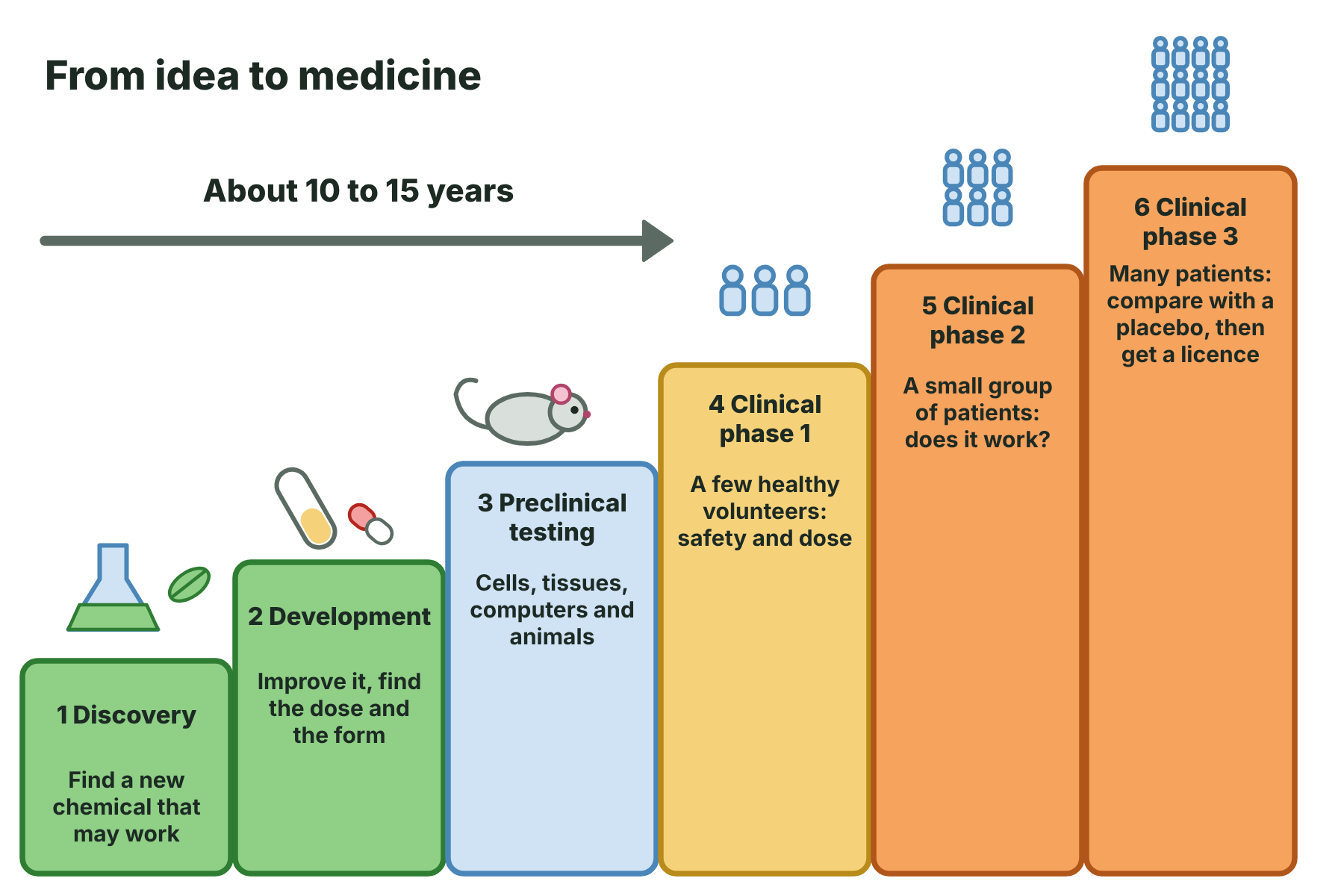
A new medicine is tested many times, and a failure at any stage stops the process.
Stage 4: Clinical testing
Clinical trials are the first tests on people, and are carried out in three phases, with more people at each one.
-
Phase 1
A small number of healthy volunteers, often 20 to 100, take a low dose to check that it is safe, and to find out how it is absorbed, and what the side effects are.
-
Phase 2
A small group of patients with the illness, often a few hundred, test whether it works, and find the best dose.
-
Phase 3
Large numbers of patients, often thousands, are given either the new medicine or a placebo, or the best current treatment, to find out whether it is better.
-
Licence
If the data show that the medicine is safe and effective, a regulator, such as the MHRA in the UK, gives a licence, and doctors can prescribe it.
-
After approval
Doctors and patients report side effects, and rare ones can still be found when millions are using it.
Fair trials
A trial must be set up so that the result is not affected by what people expect to happen.
-
Placebo
A placebo is a dummy treatment that looks the same but contains no active drug. Some patients feel better just because they believe they are being treated, so the placebo effect has to be allowed for.
-
Random allocation
Patients are put into groups at random, so that the groups are alike.
-
Blind trial
The patients do not know whether they are getting the real drug or the placebo.
-
Double-blind trial
Neither the patients nor the doctors know, until the results are analysed. This stops the doctors being biased in how they judge the results.
-
Large samples
The more patients in a trial, the more reliable the result.
Preclinical and clinical testing
Preclinical testing
- Done before any human receives the drug
- Uses cells, tissues, computer models and animals
- Finds out whether it is toxic and how it works
- Decides whether it is safe enough to try on people
Clinical testing
- Done on human volunteers and patients
- Carried out in three phases
- Finds the safety, dose and effectiveness in people
- Uses placebos and double-blind methods
- Followed by a licence if successful
Interpreting a clinical trial
In a trial, 150 patients were given a new drug and 150 were given a placebo. After 4 weeks, 120 of the patients who took the drug and 45 of those who took the placebo had improved. Calculate the percentage in each group who improved, and explain what the result suggests.
Show the solutionHide the solution
- 1 Drug group \(120 \div 150 \times 100 = 80\%\).
- 2 Placebo group \(45 \div 150 \times 100 = 30\%\).
- 3 Conclude The 30% who improved on the placebo show the placebo effect. The extra 50 percentage points are likely to be due to the drug.
Answer80% of the drug group and 30% of the placebo group improved. The drug seems to work, because far more improved than with the placebo, and the difference is much bigger than the placebo effect alone.
Case study
Thalidomide
Thalidomide was a drug sold in the late 1950s as a treatment for morning sickness in pregnancy. It had not been tested on pregnant animals, and it was not known that it could cross the placenta. More than 10 000 babies around the world were born with serious deformities, including shortened or missing limbs. The disaster led to far stricter laws on testing medicines, including tests on pregnant animals, and shows why careful testing is needed. Thalidomide is now used, under strict control, to treat some diseases, including leprosy and a type of cancer.
Summary and exam focus
- The main stages are discovery, development, preclinical testing and clinical testing.
- Preclinical tests use cells, tissues, computers and animals.
- Clinical trials test safety, dose and effectiveness in three phases.
- Placebos and double-blind trials make the results fair and unbiased.
- Testing takes 10 to 15 years, and many candidates fail.
Exam focus
Describe the stages in the development of a new medicine, and explain why clinical trials use a placebo and are double-blind. (6 marks) (6 marks)
Give the stages in order: discovery, development, preclinical testing on cells, tissues and animals, then clinical trials in three phases. For the placebo, say that it allows for the placebo effect, and for double-blind say that neither the patient nor the doctor knows, to prevent bias.
Key terms
The words this lesson expects you to use. Each one is linked from the first place it appears above.
- Discovery
- The stage in which a chemical with possible medical use is found.
- Preclinical testing
- Testing on cells, tissues and animals, before testing on people.
- Clinical trial
- A test of a medicine on human volunteers or patients.
- Toxic
- Poisonous, or harmful to living cells.
- Placebo
- A dummy treatment that contains no active drug.
- Double-blind trial
- A trial in which neither the patients nor the doctors know who is getting the real drug.
- Side effect
- An unwanted effect of a medicine.
- Dose
- The amount of a medicine given at one time.
- Licence
- Official permission to prescribe a medicine.
You've finished the notes
Check your understanding
Test yourself while it is fresh. Start with the flashcards, then try the exam questions.
Something here looks wrong?
Tell us what and we will go and look. It goes to whoever writes these pages, nobody else, and we do not ask who you are — so there is nothing to sign and nothing comes back to you.