Biology · DNA and Protein Synthesis
Extracting DNA from Fruit
You can see DNA with your own eyes. This lesson explains a simple method to extract DNA from fruit using household chemicals, why each step is needed, and how to evaluate the experiment.
Learning Objectives
Retrieval practice
-
1
Where is the DNA in a plant cell?
Show answerHide answer
In the nucleus.
-
2
What is the function of the cell membrane?
Show answerHide answer
It controls what enters and leaves the cell.
-
3
What is the function of the cell wall in a plant cell?
Show answerHide answer
It strengthens the cell and supports the plant.
-
4
What does a solvent do?
Show answerHide answer
It dissolves a substance to make a solution.
Getting the DNA out of a cell
DNA is a very long molecule, but it is tiny and wrapped up inside the nucleus of every cell. Before it can be seen it has to be released from the cell, separated from everything else and made to clump together into strands big enough to see. Fruit such as strawberries, kiwis and bananas is good to use because it is soft, easy to mash, and has plenty of DNA. Strawberries are particularly good because they have eight copies of each chromosome, so each cell has a lot of DNA.
The method
Each step breaks down a barrier between the DNA and the outside, or separates it from other substances.
-
1
Mash the fruit
Crush a small amount of fruit in a beaker or bag, to break open the cells.
-
2
Add the extraction solution
Add a solution of detergent and salt, and mix gently for several minutes.
-
3
Filter the mixture
Pour it through a filter paper or a coffee filter into a clean tube, to remove the solid fruit debris.
-
4
Add cold ethanol
Tilt the tube and slowly pour ice-cold ethanol down the side, so that it forms a separate layer on top of the filtrate.
-
5
Look for the DNA
White, stringy strands of DNA appear at the boundary between the layers. They can be lifted out with a glass rod or a cocktail stick.
DNA extraction step by step
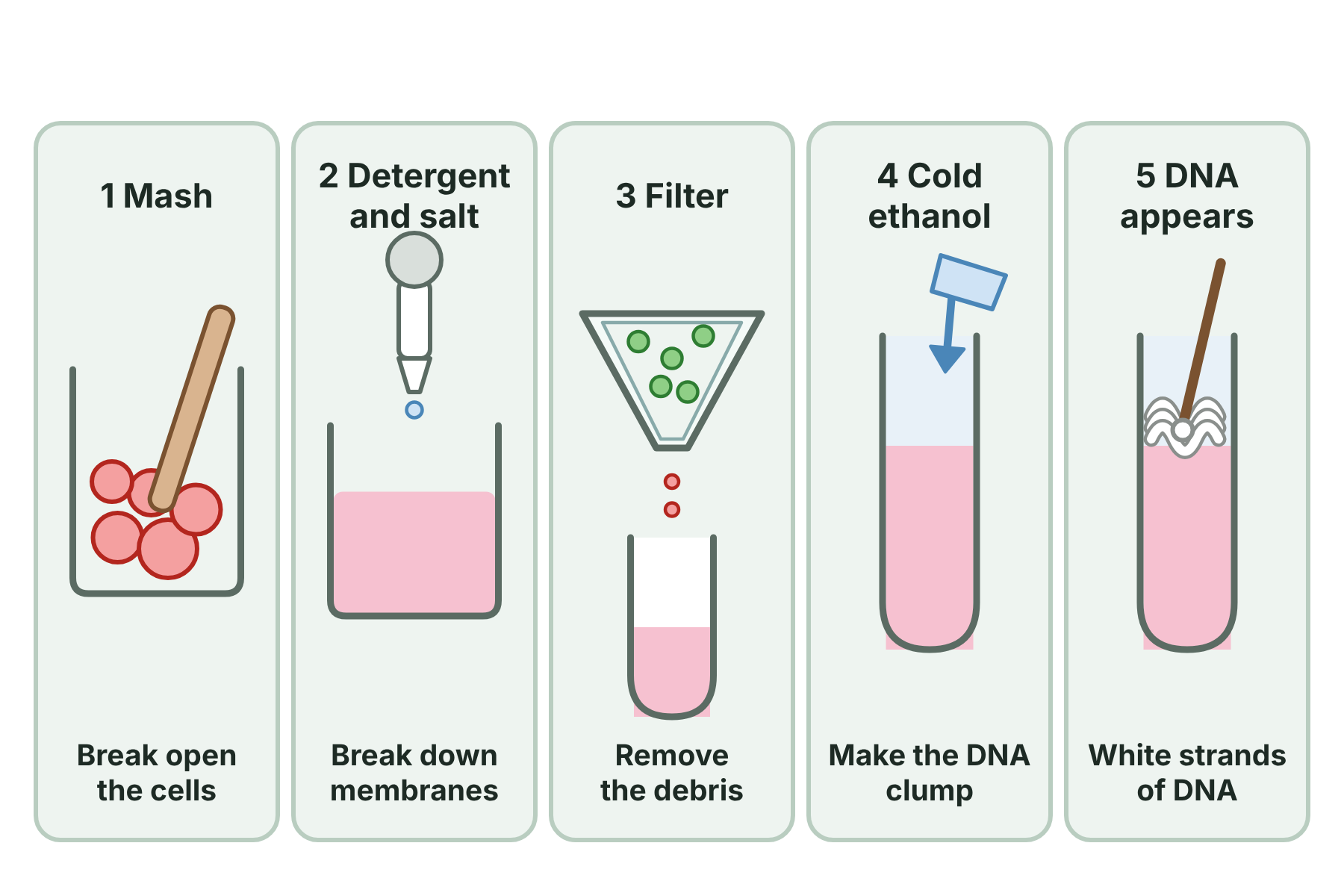
The white strands that appear between the layers are made of millions of DNA molecules.
Why each step is needed
Examiners often ask about the purpose of each step, so learn them.
-
Mashing
Breaks up the fruit and tears apart the cell walls, so the cells can be reached by the solution.
-
Detergent
Breaks down the cell membranes and the nuclear membrane, by dissolving the lipids in them, so the DNA is released.
-
Salt
Makes the DNA clump together, and helps the strands to stick together instead of staying dissolved.
-
Filtering
Removes the solid pieces of cell wall and other debris, leaving a clear solution with the DNA in it.
-
Ice-cold ethanol
DNA does not dissolve in ethanol, so it comes out of solution as a white precipitate. The cold temperature helps it to separate and also slows down enzymes that could break up the DNA.
Controlling variables and keeping it safe
If you compare different fruits, the investigation has to be a fair test.
-
Independent variable
The type of fruit you use, if you are comparing, or the amount of detergent.
-
Dependent variable
The amount of DNA that appears, for example the length or mass of the strands, or a simple score.
-
Control variables
The mass of fruit, the volumes of solutions, the time for mixing, and the temperature of the ethanol.
-
Ethanol hazard
Ethanol is flammable and harmful, so it must be kept away from naked flames, and eye protection should be worn.
-
Other precautions
Do not taste anything, wash hands afterwards and wear a lab coat or apron.
Qualitative and quantitative results
Qualitative results
- Describe what you see, such as stringy, white and cloudy
- Quick and easy to do
- Different observers may disagree
Quantitative results
- Measure the length of the strands, or their mass
- Give numbers that can be compared and graphed
- Less affected by opinion
Evaluating the investigation
The method is quick and cheap, but it is not very accurate.
-
It shows that DNA exists
The strands are visible and it is easy to see how the fruit and chemicals affect the amount.
-
It is not pure DNA
The strands also contain proteins and other cell material, so the sample is not completely pure.
-
Hard to measure
It is difficult to measure the mass of the DNA accurately, so results are usually only qualitative.
-
Improvements
Repeating the experiment and taking means, and using a balance to find the mass of the dried DNA, would give better data.
Case study
DNA in the forensic laboratory
The basic steps of this method, breaking open cells, removing proteins and making the DNA come out of solution, are used in laboratories all over the world. Forensic scientists extract DNA from a single hair or a drop of blood, then copy it millions of times so that there is enough to analyse. This lets them compare crime scene samples with a suspect. The kitchen version you do in a lesson uses the same principles in a simpler way.
Summary and exam focus
- Mash the fruit to break open the cells.
- Detergent breaks down the cell membranes and the nuclear membrane, releasing the DNA.
- Salt helps the DNA to clump together.
- Filter to remove the solids, then add ice-cold ethanol, which makes the DNA precipitate.
- The DNA appears as white, stringy strands that can be lifted out with a glass rod.
Exam focus
A student extracts DNA from a strawberry. Describe how the student could do this, and explain why detergent and ice-cold ethanol are used. (6 marks) (6 marks)
Put the steps in order, and for each chemical give both what it does and why that is needed. For ethanol, say that DNA is insoluble in it, so it precipitates out of the solution.
Key terms
The words this lesson expects you to use. Each one is linked from the first place it appears above.
- Extraction
- Separating a substance from the material it is in.
- Detergent
- A chemical that breaks down cell membranes by dissolving the lipids in them.
- Filtering
- Separating solid pieces from a liquid, using filter paper.
- Filtrate
- The liquid that passes through a filter.
- Ethanol
- A type of alcohol in which DNA is insoluble, which makes DNA come out of solution.
- Precipitate
- A solid that forms from a solution.
- Insoluble
- Does not dissolve in a particular liquid.
- Cell membrane
- The outer layer of an animal or plant cell, made of lipids and proteins.
- Mashing
- Crushing something into a soft mass.
You've finished the notes
Check your understanding
Test yourself while it is fresh. Start with the flashcards, then try the exam questions.
Something here looks wrong?
Tell us what and we will go and look. It goes to whoever writes these pages, nobody else, and we do not ask who you are — so there is nothing to sign and nothing comes back to you.