Biology · DNA and Protein Synthesis
From Genes to Proteins (Higher tier)
A gene is a code for a protein. This lesson is for separate Biology only, and for the Higher tier only: Combined Science and Foundation students do not need it. It explains how the order of bases in DNA decides the order of amino acids, and how the chain folds into a protein with a shape that suits its job.
Learning Objectives
- 1(Higher tier) Describe proteins as chains of amino acids that fold into specific shapes.
- 2(Higher tier) Explain how the order of bases in a gene decides the order of amino acids in a protein.
- 3(Higher tier) Explain that the code is read in triplets of bases, and use it to calculate the number of bases or amino acids.
- 4(Higher tier) Explain why the shape of a protein decides what it does.
Retrieval practice
-
1
What is a gene?
Show answerHide answer
A section of DNA that codes for a specific protein.
-
2
What are the four bases in DNA?
Show answerHide answer
A, T, C and G.
-
3
What is an enzyme?
Show answerHide answer
A biological catalyst, made of protein, that speeds up reactions.
-
4
What is the active site of an enzyme?
Show answerHide answer
The part of the enzyme where the substrate binds.
Why proteins matter
Proteins do most of the work in the body. Enzymes speed up reactions, antibodies fight pathogens, haemoglobin carries oxygen, collagen strengthens skin and insulin controls blood glucose. All of them are made by the cell following the instructions in a gene. The gene does not make the protein directly. Instead, the order of the bases in the DNA is a code for the order of amino acids, and that order decides what the protein is and what it can do.
What is a protein
A protein is made of smaller units joined in a chain.
-
Amino acids
Proteins are made of chains of amino acids. There are 20 different amino acids found in the proteins of living things.
-
Polypeptide
A long chain of amino acids is called a polypeptide. Some proteins are one polypeptide and some are several joined together.
-
The order matters
A protein is defined by which amino acids it has and the order they are in. Changing the order produces a different protein.
-
Folding
The chain folds and coils into a specific three-dimensional shape, held by bonds between the amino acids.
The genetic code
The DNA code has only four letters, yet it specifies 20 amino acids. It does this by reading the bases in groups of three.
-
Triplets
A group of three bases is a triplet. Each triplet codes for one amino acid.
-
Enough combinations
Four bases in groups of three give \(4 \times 4 \times 4 = 64\) different triplets, which is more than enough for 20 amino acids. Some amino acids are coded for by more than one triplet.
-
Start and stop
Some triplets are signals. One tells the cell where to start building the protein, and others tell it where to stop.
-
Order of bases decides order of amino acids
The sequence of triplets in a gene gives the sequence of amino acids in the polypeptide, in the same order.
From gene to folded protein
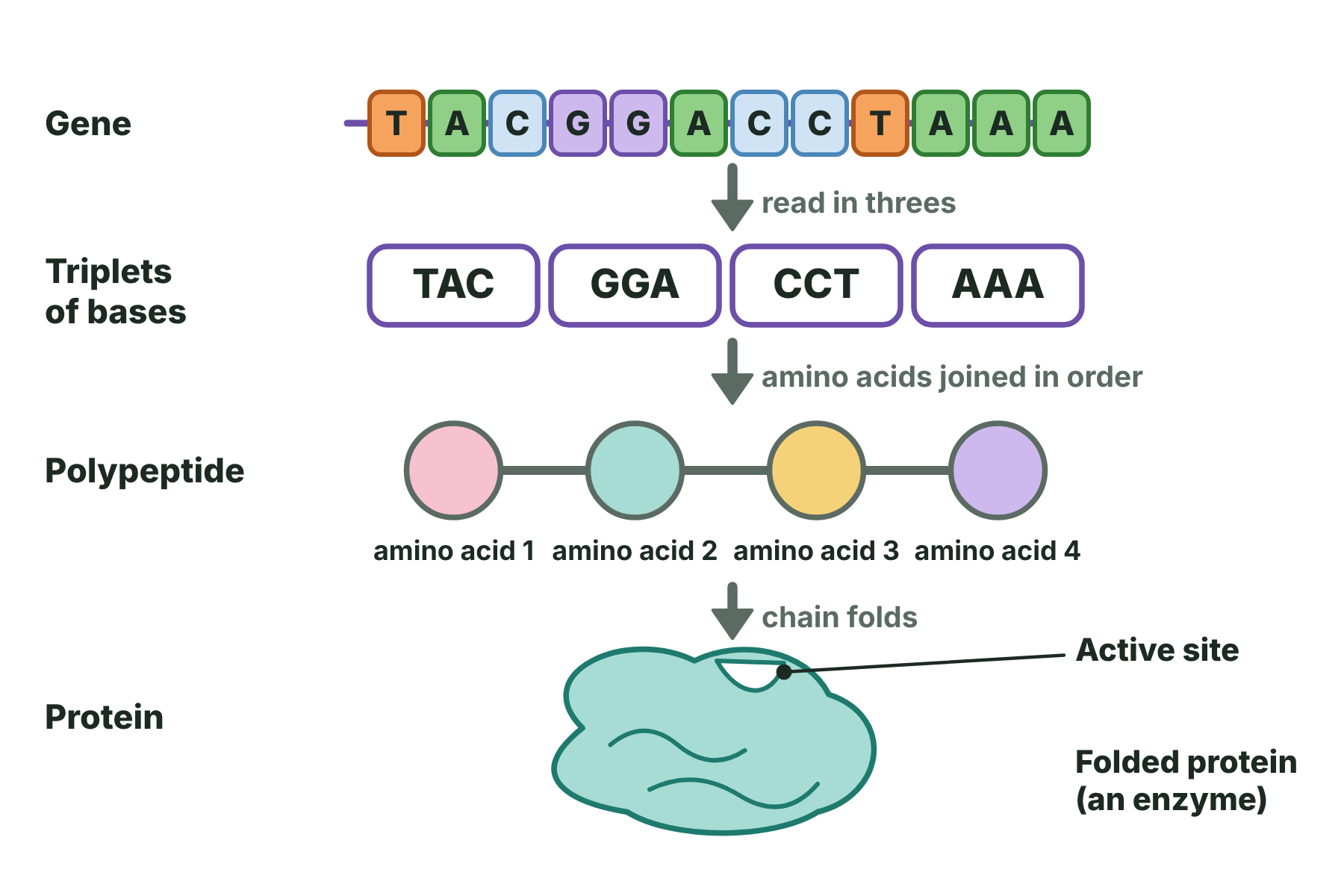
The order of bases decides the order of amino acids, and the folded chain makes the protein.
From gene to working protein
The whole path from DNA to function has four stages.
-
1
The gene
A section of DNA contains a sequence of bases.
-
2
The triplets
The bases are read in groups of three. Each triplet codes for one amino acid.
-
3
The polypeptide
Amino acids are joined in the order specified by the triplets.
-
4
The protein
The polypeptide folds into a specific shape, which lets it do its job.
Why the shape of a protein matters
The shape of a protein is what makes it work, so the order of amino acids is very important.
-
Enzymes
An enzyme has an active site with a precise shape, so only a particular substrate can fit into it. Change the shape and the substrate no longer fits.
-
Antibodies
Antibodies have a shape that fits one antigen, so they only attack a particular pathogen.
-
Receptors
Receptor proteins on cell membranes have a shape that fits one hormone or neurotransmitter.
-
Structural proteins
Proteins such as collagen are long and strong, which makes them good for supporting and strengthening tissue.
How many bases for a protein?
A polypeptide contains 120 amino acids. What is the smallest number of bases that must be in the section of the gene that codes for it? A gene has a coding section of 450 bases. How many amino acids will the polypeptide have?
Show the solutionHide the solution
- 1 Remember the triplet rule Each amino acid needs one triplet, which is 3 bases.
- 2 Amino acids to bases \(120 \times 3 = 360\) bases.
- 3 Bases to amino acids \(450 \div 3 = 150\) amino acids.
AnswerAt least 360 bases. The polypeptide will have 150 amino acids.
DNA and proteins
DNA
- Made of nucleotides
- Four different bases in the code
- A double helix, with the same structure in all genes
- Stores the instructions
Proteins
- Made of amino acids
- 20 different amino acids
- Many different folded shapes
- Carries out the functions in the cell
Case study
Insulin
Insulin is a small protein hormone made of two polypeptide chains, with 51 amino acids altogether. The gene for it is found on chromosome 11 in humans. The order of amino acids is such that, after folding, insulin has exactly the shape needed to fit into receptors on cells and trigger the uptake of glucose. When scientists insert the human insulin gene into bacteria, the bacteria follow the same code and make the correct protein.
Summary and exam focus
- Proteins are polymers made of amino acids, and 20 different amino acids are used.
- The base sequence of a gene is read in triplets, with each triplet coding for one amino acid.
- The order of bases decides the order of amino acids.
- The chain folds into a specific shape, held by bonds, and the shape decides the function.
- A change in the order of amino acids can change the shape, and so the function.
Exam focus
Explain how the sequence of bases in a gene determines the structure and function of a protein. (6 marks) (6 marks)
Follow the chain in order: bases, triplets, amino acids, polypeptide, folding, shape, function. Give an example, such as the active site of an enzyme, to show you know why shape matters.
Key terms
The words this lesson expects you to use. Each one is linked from the first place it appears above.
- Protein
- A molecule made of one or more chains of amino acids, folded into a specific shape.
- Amino acid
- The small unit that proteins are made from. There are 20 different ones.
- Polypeptide
- A long chain of amino acids.
- Triplet
- A group of three bases in DNA that codes for one amino acid.
- Genetic code
- The set of rules that links triplets of bases to the amino acids they code for.
- Active site
- The part of an enzyme where the substrate binds, with a shape that fits the substrate.
- Specific shape
- A precise three-dimensional structure that allows a protein to carry out its function.
- Antibody
- A protein made by the immune system that binds to one particular antigen.
- Receptor
- A protein that binds to a specific chemical, such as a hormone.
You've finished the notes
Check your understanding
Test yourself while it is fresh. Start with the flashcards, then try the exam questions.
Something here looks wrong?
Tell us what and we will go and look. It goes to whoever writes these pages, nobody else, and we do not ask who you are — so there is nothing to sign and nothing comes back to you.