Biology · Health and Infectious Disease
How Diseases Spread and Are Prevented
Stopping a disease from spreading is better than treating it afterwards. This lesson looks at the four main routes of infection, in water, in the air, by animal vectors and on plants, and at how the spread of each can be reduced or prevented.
Learning Objectives
- 1Explain how cholera, tuberculosis, Chalara ash dieback and malaria are spread.
- 2Explain how the spread of each of these diseases can be reduced or prevented.
- 3Describe the term vector, and explain how controlling vectors reduces disease.
- 4Evaluate the effectiveness of different methods of preventing the spread of disease.
Retrieval practice
-
1
What type of pathogen causes malaria?
Show answerHide answer
A protist.
-
2
What type of pathogen causes cholera?
Show answerHide answer
A bacterium.
-
3
What is a communicable disease?
Show answerHide answer
A disease caused by a pathogen that can spread.
-
4
What is a host?
Show answerHide answer
The organism that a pathogen lives in or on.
Getting from one host to another
A pathogen has to move from an infected host to a new one, or it will die out. The route it takes is called its mode of transmission. Knowing the route is important, because it shows where the chain can be broken. Many methods of prevention are not complicated or expensive, such as clean water or washing hands, and these have saved more lives than most medical treatments.
Four routes of infection
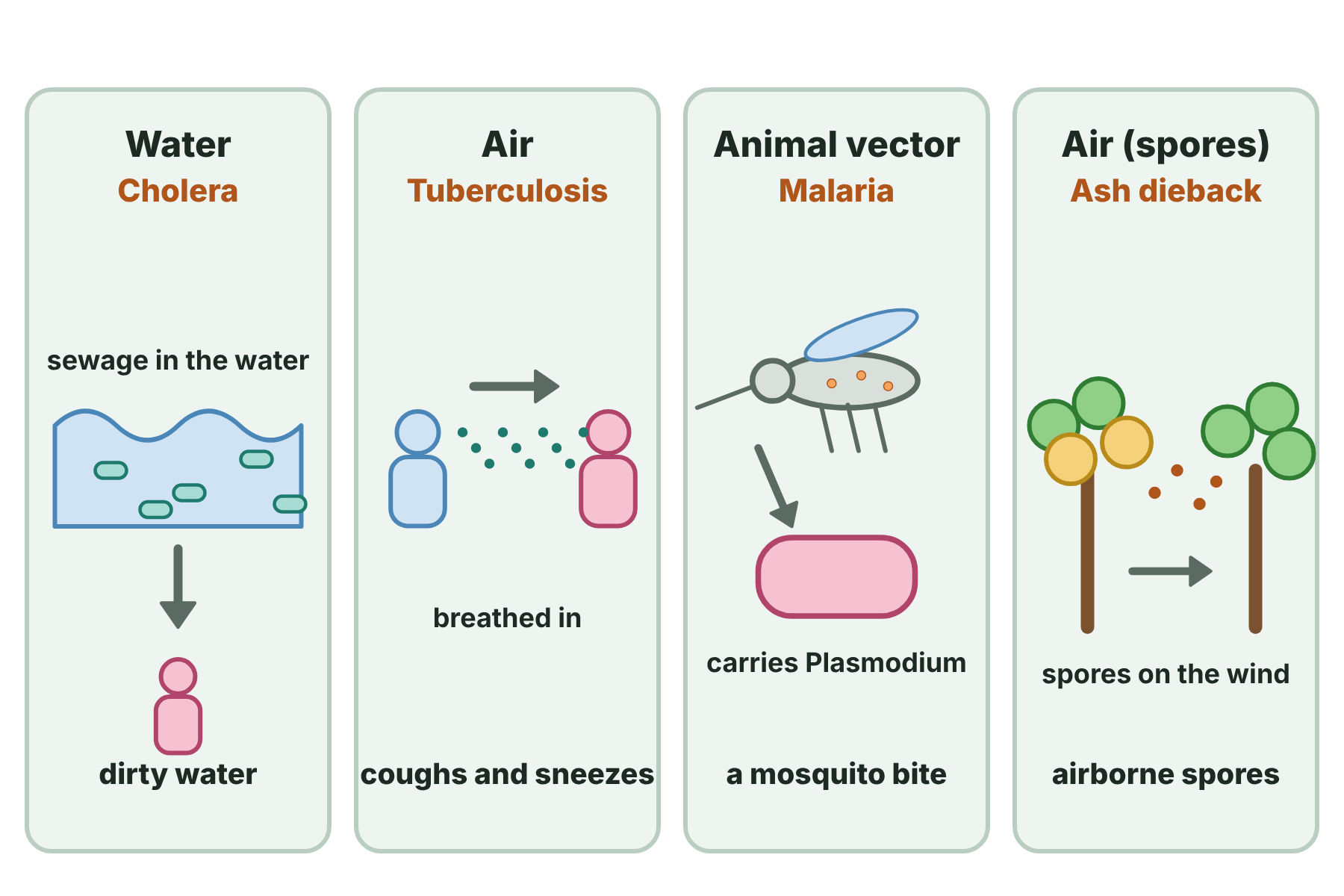
Each disease has its own route, and the route shows how to stop it.
Cholera: spread by water
Cholera bacteria pass from the faeces of an infected person into drinking water or food, and into the guts of the next person.
-
How it spreads
Water is polluted by sewage that contains the bacteria, and people drink it or use it to wash food. It spreads fastest after floods and in refugee camps.
-
Safe water
Treat drinking water with chlorine, filter it and boil it if it is not safe.
-
Sewage treatment
Separate sewage from the drinking supply, and treat it before it is released.
-
Hygiene and treatment
Wash hands with soap, cook food well, and treat the sick with oral rehydration, so the infection is not passed on. A vaccine is also available in some areas.
Tuberculosis: spread through the air
TB bacteria are carried in tiny droplets that an infected person coughs or sneezes out, and another person breathes them in.
-
How it spreads
It spreads most easily where people live close together, in crowded, badly ventilated places.
-
Isolation and treatment
A person with active TB should be isolated until treatment makes them non-infectious, and take the full course of antibiotics.
-
Vaccination
The BCG vaccine gives some protection, and is given to people at higher risk.
-
Other measures
Good ventilation, covering the mouth when coughing, and screening contacts of infected people, to find and treat cases early.
Chalara ash dieback: spread by the air
The fungus makes spores in the fallen leaves, and these are blown for many kilometres by the wind.
-
How it spreads
The spores land on the leaves of ash trees, and the fungus grows into the tree. It was also brought into the UK on imported trees.
-
Controlling imports
Ban or check imports of ash trees and wood, so that the fungus is not brought in.
-
Removing infected trees
Cut down and burn infected trees, or remove the fallen leaves, to reduce the spores.
-
Monitoring and breeding
Survey woods to find new cases, and search for trees that are resistant, to breed from.
Malaria: spread by a vector
A vector is an organism that carries a pathogen from one host to another, without usually being harmed. The vector for malaria is the female Anopheles mosquito.
-
How it spreads
A mosquito feeds on the blood of an infected person, picks up Plasmodium, and passes it to the next person it bites.
-
Kill the mosquitoes
Spray insecticides on walls, and drain or treat pools of standing water, where mosquitoes breed.
-
Avoid being bitten
Sleep under insecticide-treated nets, use repellents, and cover the skin at dusk and dawn.
-
Medicines and vaccines
Take drugs to prevent the disease when travelling, treat the sick quickly so that mosquitoes do not pick up the pathogen, and use the new malaria vaccines.
Preventing the spread of disease
Controlling the pathogen
- Clean water and sewage treatment (cholera)
- Isolating and treating infected people (TB)
- Destroying infected trees (ash dieback)
- Vaccination (TB)
Controlling the route
- Ventilation and covering coughs (TB)
- Killing mosquitoes and draining standing water (malaria)
- Mosquito nets and repellents (malaria)
- Controlling imports of trees (ash dieback)
Evaluating a control measure
A village gives every family a mosquito net, and the number of malaria cases falls from 400 per year to 150 per year. Calculate the percentage reduction in cases. State one other factor that could affect the result.
Show the solutionHide the solution
- 1 Find the fall \(400 - 150 = 250\) cases.
- 2 Divide by the original \(250 \div 400 = 0.625\).
- 3 Convert to a percentage \(0.625 \times 100 = 62.5\%\).
- 4 Think about other factors A drier year would also reduce mosquito numbers, so the nets may not be the only cause.
AnswerA 62.5% reduction. Other factors include the rainfall, which affects the number of mosquitoes, or the use of other measures.
Case study
The 1854 Broad Street cholera outbreak
In 1854 an outbreak of cholera in Soho, London, killed more than 600 people in a few weeks. The doctor John Snow marked the deaths on a map, and saw that most were near a water pump on Broad Street. He asked for the handle of the pump to be removed, and the outbreak declined. Snow had shown that cholera was spread in water, years before bacteria were known to be the cause, and his work led to improved sewers and clean water supplies.
Summary and exam focus
- Cholera spreads in water, and is prevented by safe water, sewage treatment and hygiene.
- TB spreads in the air, and is controlled by treatment, isolation, vaccination and ventilation.
- Ash dieback spreads through airborne spores, and is controlled by checking imports and destroying infected trees.
- Malaria is spread by a vector, the Anopheles mosquito, and is prevented by controlling mosquitoes and avoiding bites.
- Knowing the route of transmission shows where to break the chain of infection.
Exam focus
Explain how malaria is spread, and describe three ways in which its spread can be reduced. (6 marks) (6 marks)
Name the vector and the pathogen, and describe the order: mosquito bites an infected person, takes in Plasmodium, bites another. Then give three prevention methods that break the chain, such as nets, draining standing water and killing mosquitoes with insecticide, and say how each one works.
Key terms
The words this lesson expects you to use. Each one is linked from the first place it appears above.
- Transmission
- The spread of a pathogen from one host to another.
- Vector
- An organism that carries a pathogen from one host to another.
- Airborne
- Carried in the air, such as in droplets or as spores.
- Spore
- A tiny reproductive structure of a fungus, which can be carried by the wind.
- Sanitation
- Measures that keep people healthy by treating sewage and providing clean water.
- Isolation
- Keeping an infected person away from others, so that the disease cannot spread.
- Vaccination
- Giving a vaccine to protect against a disease.
- Insecticide
- A chemical that kills insects.
- Standing water
- Water that does not flow, where mosquitoes can breed.
- Mode of transmission
- The route by which a pathogen is passed on.
You've finished the notes
Check your understanding
Test yourself while it is fresh. Start with the flashcards, then try the exam questions.
Something here looks wrong?
Tell us what and we will go and look. It goes to whoever writes these pages, nobody else, and we do not ask who you are — so there is nothing to sign and nothing comes back to you.