Biology · Health and Infectious Disease
Sexually Transmitted Infections
Some infections are passed on through sexual contact. This lesson explains how chlamydia and HIV are spread, what they do to the body, and how their spread can be reduced or prevented.
Learning Objectives
Retrieval practice
-
1
What type of pathogen causes chlamydia?
Show answerHide answer
A bacterium.
-
2
What type of pathogen causes HIV?
Show answerHide answer
A virus.
-
3
What does HIV destroy?
Show answerHide answer
White blood cells.
-
4
Why do antibiotics not work against viruses?
Show answerHide answer
Viruses are not cells, and they live inside host cells.
Infections passed on by sexual contact
Sexually transmitted infections, or STIs, are passed from one person to another during sexual contact. Because they can be passed on without any symptoms showing, they can spread widely before anyone realises. Some STIs are caused by bacteria and can be cured with antibiotics, and some are caused by viruses and cannot be cured. Many STIs can be prevented, so it is important that people understand how they are spread, and how to protect themselves and others.
Chlamydia
Chlamydia is caused by a bacterium, Chlamydia trachomatis. It is the most common bacterial STI in the UK.
-
Symptoms
Many people have no symptoms at all, especially women. Others may have pain when passing urine, or unusual discharge from the genitals.
-
Effects if untreated
In women the infection can spread to the uterus and tubes, causing pelvic inflammatory disease, which can lead to infertility and dangerous pregnancies outside the womb. In men it can cause pain and inflammation in the testes.
-
How it spreads
By sexual contact without a condom, and from a mother to her baby at birth, which can cause eye and lung infections.
-
Treatment
It is a bacterial infection, so it is cured with a course of antibiotics, as long as it is found.
HIV
HIV is caused by the human immunodeficiency virus, and it attacks the immune system.
-
How it spreads
By sexual contact without a condom, by sharing needles and syringes with an infected person, and from a mother to her baby during pregnancy, birth or breastfeeding. It is in body fluids such as blood.
-
Effects
HIV destroys white blood cells, so the immune system gets weaker. If it is not treated, it leads to AIDS, with serious infections such as TB and some cancers.
-
No cure
There is no cure, because the virus hides inside cells. Antiretroviral drugs reduce the amount of virus in the blood to very low levels.
-
Living with HIV
With treatment, people can live a normal lifespan, and a person who has very low levels of virus cannot pass HIV on during sex.
How STIs spread and how to reduce the spread
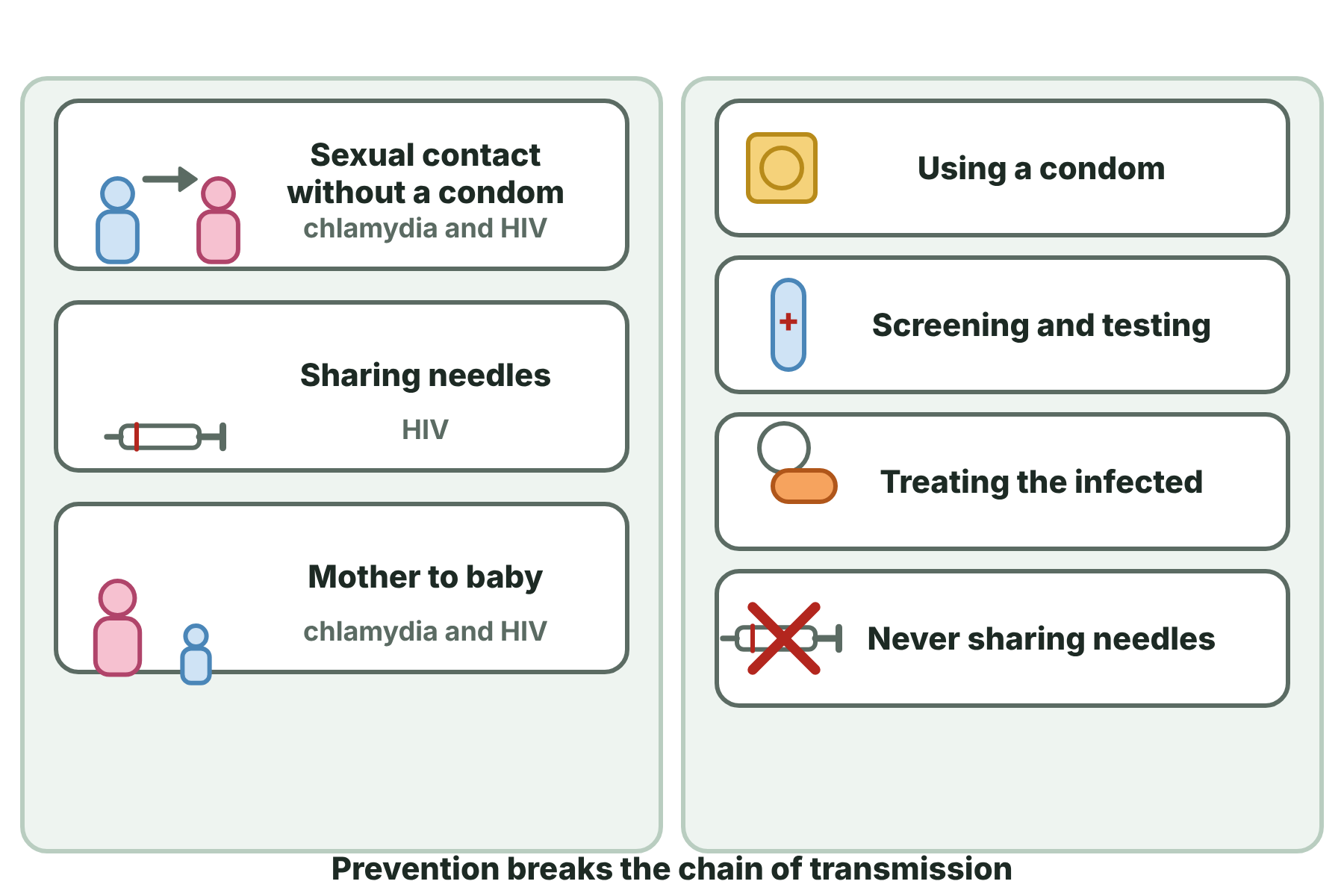
Prevention works by blocking the route of transmission, or by treating the infected person.
Reducing the spread of STIs
Several methods work together.
-
Using condoms
A condom forms a barrier that stops body fluids passing between people. It protects against both chlamydia and HIV, and also prevents pregnancy.
-
Screening and testing
Regular tests find infections in people with no symptoms, so they can be treated and their partners can be told. In England, young people are offered chlamydia screening.
-
Treatment
Treating chlamydia with antibiotics cures it. Treating HIV lowers the amount of virus, which stops it being passed on.
-
Safe use of needles
Never share needles. Needle exchange programmes provide clean ones.
-
Blood and mothers
Donated blood is tested for HIV. Mothers with HIV are given drugs, and may be advised to deliver by caesarean section and to avoid breastfeeding, so that the baby is not infected.
-
Education
Teaching people about STIs, and about how to protect themselves, so they can make informed choices.
Chlamydia and HIV
Chlamydia
- Caused by a bacterium
- Often no symptoms, so it may go unnoticed
- Can cause infertility if untreated
- Cured with antibiotics
HIV
- Caused by a virus
- May have few symptoms for years
- Destroys white blood cells and can lead to AIDS
- No cure, but drugs control it
Interpreting data on infection rates
In one town, 300 people out of 4000 people aged 16 to 24 tested positive for chlamydia. Calculate the percentage that tested positive. A screening programme then found and treated people, and the next year 180 out of 4000 tested positive. Calculate the percentage reduction in the number of positive tests.
Show the solutionHide the solution
- 1 First percentage \(300 \div 4000 \times 100 = 7.5\%\).
- 2 Fall in cases \(300 - 180 = 120\).
- 3 Percentage reduction \(120 \div 300 \times 100 = 40\%\).
- 4 Interpret The screening and treatment appear to have reduced the number of infections, although other factors may have contributed.
Answer7.5% tested positive in the first year, and the number of positive tests fell by 40%.
Case study
Chlamydia screening
Because chlamydia often has no symptoms, many people are infected without knowing. In England the National Chlamydia Screening Programme offers a free test to sexually active people under 25, using a urine sample or a swab that can be taken at home. People who test positive are treated with antibiotics, and are asked to tell their partners so that they can be tested too. The programme finds infections early, and prevents the damage and the further spread that an untreated infection would cause.
Summary and exam focus
- Chlamydia is a bacterial STI, which often has no symptoms and can cause infertility.
- HIV is a viral STI, which destroys white blood cells and can lead to AIDS.
- Both are spread by sexual contact, and HIV also by blood and from mother to baby.
- Condoms, screening, treatment, safe use of needles and education reduce the spread.
- Chlamydia is cured by antibiotics, but there is no cure for HIV, although drugs can control it.
Exam focus
Describe how HIV and chlamydia are spread, and explain how the spread of each can be reduced. (6 marks) (6 marks)
Give a route for each (sexual contact for both, and blood and mother to baby for HIV), then a specific measure for each (condoms for both, antibiotics and screening for chlamydia, antiretroviral drugs and not sharing needles for HIV), and say how each one breaks the route.
Key terms
The words this lesson expects you to use. Each one is linked from the first place it appears above.
- Sexually transmitted infection (STI)
- An infection that is passed on through sexual contact.
- Chlamydia
- A common bacterial STI that is often symptomless and is treated with antibiotics.
- HIV
- The virus that attacks the immune system and can lead to AIDS.
- Antiretroviral drug
- A drug that reduces the amount of HIV in the body.
- Condom
- A barrier that stops body fluids passing between people during sex.
- Screening
- Testing people who may have no symptoms to find an infection early.
- Pelvic inflammatory disease
- Inflammation of the female reproductive organs, which can cause infertility.
- Needle exchange
- A scheme that gives clean needles to people who inject drugs, to prevent HIV spreading.
- Symptomless
- Having no symptoms.
You've finished the notes
Check your understanding
Test yourself while it is fresh. Start with the flashcards, then try the exam questions.
Something here looks wrong?
Tell us what and we will go and look. It goes to whoever writes these pages, nobody else, and we do not ask who you are — so there is nothing to sign and nothing comes back to you.