Biology · Human Defences and Immunity
Immunisation
Vaccination has saved more lives than almost any other medical advance. This lesson explains how a vaccine that contains an inactive form of a pathogen makes the body immune, without the person having to be ill first.
Learning Objectives
- 1Explain the body's response to immunisation using an inactive form of a pathogen.
- 2Explain why a person who has been vaccinated does not become ill when they meet the pathogen.
- 3Describe why booster doses are sometimes needed and why some vaccines change every year.
- 4Interpret data on the effectiveness of vaccination.
Retrieval practice
-
1
What is an antigen?
Show answerHide answer
A molecule on the surface of a pathogen that the immune system recognises.
-
2
What are memory lymphocytes?
Show answerHide answer
Lymphocytes that stay in the body after an infection, ready for a second infection.
-
3
What is the secondary response?
Show answerHide answer
The fast, large response when the same pathogen is met again.
-
4
What is a pathogen?
Show answerHide answer
A microorganism that causes disease.
Learning without being ill
The first time that the body meets a pathogen, the primary response is slow, and the person may become very ill, or even die, before the antibodies are made. Immunisation, or vaccination, gets round this problem. A vaccine contains a harmless form of the pathogen, so the body can make the primary response and the memory lymphocytes without the person being ill. If the real pathogen arrives later, the secondary response is fast enough to stop the disease.
What is in a vaccine
A vaccine must have the antigens of the pathogen, but it must not be able to cause disease.
-
An inactive pathogen
The pathogen has been killed or inactivated, for example by heat or chemicals, so it cannot reproduce or cause the disease. It still carries the antigens.
-
A weakened pathogen
Some vaccines use a living pathogen that has been changed so that it is harmless, such as the measles vaccine.
-
Parts of the pathogen
Some vaccines contain only the antigens, or the genetic code to make them, as in some newer vaccines.
-
Giving the vaccine
Most are injected into a muscle, though a few, such as the polio vaccine in some countries, are given by mouth.
How a vaccine works
The body goes through a harmless version of the immune response.
-
1
Vaccine given
A dose containing the inactive pathogen is injected into the person.
-
2
Antigens detected
Lymphocytes recognise the antigens on the inactive pathogen as foreign.
-
3
Primary response
The lymphocytes divide and make antibodies. The person does not become ill, because the pathogen is inactive.
-
4
Memory cells made
Memory lymphocytes remain in the blood, ready for the real pathogen.
-
5
Real infection
If the person meets the live pathogen later, the memory lymphocytes make a fast secondary response, and the pathogen is destroyed before it can cause disease.
How immunisation protects
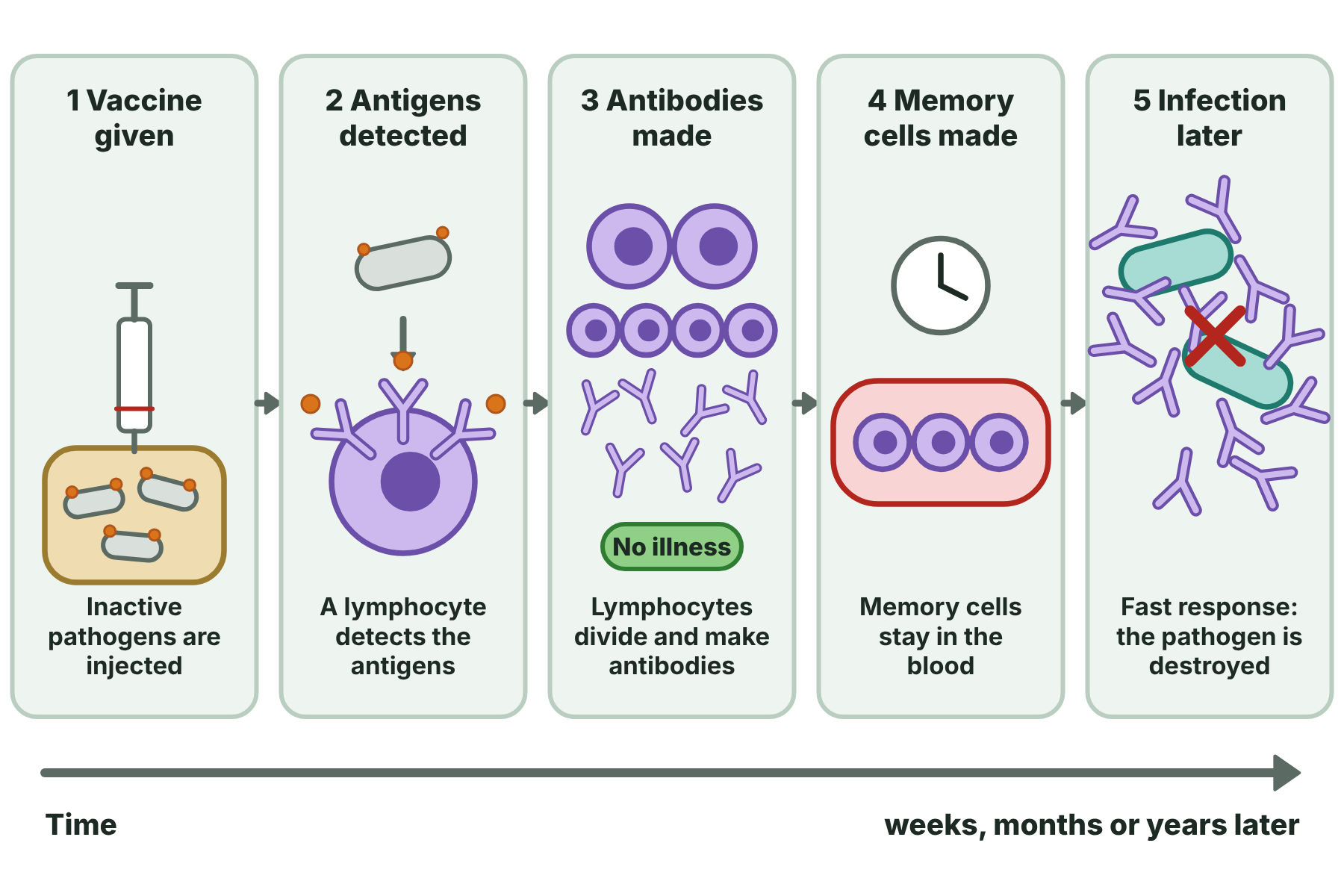
The vaccine gives the body practice, so the real infection is stopped quickly.
Why booster doses are needed
Some vaccines give lifelong protection after one or two doses, and some need more.
-
Memory fades
For some diseases, the level of memory lymphocytes falls over time, so a booster dose is given to raise it again, as for tetanus.
-
Several doses
Many childhood vaccines are given in a series of doses, so that the secondary response from the second dose makes a very strong immunity.
-
Weak vaccines
A vaccine made from an inactive pathogen is often less effective than a live one, so more doses are needed.
Why some vaccines change every year
Influenza (flu) is a good example.
-
Mutation
The flu virus mutates often, so that its surface antigens change.
-
Memory is not matched
The memory lymphocytes from last year's virus or vaccine may not recognise the new antigens, so there is no protection.
-
New vaccine each year
Scientists predict which strains will be common, and make a new vaccine every year, which is given to older people and those at risk.
-
Compare measles
The measles virus changes very little, so one vaccine works for life.
Vaccination and catching the disease
Vaccination
- Uses an inactive or weakened pathogen
- The person does not become ill
- Memory lymphocytes are made
- Gives protection against a future infection
Catching the disease
- The live pathogen infects the person
- The person may become very ill, or die
- Memory lymphocytes are made
- Gives immunity, but with the risk of the disease
Measuring how well a vaccine works
In a trial, 5000 people were given a vaccine and 5000 were given a placebo. After a year, 20 of the vaccinated people caught the disease, and 400 of the placebo group caught it. Calculate the percentage in each group that caught the disease, and the percentage reduction in the number of cases due to the vaccine.
Show the solutionHide the solution
- 1 Vaccinated group \(20 \div 5000 \times 100 = 0.4\%\).
- 2 Placebo group \(400 \div 5000 \times 100 = 8\%\).
- 3 Reduction in cases \(\frac{400 - 20}{400} \times 100 = 95\%\).
Answer0.4% of the vaccinated group and 8% of the placebo group caught the disease. The vaccine reduced the cases by 95%.
Case study
Edward Jenner and smallpox
In 1796 the English doctor Edward Jenner noticed that milkmaids who had caught cowpox, a mild disease, did not catch smallpox, which killed millions of people. He tested the idea by putting fluid from a cowpox sore into a boy's skin, and then exposing the boy to smallpox. The boy did not become ill. This was the first vaccine. Using Jenner's method and improved vaccines, smallpox was wiped out across the world, and the World Health Organization declared it eradicated in 1980.
Summary and exam focus
- A vaccine contains an inactive or weakened form of a pathogen, with its antigens.
- Lymphocytes recognise the antigens and make antibodies, without the person becoming ill.
- Memory lymphocytes are made, so the secondary response to the real pathogen is fast and large.
- Booster doses keep the level of memory lymphocytes high.
- Flu vaccines change each year because the virus mutates.
Exam focus
Explain how a vaccine containing an inactive form of a pathogen protects a person from the disease. (6 marks) (6 marks)
Describe the vaccine, the primary response and the memory cells in order. Make it clear that the person does not become ill, because the pathogen is inactive. Then explain that when the live pathogen enters, the secondary response is faster and larger.
Key terms
The words this lesson expects you to use. Each one is linked from the first place it appears above.
- Vaccine
- A preparation containing inactive or weakened pathogens, or their antigens, that makes the body immune to a disease.
- Immunisation
- Making a person immune to a disease, by giving a vaccine.
- Inactive pathogen
- A pathogen that has been killed or changed so that it cannot cause disease, but still has its antigens.
- Booster
- An extra dose of a vaccine to increase immunity.
- Placebo
- A harmless substance that has no effect, used in tests as a comparison.
- Eradicate
- To wipe out a disease completely.
- Strain
- A type of a pathogen with its own genetic features.
- Immune
- Protected against a disease because of memory lymphocytes.
- Influenza
- A viral disease, also called flu, that changes often.
You've finished the notes
Check your understanding
Test yourself while it is fresh. Start with the flashcards, then try the exam questions.
Something here looks wrong?
Tell us what and we will go and look. It goes to whoever writes these pages, nobody else, and we do not ask who you are — so there is nothing to sign and nothing comes back to you.