Biology · Inheritance
Mendel and the Discovery of Inheritance
Genetics began with a monk and some pea plants. This lesson is for separate Biology only: Combined Science students do not need it. It covers Mendel's experiments, what he concluded, and why nobody took any notice until after his death.
Learning Objectives
- 1Describe the work of Gregor Mendel in discovering the basis of genetics.
- 2Explain why pea plants were a good choice, and how Mendel designed his experiments.
- 3Use the results of Mendel's crosses to calculate ratios and percentages.
- 4Explain why it was difficult to understand inheritance before the mechanism was discovered.
Retrieval practice
-
1
What is the phenotype ratio of a cross between two heterozygous parents?
Show answerHide answer
3 dominant : 1 recessive.
-
2
What is an allele?
Show answerHide answer
A different version of the same gene.
-
3
What are the alleles of a pure-breeding tall plant?
Show answerHide answer
TT (homozygous).
-
4
What do we call the cells that carry the alleles to the next generation?
Show answerHide answer
Gametes.
The monk and the peas
People have always noticed that children resemble their parents, but before the nineteenth century no one could explain how. A common view was blending inheritance, the idea that the features of the parents mix in their children like paint, so that a tall and a short parent would have medium children. Gregor Mendel, an Austrian monk, tested this idea carefully. Between about 1856 and 1863 he grew and crossed thousands of pea plants in the monastery garden at Brno, and he counted the offspring. His results laid the foundations of modern genetics.
Why Mendel chose pea plants
Choosing the right organism made the experiments work.
-
Easy to grow
Peas are cheap, grow quickly and take up little space, so many plants could be studied.
-
Short life cycle
He could grow several generations in a few years.
-
Clear differences
The plants have characteristics with two distinct forms, such as tall or dwarf, with no in-between types.
-
Controlled breeding
Pea flowers normally pollinate themselves, but Mendel could cross-pollinate them by hand, so he knew exactly which plants were the parents.
Mendel's method
His careful design was as important as his results.
-
Pure-breeding lines
He first allowed plants to self-pollinate for several generations, until they always produced offspring like themselves, for example only tall.
-
One characteristic at a time
He studied seven characteristics, including height, seed shape, seed colour and flower colour, and looked at each separately.
-
Cross-pollination
He crossed two pure-breeding plants with different forms, such as tall and dwarf. These are the parental, or P, generation.
-
Counting
He counted the offspring of each generation, and used mathematics to look for ratios, which was very unusual in biology at the time.
Mendel's cross of tall and dwarf pea plants
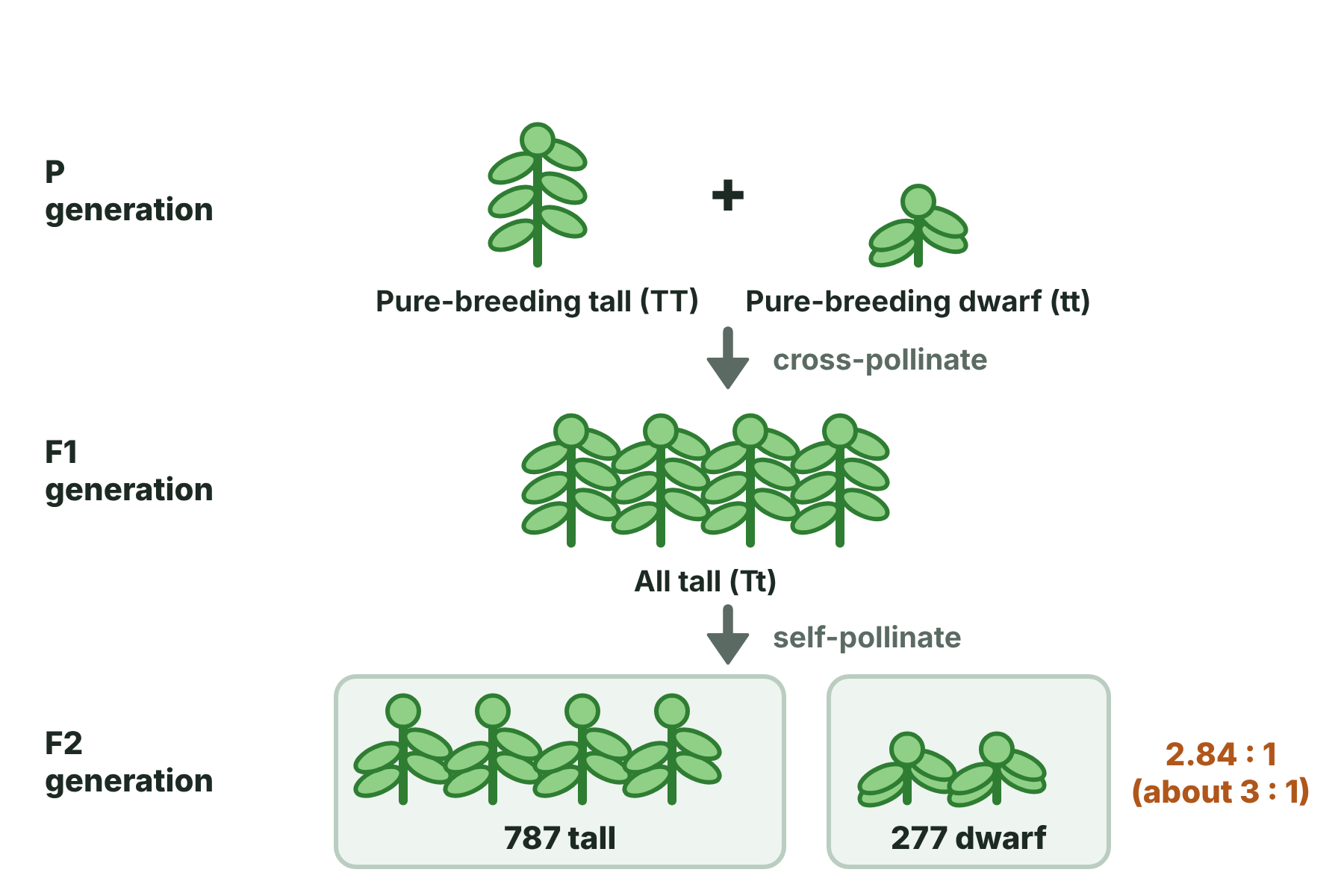
The dwarf trait disappeared in the F1 generation, and came back in about a quarter of the F2.
The tall and dwarf experiment
Mendel's results for plant height, in order.
-
1
P generation
Pure-breeding tall plants were crossed with pure-breeding dwarf plants.
-
2
F1 generation
All the offspring were tall. There were no medium plants, so the features had not blended.
-
3
Self-pollination
The F1 plants were allowed to pollinate themselves.
-
4
F2 generation
Of 1064 plants, 787 were tall and 277 were dwarf, about 3 tall to 1 dwarf.
-
5
Conclusion
The dwarf feature had not been lost. It had been hidden in the F1 plants and reappeared unchanged.
Mendel's conclusions
He explained the 3 : 1 ratio with ideas that match what we now know about genes.
-
Inherited factors
Characteristics are controlled by separate hereditary factors, which we now call genes, and which do not blend.
-
Pairs of factors
Each plant has two factors for each characteristic, one inherited from each parent.
-
Dominant and recessive
One factor can hide the other. The tall factor is dominant and the dwarf factor is recessive.
-
Gametes get one factor
The two factors separate when gametes are made, so each gamete carries only one. This matches what happens to alleles in meiosis.
Analysing Mendel's results
Mendel's F2 plants for height were 787 tall and 277 dwarf. Calculate the percentage that were tall, and the ratio of tall to dwarf in the form x : 1.
Show the solutionHide the solution
- 1 Find the total \(787 + 277 = 1064\) plants.
- 2 Calculate the percentage tall \(\frac{787}{1064} \times 100 = 74.0\%\).
- 3 Compare with the prediction A 3 : 1 ratio predicts 75%, so 74.0% is very close.
- 4 Work out the ratio Divide both by 277: \(787 \div 277 = 2.84\), so the ratio is 2.84 : 1.
Answer74.0% were tall, and the ratio is 2.84 : 1, which is close to 3 : 1.
Why nobody noticed
Mendel published his findings in 1866 but they had almost no effect in his lifetime. He died in 1884 without recognition.
-
The ideas did not fit
Scientists believed in blending inheritance, and Mendel's work was in conflict with it.
-
No mechanism
Chromosomes had not been linked to inheritance, and meiosis and fertilisation had not been fully described, so there was nothing to explain how factors could be passed on.
-
Maths in biology
His use of statistical analysis was unusual and many biologists did not understand it.
-
Obscurity
He published in a local journal and was not a well-known scientist, and his letters to famous scientists went unanswered.
After Mendel
The mechanism that Mendel lacked was discovered gradually.
-
1870s and 1880s
Cell division was observed, and chromosomes were seen in the nucleus.
-
1900
Hugo de Vries, Carl Correns and Erich von Tschermak each repeated experiments and rediscovered Mendel's work.
-
1902
Walter Sutton and Theodor Boveri suggested that Mendel's factors were carried on chromosomes.
-
1953
Watson and Crick described the structure of DNA, which showed what genes are made of.
Case study
Blending against particles
Charles Darwin believed that inheritance involved blending, and this caused him difficulties with his theory of natural selection. If a useful new feature were blended with others in each generation, it would be diluted and soon disappear. Mendel's idea of separate, unchanging factors, passed on in the gametes, would have solved the problem, but Darwin never read it. This shows how important it is for scientists to share their work, and why a lack of knowledge of the mechanism held back biology.
Summary and exam focus
- Mendel crossed pure-breeding pea plants and counted the offspring over several generations.
- The F1 plants all showed the dominant feature, and the F2 had a ratio of about 3 dominant to 1 recessive.
- He concluded that characteristics are controlled by pairs of separate factors, now called genes, which do not blend.
- His work was ignored because it conflicted with ideas of blending, and no mechanism was known.
- It was rediscovered in 1900, and linked to chromosomes in 1902.
Exam focus
Describe the work of Mendel in discovering the basis of genetics, and explain why his work was not accepted when it was published. (6 marks) (6 marks)
Describe the experiment in order (pure-breeding parents, F1 all dominant, F2 3 : 1) and state his conclusion about inherited factors. For the explanation, give at least two reasons, such as the lack of a mechanism (chromosomes and meiosis) and the belief in blending inheritance.
Key terms
The words this lesson expects you to use. Each one is linked from the first place it appears above.
- Mendel
- The Austrian monk who discovered the basic rules of inheritance by breeding pea plants.
- Pure-breeding
- Always producing offspring with the same characteristic as the parents, because they are homozygous.
- Cross-pollination
- The transfer of pollen from one plant to the flower of another plant.
- Self-pollination
- The transfer of pollen to a flower on the same plant.
- P generation
- The parental generation, the plants that are crossed at the start.
- F1 generation
- The first generation of offspring from a cross.
- F2 generation
- The offspring of the F1 generation.
- Blending inheritance
- The old idea that the features of two parents mix in their offspring.
- Hereditary factor
- Mendel's name for what we now call a gene.
You've finished the notes
Check your understanding
Test yourself while it is fresh. Start with the flashcards, then try the exam questions.
Something here looks wrong?
Tell us what and we will go and look. It goes to whoever writes these pages, nobody else, and we do not ask who you are — so there is nothing to sign and nothing comes back to you.