Biology · Non-communicable Diseases
Cancer
Cancer is not one disease but over 200, and nearly all of them start with a change in a single cell. This lesson explains how cells become cancerous, the difference between benign and malignant tumours, and how cancer can be prevented, found and treated.
Learning Objectives
- 1Describe cancer as the result of changes in cells that lead to uncontrolled cell division.
- 2Describe the difference between benign and malignant tumours.
- 3Describe risk factors for cancer, including smoking, radiation, viruses and genes.
- 4Describe how the risk of cancer can be reduced, and how cancer is detected and treated.
Retrieval practice
-
1
What is mitosis?
Show answerHide answer
Cell division that produces two genetically identical daughter cells.
-
2
What is a mutation?
Show answerHide answer
A change in the base sequence of DNA.
-
3
What is a gene?
Show answerHide answer
A section of DNA that codes for a protein.
-
4
What is a tissue?
Show answerHide answer
A group of similar cells that work together.
When cell division goes wrong
In a healthy body, the number of cells in each tissue is carefully controlled. Cells divide by mitosis only when new cells are needed, for growth or to replace dead or damaged ones, and they stop when there are enough. Genes control this. Cancer begins when a change, called a mutation, happens in the genes that control cell division. The cell then divides over and over again in an uncontrolled way, and forms a lump of abnormal cells called a tumour. Most mutations are repaired, or the cell dies, but occasionally a cell that has mutated keeps on dividing.
How a cancer develops
Cancer usually arises in stages, over many years.
-
A mutation
A mutation occurs in a gene that controls cell division, for example because of a chemical or radiation, or an error when DNA is copied.
-
More mutations
The cell and its descendants collect more mutations, and the cells divide faster and faster.
-
A tumour
The cells form a mass, or tumour, which takes the space and the nutrients of normal cells.
-
Spread
If the tumour is malignant, cells break off and move around the body, to start new tumours.
-
Why it takes time
A number of mutations are usually needed, so cancers are more common in older people, who have had more time to collect them.
Benign and malignant tumours
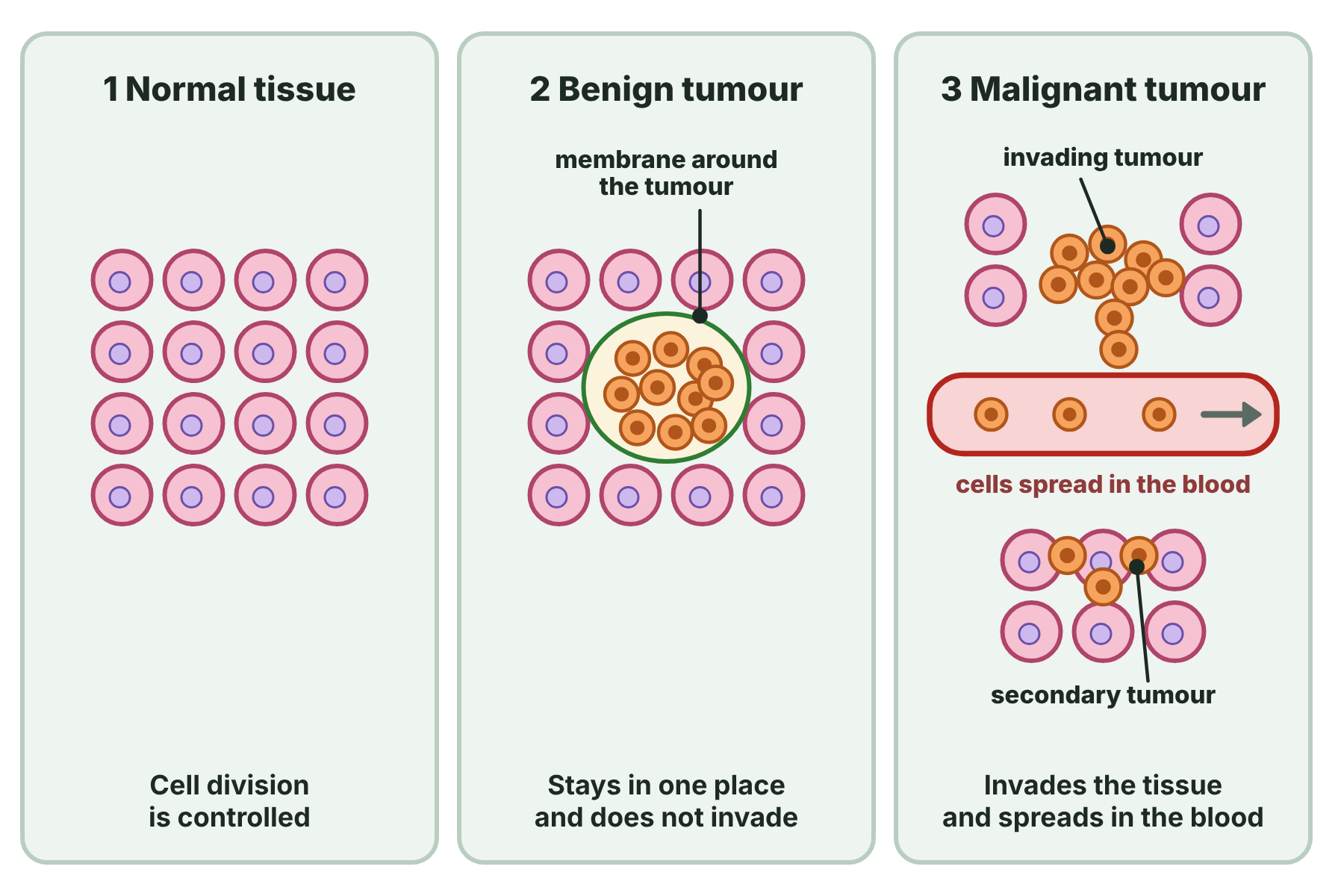
Malignant cells break away and spread, but cells of a benign tumour stay in one place.
Benign and malignant tumours
Benign tumour
- Grows slowly
- Stays in one place, often inside a membrane
- Does not invade the neighbouring tissues
- Is not cancer, and is not usually life-threatening, but can press on organs
Malignant tumour
- Grows quickly
- Invades the neighbouring tissues
- Cells travel in the blood to other parts of the body
- Forms secondary tumours, and is a cancer
Risk factors for cancer
Anything that damages DNA, or causes cells to divide more often, can raise the risk.
-
Smoking
Tobacco smoke contains many carcinogens, which damage DNA. It causes most lung cancers, and also raises the risk of cancers of the mouth, throat, bladder and other organs.
-
Ultraviolet radiation
UV rays from the sun, and sunbeds, damage the DNA in skin cells, and cause skin cancer.
-
Ionising radiation
X-rays, gamma rays and radioactive substances can cause mutations, so exposure is limited.
-
Some viruses
Human papilloma virus (HPV) can cause cervical cancer, and hepatitis B can cause liver cancer.
-
Genes
Some people inherit alleles that raise the risk, such as faulty BRCA genes, which raise the risk of breast and ovarian cancer.
-
Other risks
Obesity, a poor diet, drinking too much alcohol, and being older.
Reducing the risk, and detecting cancer
Many cancers can be prevented, and those that are found early are much easier to treat.
-
Prevention
Do not smoke, keep to a healthy weight, eat plenty of fruit and vegetables, drink less alcohol, use sunscreen, and take the HPV vaccine.
-
Know the signs
Unexplained lumps, a change in a mole, bleeding, or a cough that does not go away, should be seen by a doctor.
-
Screening
Tests of people who have no symptoms can find cancers early, such as mammograms for breast cancer, and tests for cervical cancer and bowel cancer.
-
Diagnosis
A scan, and a biopsy, in which a small sample of the tumour is removed and looked at under a microscope, show whether the tumour is benign or malignant.
Treating cancer
The treatment depends on the type of cancer and how far it has spread.
-
Surgery
The tumour is cut out. This is most successful for tumours that have not spread.
-
Radiotherapy
Beams of radiation are aimed at the tumour to kill the cells. Healthy cells nearby can also be damaged.
-
Chemotherapy
Drugs that kill cells that divide quickly are used. They also harm healthy cells that divide quickly, such as hair and gut cells, which causes side effects.
-
Monoclonal antibodies
In separate Biology, antibodies that carry a drug to the cancer cells are used, which cause fewer side effects.
-
Often combined
Several of these may be used together.
How fast does a tumour grow?
A tumour starts from one cell that divides once every day. As a simple model, calculate the number of cells after 30 days, and say why this shows that early detection matters.
Show the solutionHide the solution
- 1 Number of divisions One division each day gives 30 divisions.
- 2 Calculate \(2^{30} = 1\,073\,741\,824\), which is about 1 billion cells.
- 3 Interpret The number doubles with each division, so the tumour grows very quickly in the later stages.
- 4 Note Real tumours do not all divide at the same speed, so this is a model.
AnswerThere are about 1 billion cells after 30 days, which is about the size of a small pea, and which is only large enough to be found at about that stage. By then the tumour may already have spread, so finding it earlier makes treatment easier.
Case study
The HPV vaccine and cervical cancer
Nearly all cases of cervical cancer are caused by infection with human papilloma virus, HPV. Since 2008, girls in the UK have been offered a vaccine against the types of HPV that cause most of these cancers, and boys have been included since 2019. A study of cervical cancer in England found that the number of cases was almost 90% lower in women who were vaccinated at the age of 12 to 13 than in older women who were not. It shows how a vaccine can reduce the risk of a non-communicable disease which has an infectious cause.
Summary and exam focus
- Cancer is caused by changes in cells that lead to uncontrolled cell division.
- A tumour is a mass of abnormal cells.
- Benign tumours stay in one place, and malignant tumours invade and spread.
- Risk factors include smoking, radiation, some viruses, genes, obesity and age.
- Treatments include surgery, radiotherapy and chemotherapy.
Exam focus
Explain how cancer develops, and describe the differences between a benign tumour and a malignant tumour. (6 marks) (6 marks)
Start with a mutation in a gene that controls cell division, leading to uncontrolled mitosis and a tumour. Then give two clear differences: a benign tumour stays in one place and is not invasive, while a malignant tumour invades and spreads in the blood to form secondary tumours.
Key terms
The words this lesson expects you to use. Each one is linked from the first place it appears above.
- Cancer
- A disease in which cells divide in an uncontrolled way.
- Tumour
- A lump of abnormal cells.
- Benign tumour
- A tumour that stays in one place, and does not spread.
- Malignant tumour
- A tumour that invades other tissues, and spreads to other parts of the body.
- Secondary tumour
- A new tumour that forms when cancer cells have spread from the first one.
- Carcinogen
- A substance or radiation that can cause cancer.
- Screening
- Testing people who have no symptoms, to find a disease early.
- Biopsy
- A small sample of tissue taken to be examined for disease.
- Chemotherapy
- The use of drugs to kill cancer cells.
You've finished the notes
Check your understanding
Test yourself while it is fresh. Start with the flashcards, then try the exam questions.
Something here looks wrong?
Tell us what and we will go and look. It goes to whoever writes these pages, nobody else, and we do not ask who you are — so there is nothing to sign and nothing comes back to you.