Biology · Non-communicable Diseases
Diet, Obesity and BMI
Food gives you the energy you need, but the wrong amount, or the wrong kind, can harm you. This lesson looks at how diet and exercise affect obesity and malnutrition, and shows how to calculate body mass index (BMI) and waist to hip ratio.
Learning Objectives
- 1Explain the effects of diet and exercise on obesity and malnutrition.
- 2Calculate BMI using the equation BMI = mass in kg divided by height in m squared, and interpret the result.
- 3Calculate and interpret the waist to hip ratio.
- 4Explain how diet and exercise affect health at local, national and global levels.
Retrieval practice
-
1
What nutrients make up a balanced diet?
Show answerHide answer
Carbohydrates, proteins, lipids, vitamins, minerals, fibre and water.
-
2
What is a deficiency disease?
Show answerHide answer
A disease caused by a lack of a nutrient.
-
3
What is a risk factor?
Show answerHide answer
Something that increases the chance of getting a disease.
-
4
What is the unit of energy used in food?
Show answerHide answer
The kilojoule (kJ), or the calorie.
Too much and too little
Your body needs energy for everything it does, and gets it from food. If you take in the same amount of energy that you use, your mass stays the same. If you eat more than you use, the extra energy is stored as fat, and over time the person may become obese. If you eat too little, or lack some nutrients, the person is undernourished. Malnutrition is the word for a diet that is out of balance, which can mean too little, too much, or the wrong mix of nutrients. Both extremes harm health.
Diet and exercise
Energy in from food, and energy out from the body, have to be balanced.
-
Diet
A healthy diet has the right amount of energy, plenty of fruit, vegetables and fibre, and not too much saturated fat, sugar and salt. Foods that are high in fat and sugar contain a lot of energy.
-
Exercise
Exercise uses energy, builds muscle and strengthens the heart and bones. Being inactive means that less energy is used, so more is stored as fat.
-
Obesity
Obesity means having a very high body fat. It raises the risk of type 2 diabetes, cardiovascular disease, some cancers, joint problems and sleep problems.
-
Undernutrition
Too little energy leads to weight loss and weakness. A lack of particular nutrients causes deficiency diseases, such as scurvy (vitamin C), rickets (vitamin D) and anaemia (iron).
Measuring body mass index
Body mass index, BMI, is a quick way to find out whether a person is a healthy mass for their height.
-
The equation
\(\text{BMI} = \frac{\text{mass (kg)}}{\text{height (m)}^2}\)
-
Units
Mass is measured in kilograms, and height in metres. The BMI itself is a number with no unit.
-
Under 18.5
Underweight.
-
18.5 to 24.9
A healthy range.
-
25 to 29.9
Overweight.
-
30 or more
Obese.
BMI and the waist to hip ratio
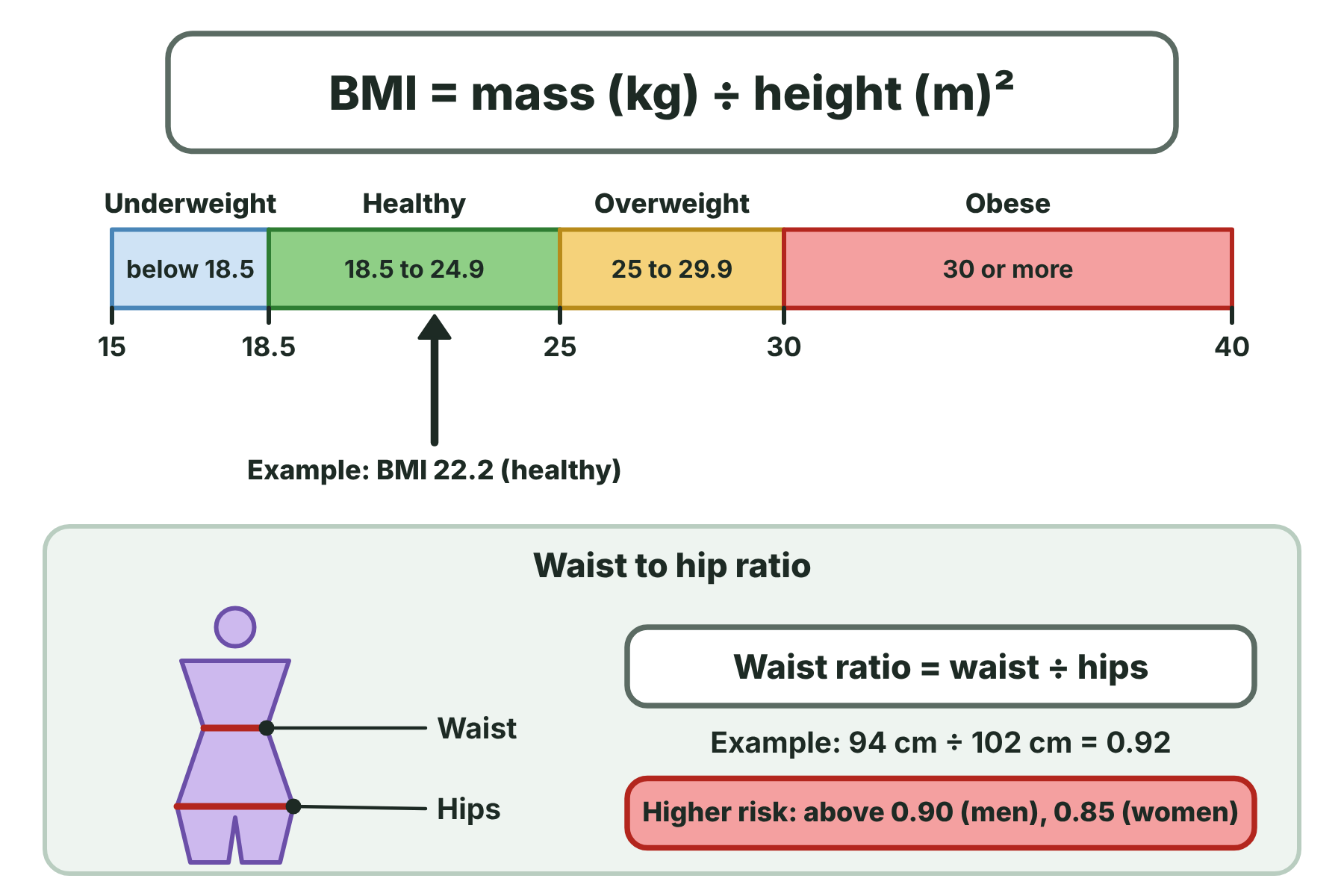
BMI and waist to hip ratio are two ways to tell if a person is at a healthy mass.
Calculating a BMI
A man has a mass of 72 kg and a height of 1.80 m. Calculate his BMI, to 1 decimal place, and say which category it falls into.
Show the solutionHide the solution
- 1 Square the height \(1.80^2 = 3.24\).
- 2 Divide \(72 \div 3.24 = 22.2\).
- 3 Compare 22.2 is between 18.5 and 24.9, so it is healthy.
AnswerHis BMI is 22.2, which is in the healthy range.
A BMI in the obese range
A woman has a mass of 95 kg and a height of 1.65 m. Calculate her BMI to 1 decimal place, and say what category it falls into.
Show the solutionHide the solution
- 1 Square the height \(1.65^2 = 2.7225\).
- 2 Divide \(95 \div 2.7225 = 34.9\).
- 3 Compare 34.9 is above 30, so she is obese, and has a higher risk of a number of diseases.
AnswerHer BMI is 34.9, which is in the obese range.
Waist to hip ratio
A man has a waist measurement of 94 cm and a hip measurement of 102 cm. Calculate his waist to hip ratio to 2 decimal places, and say what it shows.
Show the solutionHide the solution
- 1 Divide \(94 \div 102 = 0.92\).
- 2 Compare The risk is higher when the ratio is above 0.90 for men, or 0.85 for women.
- 3 Note A ratio is used because fat around the waist is more dangerous than fat on the hips.
AnswerHis waist to hip ratio is 0.92, which is above 0.90, so he has a higher risk of heart disease and type 2 diabetes.
Limits of BMI, and why waist to hip ratio helps
BMI is quick, but it does not tell the whole story.
-
Muscle
Muscle has more mass than fat, so a muscular athlete can have a high BMI and still be healthy.
-
Fat position
BMI does not show where fat is carried. Fat around the abdomen is linked to a higher risk of heart disease and diabetes.
-
Waist to hip ratio
This compares waist and hip measurements, and shows where fat is stored. A high ratio means a larger risk.
-
Other differences
BMI is less reliable for children, the elderly and some ethnic groups.
Local, national and global levels
The problems of diet and exercise can be seen at every scale.
-
Local
Access to cheap fresh food, safe places to exercise and cooking skills differ between communities, and so do rates of obesity.
-
National
Obesity costs the NHS billions of pounds a year. Governments use measures such as taxes on sugary drinks, healthy school meals and food labelling.
-
Global
World-wide, obesity has nearly tripled since 1975. At the same time hundreds of millions of people do not get enough food, so the world faces both obesity and undernutrition.
Summary and exam focus
- A balanced diet and regular exercise keep energy in and energy out in balance.
- Obesity raises the risk of type 2 diabetes, heart disease and some cancers.
- BMI equals mass in kg divided by height in m squared.
- Waist to hip ratio shows where fat is stored.
- Diet and exercise affect health at local, national and global levels.
Exam focus
A woman has a mass of 80 kg and a height of 1.60 m. Calculate her BMI and explain why a BMI may not be a good guide to the health of a very muscular person. (4 marks) (4 marks)
Square the height first, then divide the mass by it, and state the category. For the muscular person, say that muscle has a greater mass than fat, so a high BMI could be due to muscle, not fat.
Key terms
The words this lesson expects you to use. Each one is linked from the first place it appears above.
- Malnutrition
- A diet that is out of balance, with too little or too much of some nutrients.
- Obesity
- Having a very high level of body fat.
- Body mass index
- A measure of body mass compared with height, found by mass divided by height squared.
- Waist to hip ratio
- The waist measurement divided by the hip measurement.
- Deficiency disease
- A disease caused by a lack of a nutrient.
- Balanced diet
- A diet with the right amount of all of the nutrients.
- Type 2 diabetes
- A condition in which the body does not respond properly to insulin, linked to obesity.
- Saturated fat
- A type of fat, found in foods such as butter and fatty meat, that raises the risk of heart disease.
- Energy balance
- The difference between the energy taken in as food, and the energy used.
You've finished the notes
Check your understanding
Test yourself while it is fresh. Start with the flashcards, then try the exam questions.
Something here looks wrong?
Tell us what and we will go and look. It goes to whoever writes these pages, nobody else, and we do not ask who you are — so there is nothing to sign and nothing comes back to you.