Biology · Non-communicable Diseases
Non-communicable Diseases and their Causes
Most deaths in the world are caused by diseases that you cannot catch from anyone. This lesson looks at the main non-communicable diseases, why they usually have several causes working together, and how scientists tell the difference between a link and a cause.
Learning Objectives
- 1Describe the difference between communicable and non-communicable diseases.
- 2Describe examples of non-communicable diseases: cardiovascular diseases, cancers, lung and liver diseases, and diseases influenced by nutrition.
- 3Explain that many non-communicable diseases are caused by the interaction of a number of factors.
- 4Interpret data on risk factors, and explain the difference between a correlation and a cause.
Retrieval practice
-
1
What is a communicable disease?
Show answerHide answer
A disease caused by a pathogen, which can be passed from one person to another.
-
2
What is a pathogen?
Show answerHide answer
A microorganism that causes disease.
-
3
What is an allele?
Show answerHide answer
A different version of a gene.
-
4
How does the World Health Organization define health?
Show answerHide answer
A state of complete physical, mental and social well-being, and not just the absence of disease.
Diseases that are not caught
Many diseases are caused by pathogens, and can spread, such as flu and cholera. Other diseases cannot be passed on, because no pathogen is involved. These are called non-communicable diseases. They last a long time, often for years, and develop slowly. In the UK and in most countries of the world, they cause the largest number of deaths, and about 7 out of every 10 deaths worldwide are due to them. As more people live to an older age, and as lifestyles change, they are becoming more common.
The main groups of non-communicable disease
The specification names four main groups.
-
Cardiovascular diseases
Diseases of the heart and blood vessels, including coronary heart disease, where the arteries that supply the heart become narrowed, as well as strokes and high blood pressure.
-
Cancers
Many forms of cancer, such as lung cancer, bowel cancer, breast cancer and skin cancer, caused by uncontrolled cell division.
-
Lung and liver diseases
Lung diseases include emphysema and chronic bronchitis, which are often caused by smoking. Liver diseases include cirrhosis, which is often caused by alcohol.
-
Diseases influenced by nutrition
Obesity and type 2 diabetes, which can be caused by eating too much, and deficiency diseases, which are caused by a lack of a nutrient, such as scurvy, which is caused by a lack of vitamin C.
What causes a non-communicable disease
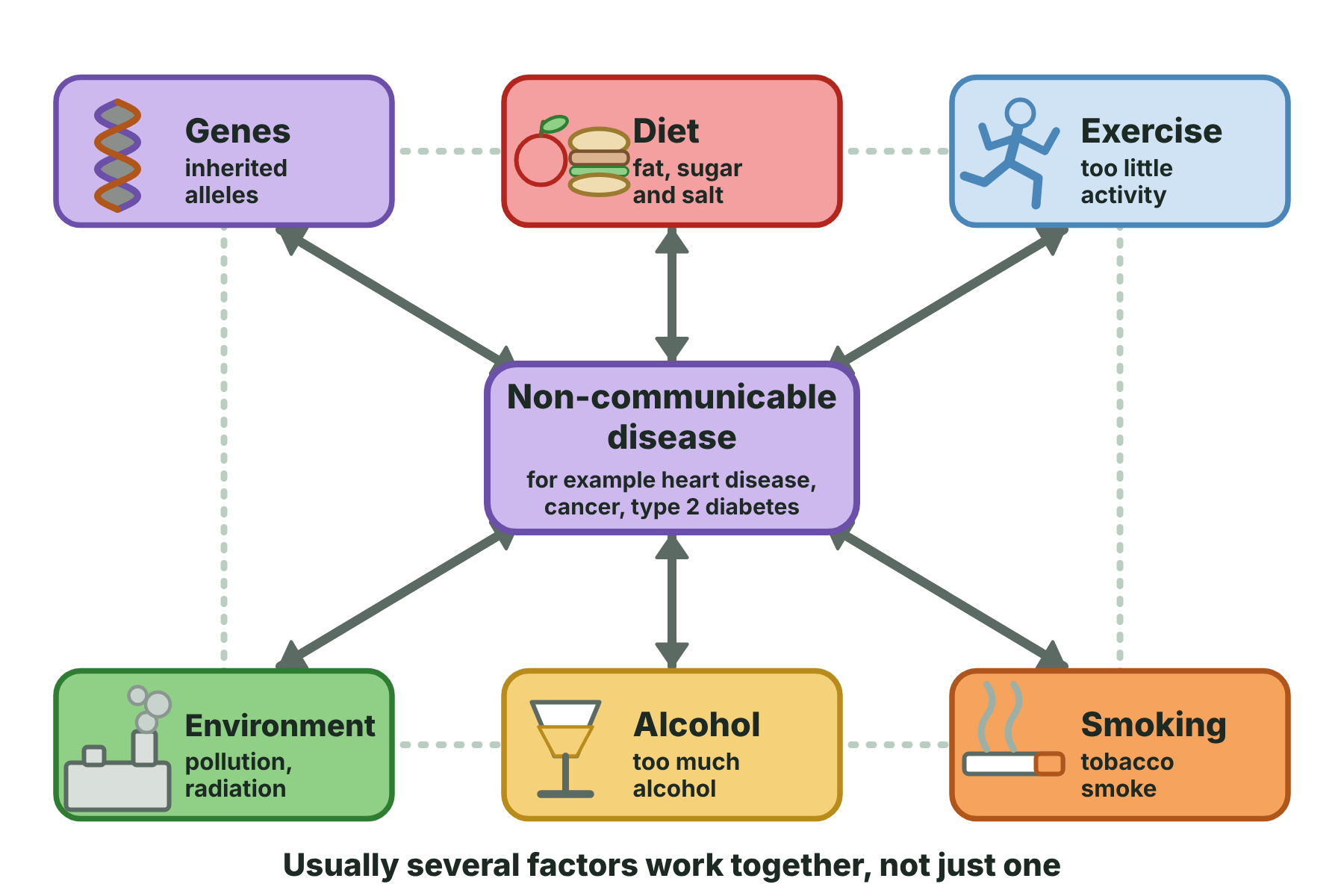
Most non-communicable diseases are caused by a number of factors that interact.
Many factors, working together
A person who gets heart disease, or a cancer, did not have just one cause. Several risk factors usually combine.
-
Genes
You inherit alleles that make some diseases more likely, for example a tendency to a high level of cholesterol in the blood.
-
Lifestyle
What you eat and drink, how much you exercise, and whether you smoke or drink alcohol have large effects.
-
The environment
Air pollution, radiation, workplace chemicals such as asbestos and the amount of sun that you get can all raise the risk.
-
Age and other conditions
The risk of most diseases rises with age. Being obese raises the risk of heart disease, type 2 diabetes and cancer.
-
A risk factor
A risk factor is something that increases the chance of getting a disease. It does not mean that a person will definitely get it, and a person with no risk factors can still become ill.
-
Interaction
The risk factors can multiply each other. A person who smokes and has high blood pressure has a much higher risk of a heart attack than the effect of each factor added together.
Correlation and cause
Scientists find risk factors by looking for patterns in data from large numbers of people.
-
Correlation
A correlation is a link between two variables. A scatter diagram can show a positive correlation, where both rise together, a negative correlation, where one rises as the other falls, or no correlation.
-
Correlation is not cause
Two things can rise together without one causing the other. For example, ice cream sales and sunburn both rise in summer, because of the weather.
-
Evidence of a cause
A cause is more likely if the correlation is found in many large studies, if the effect is bigger with a greater dose, and if there is a scientific explanation of how the factor could cause the disease.
-
Sample size
Larger samples, which are chosen at random, give more reliable results than small ones.
Local, national and global levels
The effects of lifestyle on health can be seen at all scales.
-
Local
Rates of disease can differ between areas of a town, because of differences in income, access to fresh food and places to exercise, and the number of people who smoke.
-
National
These diseases cost a country a great deal. In the UK the NHS spends billions of pounds each year on treating diabetes, heart disease and cancer. Governments try to reduce the risk by laws, such as the ban on smoking in public places, and by campaigns.
-
Global
Non-communicable diseases are rising fastest in low and middle income countries, as diets change to include more processed food, and as more people smoke and live in cities.
Communicable and non-communicable diseases
Communicable diseases
- Caused by a pathogen such as a virus or a bacterium
- Can be passed from person to person
- Often develop quickly, and may last a short time
- Examples are flu, cholera and malaria
Non-communicable diseases
- Not caused by a pathogen, and cannot be passed on
- Have several causes, including genes and lifestyle
- Often develop slowly, and last a long time
- Examples are heart disease, many cancers and type 2 diabetes
Comparing risk in two groups
In a study, 500 smokers and 1500 non-smokers were followed for 20 years. 75 of the smokers and 45 of the non-smokers developed a lung disease. Calculate the percentage in each group, and say how many times more likely the smokers were to develop a lung disease.
Show the solutionHide the solution
- 1 Smokers \(75 \div 500 \times 100 = 15\%\).
- 2 Non-smokers \(45 \div 1500 \times 100 = 3\%\).
- 3 Compare \(15 \div 3 = 5\), so smokers were 5 times as likely.
- 4 Careful The groups may differ in other ways, such as age or where they live, so further evidence is needed to show cause.
Answer15% of smokers and 3% of non-smokers developed a lung disease, so smokers were 5 times as likely to develop it. This is a correlation, and other evidence is needed to show that smoking is the cause.
Case study
Doll and Hill: the doctors who showed that smoking harms
In the 1950s lung cancer deaths were rising quickly in Britain, and many people suspected that smoking was to blame. In 1951 the scientists Richard Doll and Austin Bradford Hill asked all of the doctors in Britain to answer questions about their smoking, and followed more than 30 000 of them for decades. They found that the death rate from lung cancer rose with the number of cigarettes smoked, and that those who gave up smoking had a lower risk. The size of the study, and the clear pattern, convinced most scientists that smoking is a cause of lung cancer.
Summary and exam focus
- Non-communicable diseases are not caused by pathogens, and cannot be passed on.
- Examples are cardiovascular diseases, cancers, some lung and liver diseases, and diseases linked to nutrition.
- Most have several causes, including genes, lifestyle and the environment.
- A risk factor increases the chance of disease, but does not make it certain.
- A correlation does not prove a cause.
Exam focus
Explain why many non-communicable diseases are caused by a number of factors working together, and describe how scientists can tell if a risk factor is a cause of a disease. (6 marks) (6 marks)
Name two or three factors, such as genes, diet and smoking, and say that they interact. Then say that a correlation does not prove a cause, and that you need large samples, a clear mechanism and repeated studies to show that a factor causes the disease.
Key terms
The words this lesson expects you to use. Each one is linked from the first place it appears above.
- Non-communicable disease
- A disease that is not caused by a pathogen and cannot be passed from one person to another.
- Risk factor
- Something that increases the chance of developing a disease.
- Cardiovascular disease
- A disease of the heart or blood vessels.
- Correlation
- A link between two variables.
- Lifestyle
- The way a person lives, including their diet, exercise and habits.
- Deficiency disease
- A disease caused by a lack of a nutrient.
- Obesity
- Having a very high amount of body fat.
- Interaction
- When factors affect each other, so that the combined effect is different to the effects on their own.
- Carcinogen
- A substance or radiation that can cause cancer.
You've finished the notes
Check your understanding
Test yourself while it is fresh. Start with the flashcards, then try the exam questions.
Something here looks wrong?
Tell us what and we will go and look. It goes to whoever writes these pages, nobody else, and we do not ask who you are — so there is nothing to sign and nothing comes back to you.