Biology · Selective Breeding and Genetic Engineering
GM Crops
Some crops now carry a gene from a bacterium that protects them from insects. This lesson is for separate Biology only: Combined Science students do not need it. It explains how GM crops such as Bt maize are made and works through the advantages and disadvantages.
Learning Objectives
- 1Describe how a gene for insect resistance from Bacillus thuringiensis is introduced into a crop plant.
- 2Explain how the Bt toxin protects the crop from insect pests.
- 3Explain the advantages and the disadvantages of GM crops.
- 4Evaluate the use of GM crops in agriculture.
Retrieval practice
-
1
What is genetic engineering?
Show answerHide answer
Modifying the genome of an organism by adding a gene from another organism.
-
2
What is a vector?
Show answerHide answer
A carrier that moves a gene into a host cell, such as a plasmid.
-
3
What is a pest?
Show answerHide answer
An organism that damages crops or other things that people value.
-
4
What is natural selection?
Show answerHide answer
The process by which better adapted individuals survive and reproduce.
Crops that make their own insecticide
Insect pests can destroy a large part of a crop, and farmers have to spray insecticides to protect it. These chemicals cost money, and can harm wildlife and the people who use them. Genetic engineering offers another approach. Scientists have given crop plants a gene from a soil bacterium, Bacillus thuringiensis, that makes a protein which is poisonous to certain insects. The plants make the protein themselves, so the insects die when they eat the crop.
Making an insect-resistant crop
The stages follow the general method of genetic engineering.
-
1
Find the gene
Bacillus thuringiensis (Bt) makes a protein toxin that kills the larvae of some moths and beetles. The gene for the toxin is identified.
-
2
Cut it out
A restriction enzyme removes the Bt gene from the bacterial DNA.
-
3
Insert into a vector
The gene is joined into a plasmid from a bacterium that infects plants, using ligase.
-
4
Transfer to plant cells
The bacterium infects plant cells and puts the gene into the plant's chromosomes.
-
5
Grow plants
The modified plant cells are grown by tissue culture into whole plants, which all carry the Bt gene.
-
6
The plant makes the toxin
The cells of the crop make the Bt protein, so insects that eat it are killed.
How a Bt crop protects itself
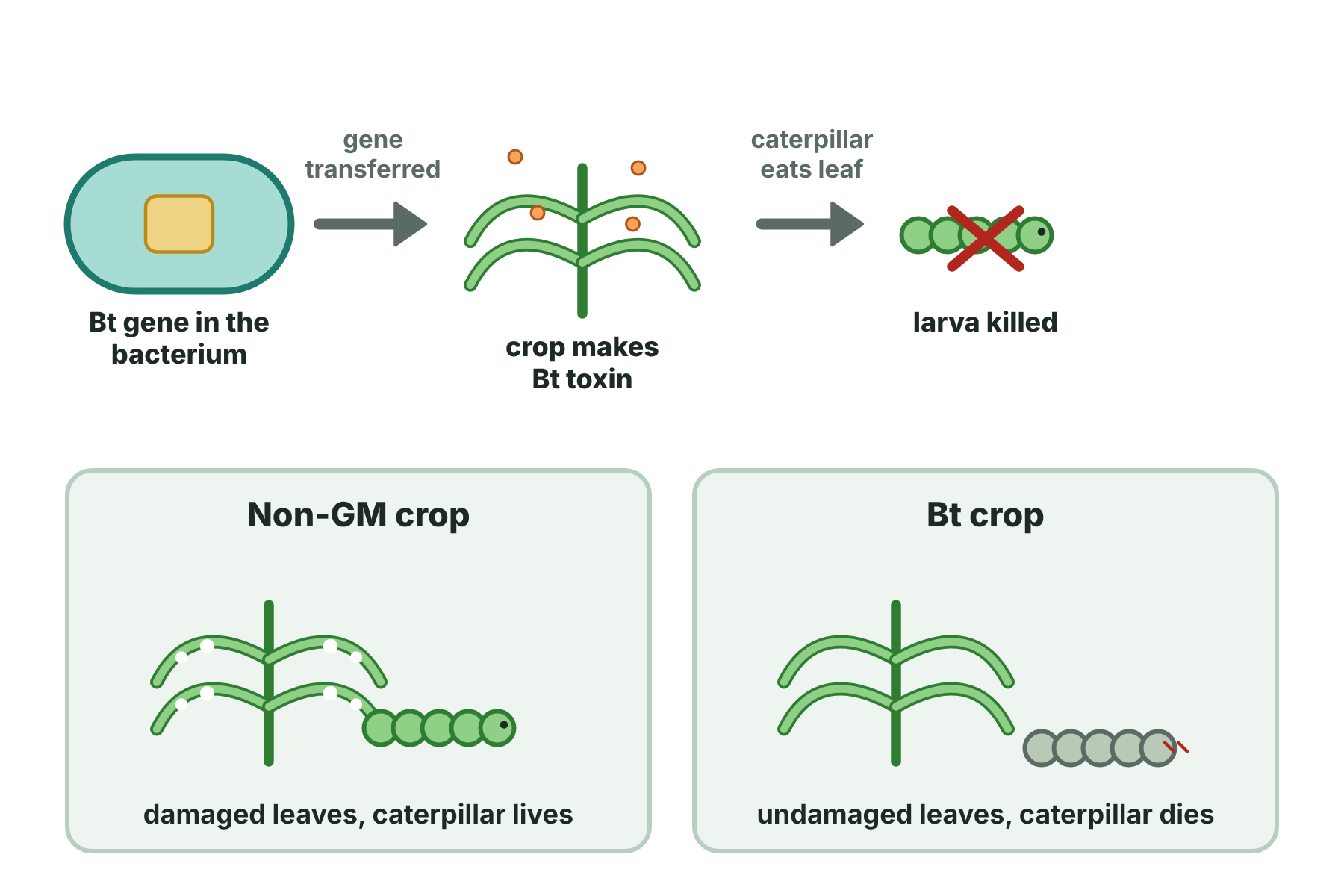
The crop makes the toxin, so caterpillars that eat it die and the plant is not damaged.
Advantages of GM crops
The main benefit is that crops are better protected, and farmers can grow more food.
-
Higher yields
Less of the crop is eaten by pests, so more of it can be harvested.
-
Less spraying
Farmers use fewer chemical insecticides, which saves money and time, and reduces pollution of soil and water.
-
Fewer harmful effects on wildlife
Insects that do not feed on the crop, such as bees, are not hit by sprays.
-
Healthier for farmers
In some countries farmers who spray by hand have suffered insecticide poisoning, and Bt crops reduce this.
-
Other benefits
Crops can be engineered to resist weedkillers or drought, or to contain more nutrients, as in golden rice.
Disadvantages and concerns
Many people are worried about GM crops, and some of the concerns are scientific.
-
Resistance may evolve
Insects can evolve resistance to the Bt toxin by natural selection, so that the crop no longer protects itself. Farmers are told to grow a refuge of non-GM crop nearby.
-
Effects on other organisms
The toxin could harm non-target insects, such as butterflies, if they eat pollen from the crop, and so reduce biodiversity.
-
Gene transfer
Genes could spread by pollen to wild relatives or to non-GM crops, and might create problem weeds.
-
Cost and control
GM seeds are patented and more expensive, and farmers often have to buy new seed each year, which can be hard on poor farmers.
-
Public concerns
Some people worry that eating GM food could be unsafe. Tests have so far found no harm to health, but some people want long-term studies.
Bt crops and conventional crops
Conventional crop
- Needs insecticides to be sprayed
- Insecticides may harm other insects
- More of the crop may be lost to pests
- Seed can be saved from year to year
Bt crop
- Makes its own insecticide in its cells
- Only insects that eat the crop are affected
- Less of the crop is lost
- Seed is usually bought new each year
Calculating the benefits
A farmer sprays a field of conventional maize 6 times in a season, and a field of Bt maize twice. The yield of the conventional field is 8.0 tonnes per hectare, and the Bt field is 9.2 tonnes per hectare. Calculate the percentage reduction in spraying, and the percentage increase in yield.
Show the solutionHide the solution
- 1 Reduction in sprays \(6 - 2 = 4\) fewer sprays.
- 2 Percentage reduction \(4 \div 6 \times 100 = 66.7\%\), which is 67%.
- 3 Increase in yield \(9.2 - 8.0 = 1.2\) tonnes per hectare.
- 4 Percentage increase \(1.2 \div 8.0 \times 100 = 15\%\).
AnswerSpraying is reduced by 67% (to the nearest whole number), and the yield is increased by 15%.
Case study
Bt cotton in India
Cotton is badly damaged by the cotton bollworm, and farmers used to spray insecticide many times. Bt cotton was introduced in India in 2002, and it is now grown on most of the country's cotton land. Studies reported higher yields and a big fall in the use of insecticide. However, the seed costs more, and in some places the bollworm has evolved resistance to the Bt toxin, which shows the risk of relying on one gene. It is a case where the benefits and the problems can both be seen.
Summary and exam focus
- The gene for the toxin of Bacillus thuringiensis (Bt) is transferred to crop plants such as maize and cotton.
- The plants make the Bt toxin, which kills the caterpillars that feed on them.
- Advantages are higher yields and less spraying with insecticide.
- Disadvantages are the evolution of resistance, possible harm to other organisms, gene transfer and cost.
- Evaluation needs a balanced judgement, with evidence.
Exam focus
Describe how a crop plant can be modified to resist insects, and evaluate the use of GM crops in agriculture. (6 marks) (6 marks)
Describe the transfer of the Bt gene to the plant, and its effect: the plant makes toxin. In the evaluation, give at least two advantages and two concerns, such as the evolution of resistance and the effect on other species, and finish with a judgement.
Key terms
The words this lesson expects you to use. Each one is linked from the first place it appears above.
- GM crop
- A crop plant that has had its genes changed by genetic engineering.
- Bacillus thuringiensis
- A soil bacterium that makes a toxin that kills certain insects.
- Bt toxin
- A protein made by Bacillus thuringiensis that is poisonous to some insect larvae.
- Pest
- An organism that damages a crop or something else people value.
- Insecticide
- A chemical that kills insects.
- Yield
- The amount of crop that is produced from an area of land.
- Biodiversity
- The variety of living things in an area.
- Refuge
- A part of a field planted with non-GM crop, so that some insects stay non-resistant.
- Herbicide
- A chemical that kills weeds.
You've finished the notes
Check your understanding
Test yourself while it is fresh. Start with the flashcards, then try the exam questions.
Something here looks wrong?
Tell us what and we will go and look. It goes to whoever writes these pages, nobody else, and we do not ask who you are — so there is nothing to sign and nothing comes back to you.