Biology · Selective Breeding and Genetic Engineering
The Stages of Genetic Engineering (Higher tier)
How exactly is a gene cut out and put into a bacterium? This lesson is for the Higher tier only: Foundation students do not need it. It covers the main stages of genetic engineering, with restriction enzymes, ligase, sticky ends and vectors.
Learning Objectives
- 1(Higher tier) Describe the main stages of genetic engineering.
- 2(Higher tier) Explain the role of restriction enzymes and sticky ends.
- 3(Higher tier) Explain the role of DNA ligase and of a vector.
- 4(Higher tier) Describe how the recombinant DNA is put into a host cell, and how the product is made.
Retrieval practice
-
1
What is genetic engineering?
Show answerHide answer
Modifying the genome of an organism by adding a gene from another organism.
-
2
What is a plasmid?
Show answerHide answer
A small ring of DNA in a bacterium.
-
3
What is an enzyme?
Show answerHide answer
A biological catalyst, made of protein, that speeds up reactions.
-
4
Which bases pair together in DNA?
Show answerHide answer
A with T, and C with G.
Molecular scissors and glue
To move a gene from one organism to another, scientists need tools that can cut DNA at exact places and join pieces together. Enzymes provide them. Restriction enzymes act as molecular scissors, which cut DNA at particular base sequences, and DNA ligase acts as molecular glue. A small ring of DNA, called a vector, then carries the gene into a host cell, where it can be copied and used.
The main stages
Learn the stages in order, and the name of the enzyme in each.
-
1
Isolate the gene
Use a restriction enzyme to cut the gene from the DNA of the donor organism. It leaves sticky ends.
-
2
Prepare the vector
Cut a plasmid with the same restriction enzyme, so that it has matching sticky ends.
-
3
Join the gene and the vector
Mix the gene and the cut plasmid. The sticky ends pair up by complementary base pairing, and DNA ligase joins the backbones to make recombinant DNA.
-
4
Insert into the host
The recombinant plasmid is put into a bacterium, for example by a brief heat shock.
-
5
Grow and collect
Grow the bacteria in a fermenter. They copy the plasmid, make the protein, and the product can be collected and purified.
Cutting and joining DNA
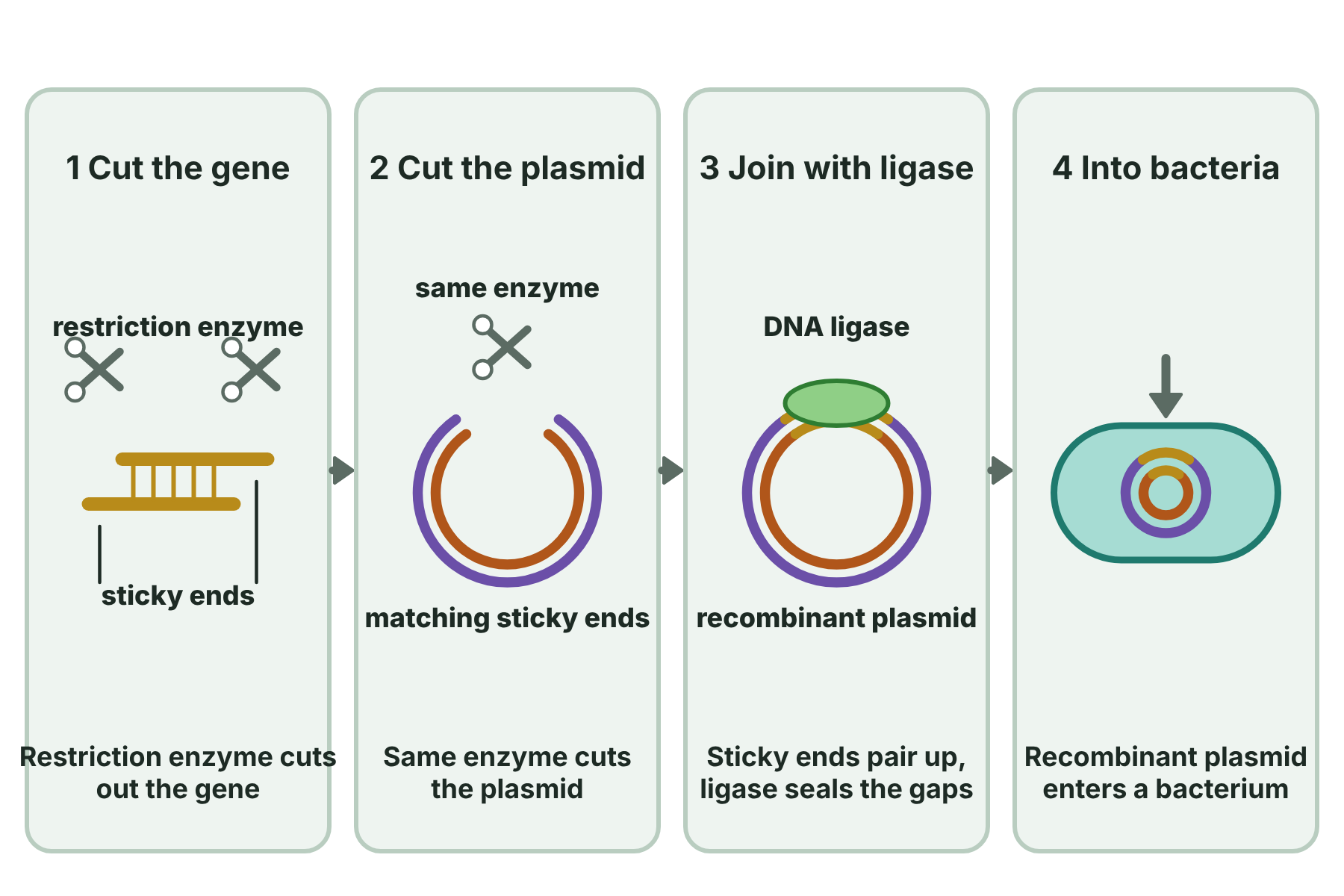
The same restriction enzyme gives matching sticky ends on the gene and the plasmid.
Restriction enzymes and sticky ends
The key to cutting the DNA in the right place is the shape of the enzyme.
-
Specific
Each restriction enzyme recognises a particular short sequence of bases, such as GAATTC, and cuts the DNA there. It does not cut elsewhere.
-
Sticky ends
Many enzymes cut the two strands at slightly different places, so that a few unpaired bases stick out from each end. These are called sticky ends.
-
Matching ends
Sticky ends are made of unpaired bases that can pair with a complementary set. If the same enzyme is used on the gene and on the plasmid, the sticky ends will match.
-
Why use one enzyme
It means that any piece of DNA cut with the enzyme can be joined to any other piece that has been cut with it.
DNA ligase and the vector
Two more tools complete the process.
-
DNA ligase
An enzyme that joins the sugar-phosphate backbones of the DNA, sealing the gaps between the gene and the plasmid, so that the DNA is a single continuous molecule.
-
Recombinant DNA
The new combination of DNA from two sources, here the plasmid with the gene in it.
-
Vector
A carrier that takes the gene into a host cell. Plasmids are used, as they are small, can be copied in the bacterium, and are easily taken up. Viruses can also be used as vectors for gene therapy.
-
Host cell
The cell that receives the recombinant DNA. Bacteria are often used because they grow and reproduce quickly.
Matching sticky ends
A restriction enzyme cuts a plasmid and leaves the sticky end A A T T on one strand. State the sequence of the sticky end that would pair with it on the gene fragment, and name the enzyme that would join them.
Show the solutionHide the solution
- 1 Use base pairing A pairs with T, and T pairs with A.
- 2 Pair each base A A T T pairs with T T A A.
- 3 Name the joining enzyme DNA ligase forms the bonds in the backbone.
AnswerT T A A, and the enzyme DNA ligase joins them.
Restriction enzymes and ligase
Restriction enzyme
- Cuts DNA at a specific base sequence
- Leaves sticky ends
- Used to remove the gene and to open the plasmid
- Acts like a pair of scissors
DNA ligase
- Joins pieces of DNA together
- Seals the backbone between the sticky ends
- Used to make recombinant DNA
- Acts like glue
Growing the product
Once the recombinant plasmid is inside the bacteria, they can be used to make large amounts of the protein.
-
Take up the plasmid
Bacteria are treated, for example by a heat shock, so that some of them take up the plasmid.
-
Selecting the bacteria
Only a few bacteria take up the plasmid, so they are identified using a marker gene on the plasmid, such as one for antibiotic resistance.
-
Fermenter
The bacteria are grown in a large vessel with nutrients, at the right temperature and pH, so that they multiply.
-
Product
The bacteria make the protein, such as insulin, which is separated and purified.
Case study
Restriction enzymes from bacteria
Restriction enzymes are made naturally by bacteria, as a defence against viruses. If a virus injects its DNA, the enzyme cuts it up at a particular sequence, so it cannot take over the cell. The bacterium protects its own DNA by marking it so that the enzyme does not cut it. Scientists discovered these enzymes in the 1970s, and found they could use them as precise tools for cutting DNA. More than a hundred are now available.
Summary and exam focus
- A restriction enzyme cuts the insulin gene out of human DNA, leaving sticky ends.
- The same restriction enzyme cuts a plasmid, the vector, and gives it matching sticky ends.
- The gene and the plasmid are mixed, and DNA ligase joins them to form recombinant DNA.
- The recombinant plasmid is put into bacteria, which are grown in a fermenter.
- The bacteria make insulin, which is collected and purified.
Exam focus
Describe the main stages of genetic engineering to produce human insulin in bacteria, including the use of restriction enzymes, ligase, sticky ends and vectors. (6 marks) (6 marks)
Write the stages in order and name the enzyme and the role of it at each stage. Explain that the same restriction enzyme gives matching sticky ends, and that ligase joins the DNA, so that it can be put into the host by a vector.
Key terms
The words this lesson expects you to use. Each one is linked from the first place it appears above.
- Restriction enzyme
- An enzyme that cuts DNA at a specific base sequence.
- DNA ligase
- An enzyme that joins pieces of DNA together.
- Sticky ends
- Short stretches of unpaired bases left at the ends of DNA cut by a restriction enzyme.
- Vector
- A carrier, such as a plasmid, used to transfer a gene into a host cell.
- Recombinant DNA
- DNA made by joining DNA from two different sources.
- Plasmid
- A small ring of DNA found in bacteria, used as a vector.
- Host cell
- A cell that receives recombinant DNA.
- Marker gene
- A gene on a plasmid, such as for antibiotic resistance, which shows which cells have taken it up.
- Complementary
- Able to pair with each other, such as the bases A and T.
You've finished the notes
Check your understanding
Test yourself while it is fresh. Start with the flashcards, then try the exam questions.
Something here looks wrong?
Tell us what and we will go and look. It goes to whoever writes these pages, nobody else, and we do not ask who you are — so there is nothing to sign and nothing comes back to you.