Biology · Selective Breeding and Genetic Engineering
Genetic Engineering
Genetic engineering lets scientists move a gene from one species to another in a single step. This lesson explains what genetic engineering is, why it works, and how it is used to make medicines and improve crops.
Learning Objectives
- 1Describe genetic engineering as a process that involves modifying the genome of an organism to introduce desirable characteristics.
- 2Explain why a gene can work in a different organism.
- 3Give examples of genetic engineering in medicine and in agriculture.
- 4Compare genetic engineering with selective breeding.
Retrieval practice
-
1
What is a gene?
Show answerHide answer
A section of DNA that codes for a specific protein.
-
2
What is the genome?
Show answerHide answer
The entire DNA of an organism.
-
3
What is selective breeding?
Show answerHide answer
Humans choosing which organisms breed, to produce desired characteristics.
-
4
What type of organism makes insulin in humans?
Show answerHide answer
Cells in the pancreas.
Moving genes between species
Selective breeding can only work with the genes that a species already has. Genetic engineering is a much more powerful technique. In genetic engineering, a gene is taken from one organism and put into the genome of another, so that the second organism gains a new characteristic. The result is a genetically modified (GM) organism. It was first achieved in the 1970s, and today it is used to make medicines, to improve crops and to study disease.
Why can a gene work in another species?
It seems surprising that a human gene can work in a bacterium, but it does.
-
One genetic code
All living things use the same genetic code, in which a triplet of bases codes for the same amino acid in every organism.
-
Same machinery
Bacteria, plants and humans all make proteins by transcription and translation, so a bacterium can read a human gene.
-
A copy that is passed on
When the host cell divides, the new gene is copied with the rest of the DNA, so every new cell has it.
-
Characteristic changes
The gene makes its protein in the new host, which gives the organism a new characteristic.
The basic idea of genetic engineering
The detailed stages are covered at Higher tier. This is the outline.
-
1
Find the gene
Identify the gene for the characteristic that you want, in the organism that has it.
-
2
Cut it out
Remove the gene from the DNA of that organism.
-
3
Insert it
Put the gene into the genome of the target organism, often using a vector such as a plasmid.
-
4
Grow the host
The host cells are grown, and copy the new gene each time they divide.
-
5
Express the gene
The host makes the new protein, and the new characteristic appears.
Making human insulin in bacteria
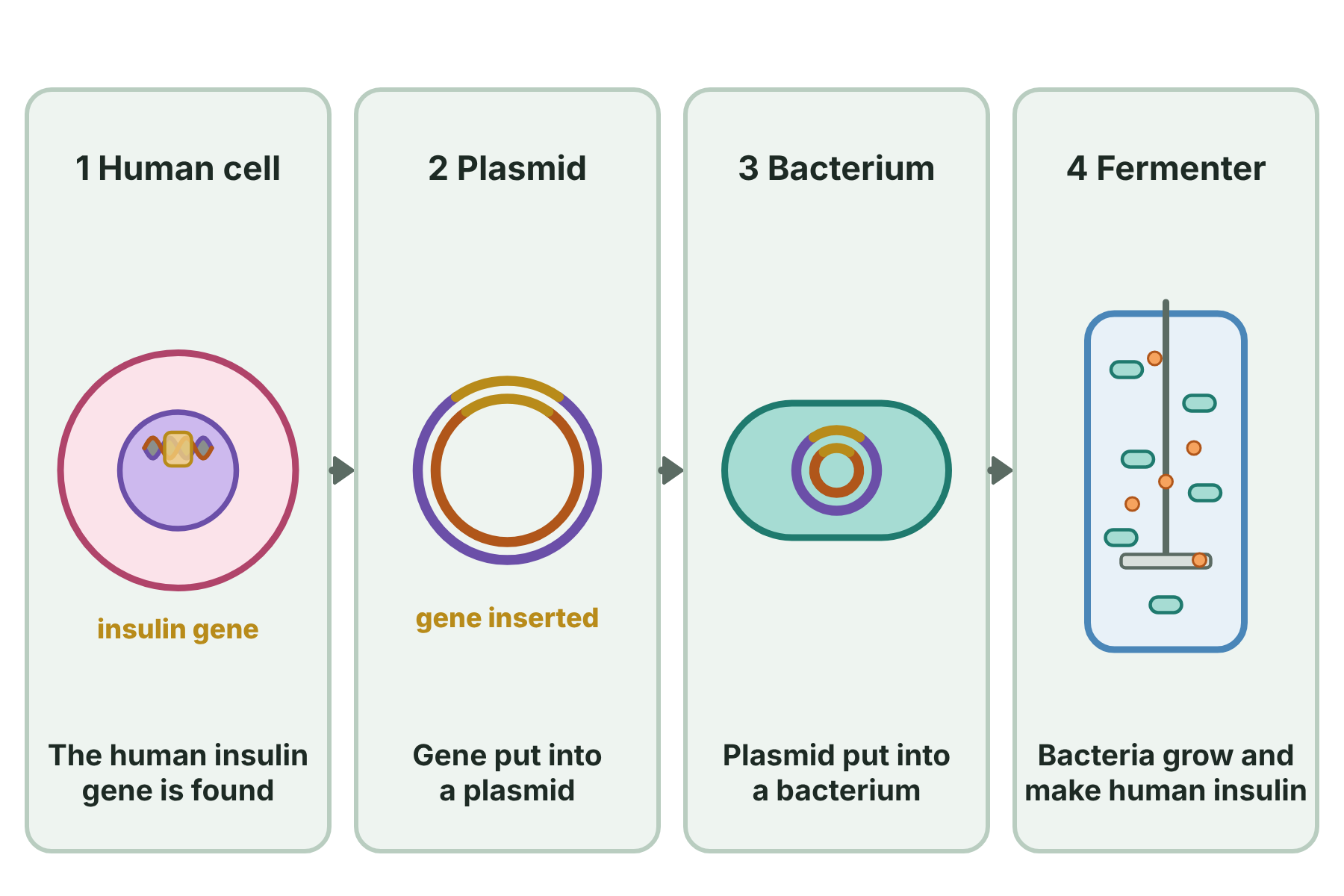
Bacteria with the human gene make human insulin, using the same genetic code.
Uses in medicine
Genetic engineering has made several important medicines.
-
Human insulin
Bacteria with the human insulin gene make insulin for people with diabetes. It replaced insulin from pigs and cattle, and was first sold in 1982.
-
Other proteins
Human growth hormone and clotting factors for haemophilia are made in the same way.
-
GM animals
Some goats and sheep have been engineered to make human proteins in their milk.
-
Gene therapy
A healthy copy of a faulty gene can be put into a patient's cells, as in some treatments for severe inherited immune deficiency.
Uses in agriculture
Crop plants can be modified to give new characteristics.
-
Insect resistance
Crops with a gene that makes a toxin harmful to certain insects need less pesticide.
-
Herbicide resistance
Crops that tolerate a weedkiller allow farmers to kill the weeds without harming the crop.
-
Golden rice
Rice that has had genes added so that it makes beta-carotene, which the body turns into vitamin A, to help to prevent vitamin A deficiency.
-
Longer shelf life
Fruits such as tomatoes can be modified to ripen more slowly.
Selective breeding and genetic engineering
Selective breeding
- Uses genes already in the species
- Takes many generations
- Chooses whole organisms, with all their genes
- Cannot add genes from another species
Genetic engineering
- Can use a gene from any species
- Takes effect in one generation
- Moves one gene, or a few, at a time
- Can give a species a completely new characteristic
Case study
The first GM medicine
Before 1982, insulin for diabetes had to be taken from the pancreas of pigs and cattle, and it was not identical to human insulin, so a few patients had reactions to it. Scientists at the American company Genentech inserted the human insulin gene into bacteria, which made insulin that was identical to a person's own. Human insulin from bacteria was approved for use in 1982, and it was the first GM medicine. Now most insulin used by people with diabetes is made by genetically engineered bacteria or yeast.
Summary and exam focus
- Genetic engineering is modifying the genome of an organism by adding a gene from another organism.
- All organisms use the same genetic code, so a gene can work in a different species.
- Human insulin is made by bacteria that contain the human gene.
- GM crops include those with insect resistance or herbicide resistance, and golden rice.
- Unlike selective breeding, it can add genes from any species, in a single generation.
Exam focus
Describe what is meant by genetic engineering, and explain why a gene from a human can be made to work in a bacterium. (4 marks) (4 marks)
Define genetic engineering as moving a gene from one organism to the genome of another, to give a desired characteristic. For the explanation, say that all organisms use the same genetic code, so the bacterium makes the same protein from the human gene.
Key terms
The words this lesson expects you to use. Each one is linked from the first place it appears above.
- Genetic engineering
- Modifying the genome of an organism by introducing a gene from another organism, to give a desirable characteristic.
- Genetically modified (GM)
- An organism that has had its genes changed by genetic engineering.
- Genome
- The entire DNA of an organism.
- Vector
- A carrier, such as a plasmid, that is used to move a gene into a cell.
- Plasmid
- A small ring of DNA found in bacteria.
- Gene therapy
- Treating a genetic disorder by putting a healthy gene into a patient's cells.
- Insulin
- A hormone that controls blood glucose, which is used to treat diabetes.
- Golden rice
- A GM rice that makes beta-carotene.
- Fermenter
- A large vessel in which microorganisms are grown to make a product.
You've finished the notes
Check your understanding
Test yourself while it is fresh. Start with the flashcards, then try the exam questions.
Something here looks wrong?
Tell us what and we will go and look. It goes to whoever writes these pages, nobody else, and we do not ask who you are — so there is nothing to sign and nothing comes back to you.