Biology · The Nervous System
The Brain
The brain is the control centre of the body. This lesson is for separate Biology only: Combined Science students do not need it. It covers the cerebral hemispheres, the cerebellum and the medulla oblongata, and what each one does.
Learning Objectives
- 1Describe the structure of the human brain, naming the cerebral hemispheres, the cerebellum and the medulla oblongata.
- 2Describe the function of each of these three regions.
- 3Explain how damage to a part of the brain affects the body.
- 4Link the structure of the brain to the way it coordinates voluntary and unconscious actions.
Retrieval practice
-
1
What two organs make up the central nervous system?
Show answerHide answer
The brain and the spinal cord.
-
2
What carries impulses from the CNS to an effector?
Show answerHide answer
A motor neurone.
-
3
What is a voluntary action?
Show answerHide answer
An action controlled by conscious thought.
-
4
What is a reflex action?
Show answerHide answer
A fast, automatic response that does not involve conscious thought.
The control centre
The human brain has a mass of about 1.4 kg and contains around 86 billion neurones. It receives information from every receptor in the body, decides what to do and sends messages to the effectors. It is protected by the skull and by membranes called meninges, and it is cushioned by fluid. Different parts of the brain do different jobs, and the three main regions you need to know are the cerebral hemispheres, the cerebellum and the medulla oblongata.
The three main regions
Each region has its own structure and its own jobs.
-
Cerebral hemispheres
The two large, folded halves at the top and front of the brain. They control the highest functions: consciousness, intelligence, memory, language and voluntary movement.
-
Cerebellum
A smaller, tightly folded region at the back, below the hemispheres. It coordinates movement and balance, and keeps the body upright.
-
Medulla oblongata
The part of the brain at the base, which joins the brain to the spinal cord. It controls unconscious activities such as the heart rate and the breathing rate.
Regions of the brain
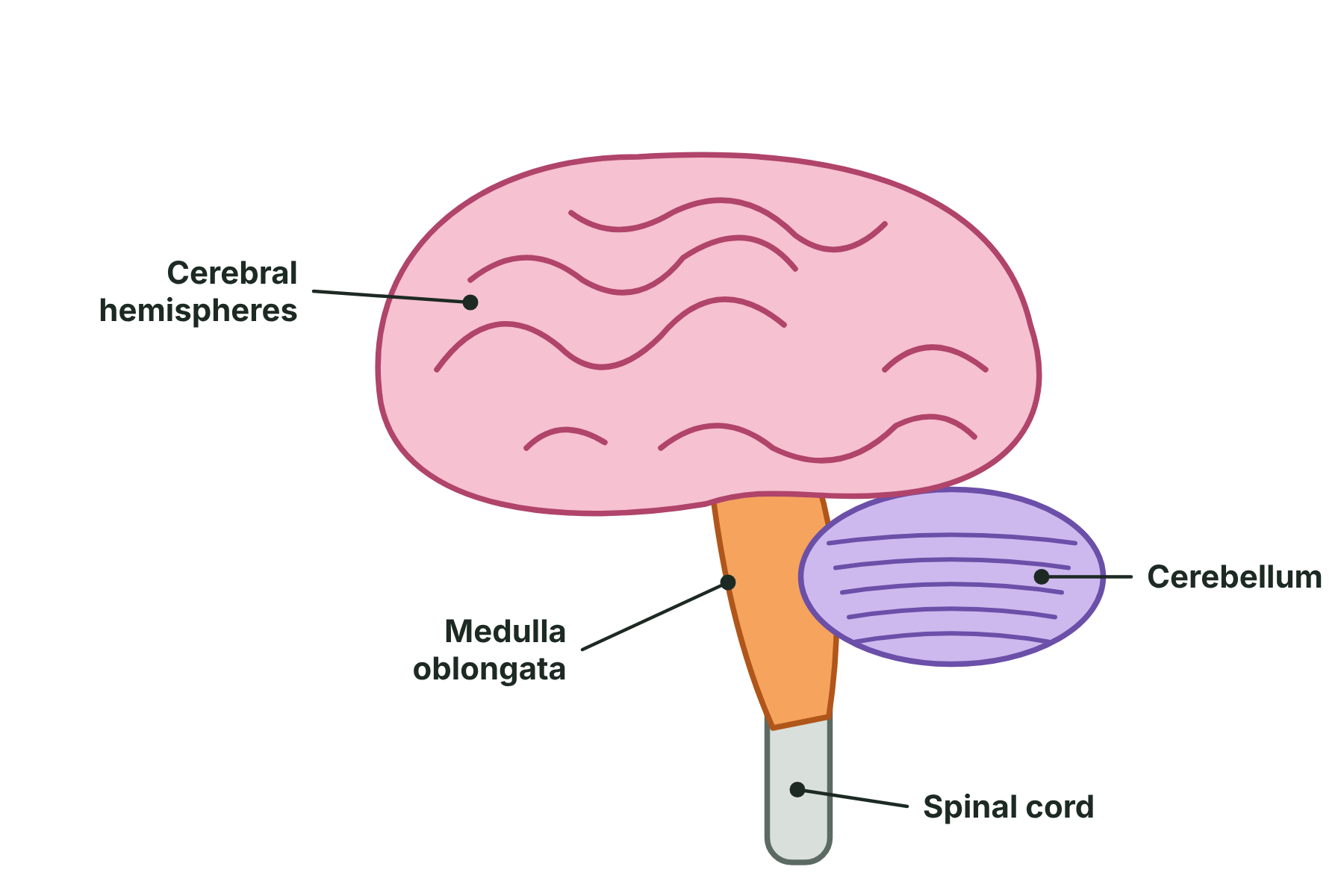
The three regions you need to know, and the spinal cord that continues from the medulla.
The cerebral hemispheres
The cerebral hemispheres are the largest part of the human brain, and the part that makes us most different from other animals.
-
Two halves
The brain is divided into a left and a right hemisphere, joined in the middle. In general, each side deals with the opposite side of the body.
-
A folded surface
The outer layer, called the cerebral cortex, is folded into ridges and grooves. The folds give a very large surface area, which fits many more neurones into the skull.
-
Different areas have different jobs
Some areas receive information from the senses, such as vision at the back of the brain. Some areas send impulses to muscles to start movement. Other areas are used for thinking, memory and language.
-
Conscious thought
Learning, remembering, speaking and deciding all happen in the hemispheres.
The cerebellum and the medulla oblongata
These regions work automatically, in the background, and keep the body running.
-
Cerebellum: balance
It receives information from the ears and the muscles about the position of the body, and uses it to keep you balanced.
-
Cerebellum: coordination
It makes sure that movements are smooth and precise. Riding a bike, catching a ball or playing the piano all rely on it.
-
Medulla oblongata: unconscious control
It controls the activities that you do not have to think about, including the heart rate and the breathing rate.
-
Medulla oblongata: a vital link
It also connects the brain to the spinal cord, so all the impulses between the brain and the body pass through it.
Catching a ball
Even a simple action uses all three regions at once.
-
1
Eyes detect the ball
Light receptors send impulses along the optic nerve to the visual area at the back of the cerebral hemispheres.
-
2
Hemispheres decide
The cerebral hemispheres recognise the ball and decide to catch it.
-
3
Impulses sent to the muscles
A motor area sends impulses along motor neurones to the muscles of the arm and hand.
-
4
Cerebellum coordinates
The cerebellum adjusts the movements and keeps the body balanced as the arm moves.
-
5
Medulla keeps the body supplied
The medulla increases the heart rate and breathing rate to supply the muscles with more oxygen.
Conscious and unconscious control
Cerebral hemispheres
- Control actions that you choose to do
- Used for thinking, memory, language and intelligence
- Receive and interpret information from the senses
- Damage can change personality or cause loss of speech
Cerebellum and medulla oblongata
- Control actions that happen automatically
- Cerebellum: balance and smooth movement
- Medulla: heart rate and breathing rate
- Damage can cause clumsiness or be life threatening
Case study
Phineas Gage
In 1848 a railway worker called Phineas Gage was packing explosive into a rock when it went off, and an iron rod about a metre long passed through the front of his head. He survived, and could walk and talk, but people who knew him said his personality changed and that he became impatient and hard to deal with. His case was one of the first to suggest that different parts of the brain are responsible for different functions, in this case the parts of the cerebral hemispheres connected with behaviour.
What happens when part of the brain is damaged
Because each region has its own role, the effect of damage depends on where it is.
-
Stroke in the hemispheres
A blocked or burst blood vessel can stop oxygen reaching an area. This can cause paralysis on one side of the body, or problems with speech and memory.
-
Damage to the cerebellum
A person may have poor balance, shaky movements and difficulty with tasks such as walking in a straight line.
-
Damage to the medulla
It is often fatal, because the heart and breathing may stop being controlled.
-
Injury and disease
Head injuries, tumours and diseases such as Alzheimer's can all affect the brain, and the symptoms show which region is involved.
Summary and exam focus
- The cerebral hemispheres control consciousness, intelligence, memory, language and voluntary movement.
- The cerebellum coordinates movement and balance.
- The medulla oblongata controls unconscious activities such as heart rate and breathing.
- The medulla also joins the brain to the spinal cord.
- Damage to a region produces symptoms that depend on that region's job.
Exam focus
Describe the functions of the cerebral hemispheres, the cerebellum and the medulla oblongata. (6 marks) (6 marks)
Give two marks for each region. Name the region, state its main job using the exam words (consciousness and memory, balance and coordination, heart rate and breathing), and give a short example to show you understand it.
Key terms
The words this lesson expects you to use. Each one is linked from the first place it appears above.
- Brain
- The organ in the skull that coordinates the body's responses, and is the centre of conscious thought.
- Cerebral hemispheres
- The two large, folded halves of the brain, which control conscious thought, memory, language and voluntary movement.
- Cerebral cortex
- The thin, folded outer layer of the cerebral hemispheres.
- Cerebellum
- The part of the brain at the back that coordinates movement and balance.
- Medulla oblongata
- The part of the brain at the base that controls unconscious activities such as heart rate and breathing, and joins the brain to the spinal cord.
- Spinal cord
- A column of nervous tissue inside the backbone that carries impulses between the brain and the body.
- Unconscious activity
- An activity that is controlled without the person having to think about it.
- Stroke
- Damage to part of the brain caused by a blocked or burst blood vessel.
- Meninges
- The protective membranes that cover the brain and spinal cord.
You've finished the notes
Check your understanding
Test yourself while it is fresh. Start with the flashcards, then try the exam questions.
Something here looks wrong?
Tell us what and we will go and look. It goes to whoever writes these pages, nobody else, and we do not ask who you are — so there is nothing to sign and nothing comes back to you.