Biology · Homeostasis
Glucagon and Blood Glucose (Higher tier)
Between meals, and during exercise, the blood glucose concentration can fall, and then a second hormone comes into play. This lesson is for the Higher tier only: Foundation students do not need it. It explains how glucagon raises the blood glucose concentration, and how insulin and glucagon work together as a negative feedback system.
Learning Objectives
- 1(Higher tier) Describe when the pancreas releases glucagon, and where it acts.
- 2(Higher tier) Explain how glucagon raises the blood glucose concentration.
- 3(Higher tier) Explain how insulin and glucagon work together to keep the blood glucose concentration steady.
- 4(Higher tier) Interpret data on the control of blood glucose.
Retrieval practice
-
1
Which hormone lowers the blood glucose?
Show answerHide answer
Insulin.
-
2
What does the liver store glucose as?
Show answerHide answer
-
3
Where is insulin made?
Show answerHide answer
The pancreas.
-
4
What is negative feedback?
Show answerHide answer
A response that reverses a change, and returns a condition to normal.
When the glucose falls
The blood glucose concentration is not only raised by meals. It falls when a person has not eaten for several hours, or has exercised, because the cells keep using glucose in respiration. If it falls too low, the brain and the muscles run out of fuel for respiration. The body has a second hormone, glucagon, that acts in the opposite way to insulin. It is also made in the pancreas, and it raises the blood glucose concentration back to normal. This means that the level is controlled in both directions, which is possible because insulin and glucagon have opposite effects.
How glucagon works
Glucagon is a hormone that is made in the pancreas, and carried in the blood to the liver.
-
The change
The blood glucose concentration falls below the normal level, for example between meals.
-
The receptor
Cells in the pancreas detect the low glucose concentration.
-
The response
The pancreas releases the hormone glucagon into the blood.
-
Target organ
Glucagon is carried by the blood to the liver, where it acts on the liver cells.
-
The effect
Glucagon makes the liver convert the stored glycogen back into glucose, which is released into the blood.
-
The result
The blood glucose concentration rises back to normal, and less glucagon is released.
Insulin and glucagon
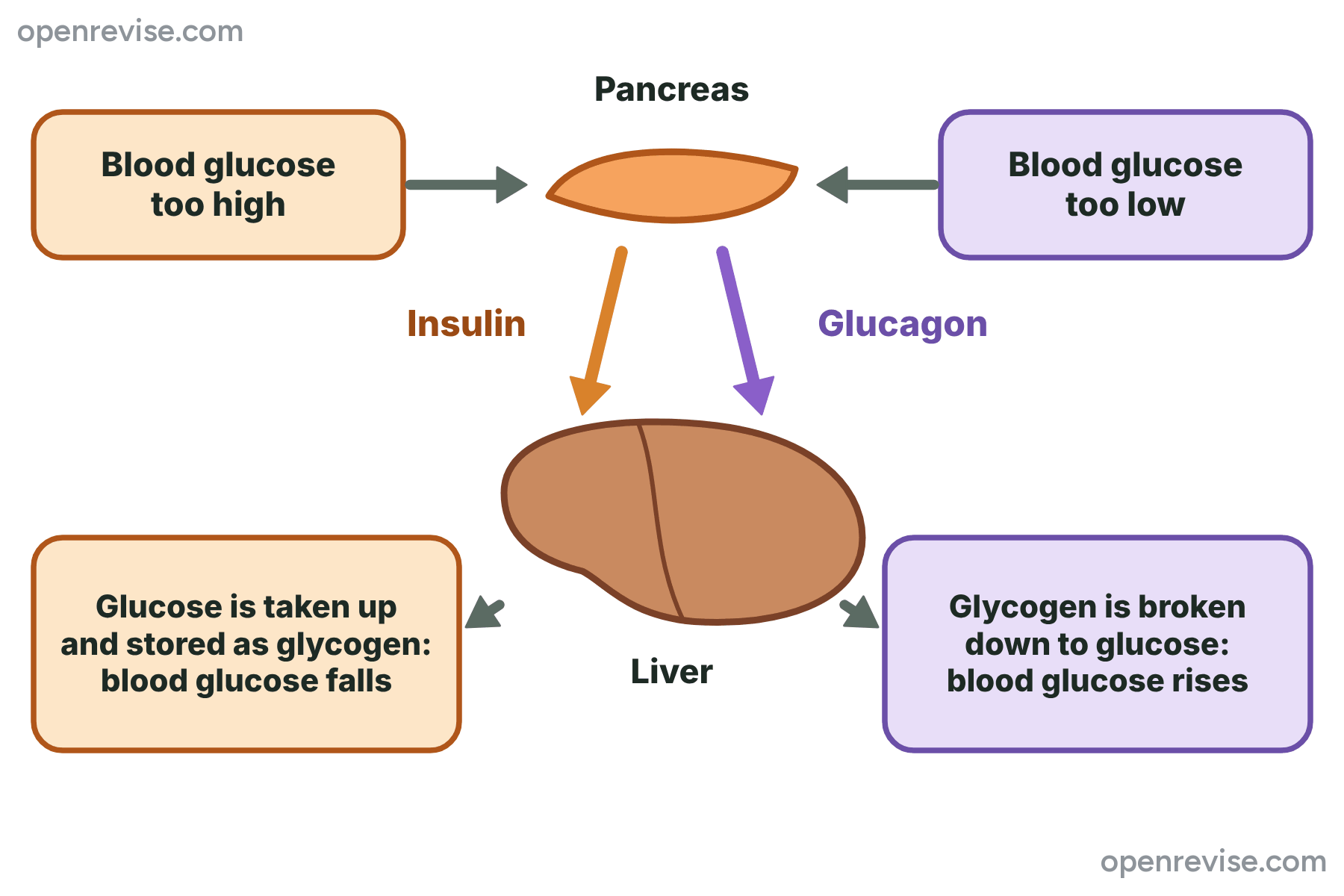
Insulin lowers the blood glucose, and glucagon raises it, and both act on the liver.
Blood glucose through the day
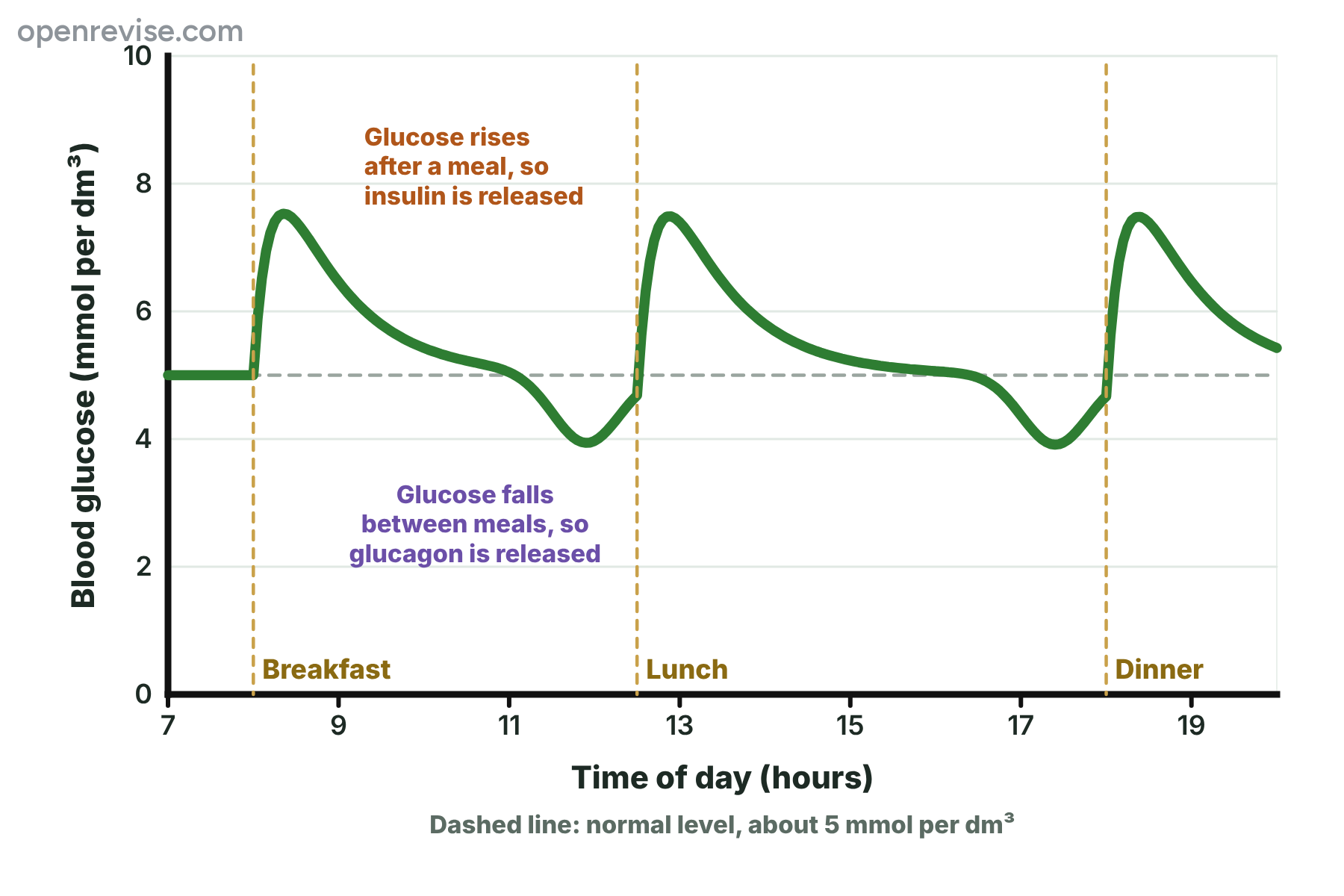
The blood glucose concentration stays close to 5 mmol per dm³, because insulin and glucagon act in opposite directions.
Insulin and glucagon
Insulin
- Released when the blood glucose is too high
- Made in the pancreas
- Makes cells take up glucose
- Liver converts glucose to glycogen
Glucagon
- Released when the blood glucose is too low
- Made in the pancreas
- Acts on the liver
- Liver converts glycogen to glucose, which is released
Interpreting the graph
The graph shows that the blood glucose concentration of a healthy person falls to 4.0 mmol per dm³ just before lunch. Explain what happens next, and what controls it.
Show the solutionHide the solution
- 1 The change The glucose concentration is below normal.
- 2 Receptor Cells in the pancreas detect the low concentration.
- 3 Response Glucagon is released, and carried to the liver.
- 4 Effect Glycogen is broken down to glucose, which enters the blood, and the concentration rises.
AnswerThe pancreas detects the low concentration, and releases glucagon. Glucagon makes the liver convert glycogen to glucose, which is released into the blood, so the concentration rises back to about 5 mmol per dm³. This is negative feedback.
Two hormones, one system
Insulin and glucagon work together, so the blood glucose concentration is controlled in both directions.
-
Too high
Insulin is released. Cells take up glucose, and the liver stores it as glycogen, so the concentration falls.
-
Too low
Glucagon is released. The liver breaks down glycogen to glucose, and releases it, so the concentration rises.
-
Normal
Both hormones are released at a low rate, and the concentration is steady.
-
Negative feedback
In each case, the response reverses the change, and returns the concentration to normal.
Case study
Glycogen stores in the long run
The liver of an adult can store about 100 g of glycogen, and the muscles store more, but the liver is the one that releases glucose into the blood. This lasts about a day of fasting. During a long run, the liver releases glycogen as glucose, which glucagon controls, and when the glycogen runs out, runners can suffer from a sudden loss of energy, which is called hitting the wall. This is why runners eat carbohydrates before and during a race, to replace the glucose.
Summary and exam focus
- Glucagon is released when the blood glucose concentration is too low.
- It makes the liver convert glycogen into glucose.
- Insulin and glucagon have opposite effects.
- Both are made in the pancreas, and both act on the liver.
- Together they are a negative feedback system.
Exam focus
Explain how insulin and glucagon work together to control the blood glucose concentration. (6 marks) (6 marks)
Use two clear halves: one for a high concentration, with insulin, cells taking up glucose and glycogen being made, and one for a low concentration, with glucagon and glycogen being broken down. Finish with negative feedback.
Key terms
The words this lesson expects you to use. Each one is linked from the first place it appears above.
- Glucagon
- A hormone made in the pancreas that raises the blood glucose concentration.
- Glycogen
- A storage carbohydrate, made from glucose, in the liver and muscles.
- Insulin
- A hormone made in the pancreas that lowers the blood glucose concentration.
- Pancreas
- A gland that makes insulin and glucagon.
- Liver
- The organ that stores glycogen, and releases glucose.
- Negative feedback
- A response that reverses a change.
- Antagonistic
- Having opposite effects, as insulin and glucagon do.
- Target organ
- An organ that responds to a hormone.
- Fasting
- Not eating for a period of time.
You've finished the notes
Check your understanding
Test yourself while it is fresh. Start with the flashcards, then try the exam questions.
Something here looks wrong?
Tell us what and we will go and look. It goes to whoever writes these pages, nobody else, and we do not ask who you are — so there is nothing to sign and nothing comes back to you.