Biology · Homeostasis
Insulin and Blood Glucose
After a meal, a lot of glucose enters the blood, but the level soon returns to normal. This lesson explains how the hormone insulin controls the concentration of glucose in the blood, and how this is an example of negative feedback.
Learning Objectives
- 1State where glucose in the blood comes from, and why the blood glucose concentration must be controlled.
- 2Describe the role of the pancreas in monitoring the blood glucose concentration and releasing insulin.
- 3Explain how insulin controls the blood glucose concentration, including the role of the liver and of glycogen.
- 4Explain why this control is a negative feedback system.
Retrieval practice
-
1
What is a hormone?
Show answerHide answer
A chemical messenger made in a gland and carried in the blood.
-
2
What is glucose used for in cells?
Show answerHide answer
Respiration, to release energy.
-
3
What is glycogen?
Show answerHide answer
A carbohydrate used to store glucose in the liver and the muscles.
-
4
What is the pancreas?
Show answerHide answer
A gland that makes digestive enzymes and hormones.
Glucose in the blood
Every cell needs a supply of glucose for respiration, and the blood carries it. The concentration of glucose in the blood is kept at about 5 mmol per dm³, and it is controlled by the hormone insulin. When you eat a meal that contains carbohydrate, the food is digested to glucose, which is absorbed into the blood in the small intestine, so the blood glucose concentration rises. If it stayed high, the blood would be too concentrated, and water would leave the cells by osmosis, and the cells would be damaged. The pancreas detects the rise and releases insulin.
How insulin works
Insulin is a hormone that is made in the pancreas, and carried in the blood.
-
The change
After a meal, glucose is absorbed into the blood, so the blood glucose concentration rises.
-
The receptor
Cells in the pancreas detect the high concentration of glucose in the blood.
-
The response
The pancreas releases the hormone insulin into the blood.
-
Target cells
Insulin is carried by the blood to the liver, the muscles and other cells. It makes the cells take up glucose from the blood.
-
In the liver
Insulin makes the liver convert glucose into glycogen, which it stores.
-
The result
The blood glucose concentration falls back to normal, and less insulin is released.
How insulin controls blood glucose
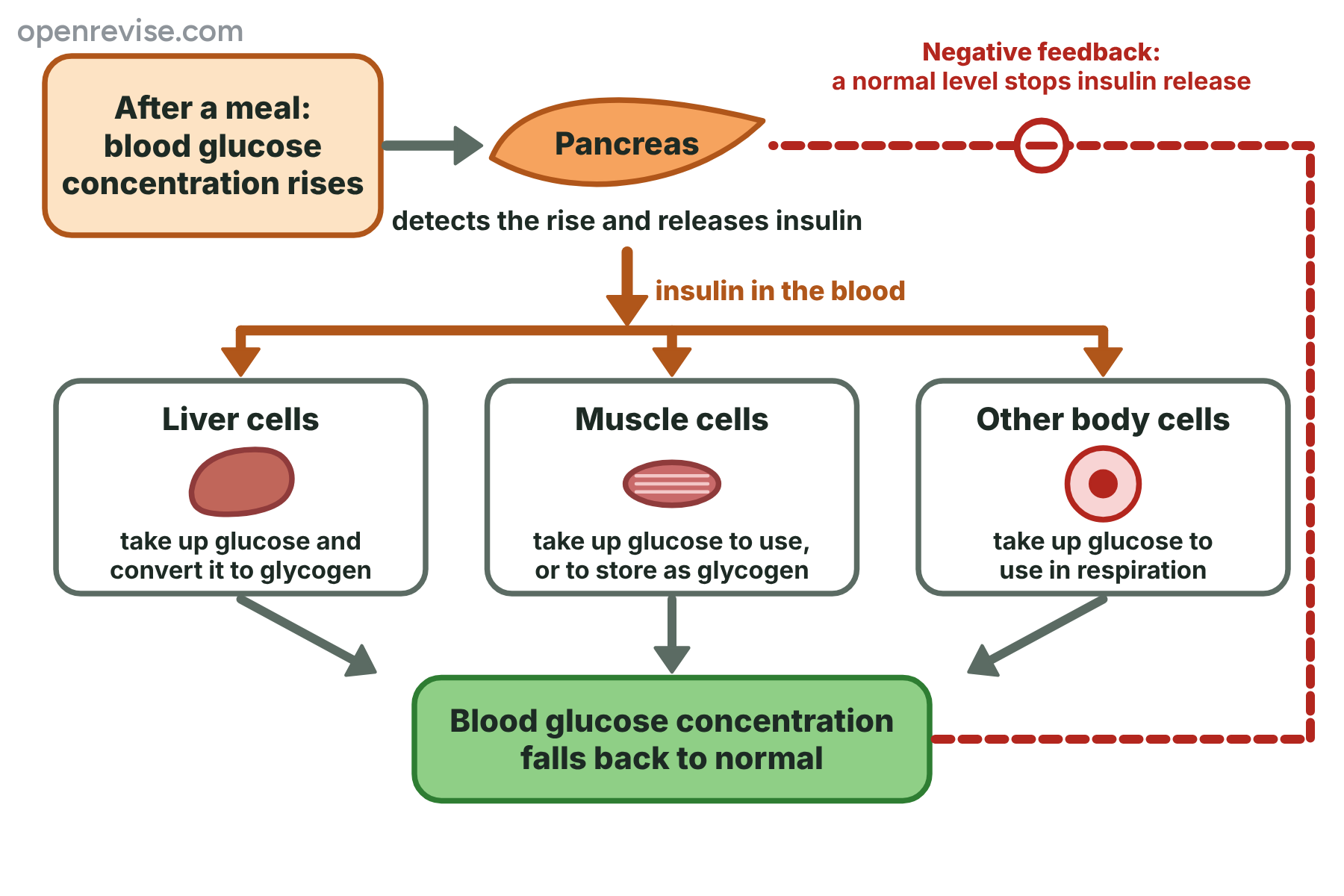
Insulin makes cells take up glucose from the blood, which lowers the blood glucose concentration.
Before and after insulin
Blood glucose too high
- Glucose rises after a meal
- Pancreas releases insulin
- Cells take up glucose
- Liver converts glucose to glycogen
Blood glucose back to normal
- Blood glucose falls
- Less insulin is released
- Glycogen is stored in the liver
- Cells have glucose for respiration
Rate of fall of blood glucose
After a meal, the blood glucose concentration of a healthy person rises to 8.0 mmol per dm³. Two hours later it has fallen to 5.0 mmol per dm³. Calculate the mean rate of fall in the blood glucose concentration, and explain what caused the fall.
Show the solutionHide the solution
- 1 Change 8.0 minus 5.0 is 3.0 mmol per dm³.
- 2 Rate 3.0 divided by 2 hours is 1.5 mmol per dm³ per hour.
- 3 Cause The high concentration of glucose caused the pancreas to release insulin.
- 4 Mechanism The cells took up glucose, and the liver stored it as glycogen, so the concentration fell.
AnswerThe mean rate of fall is 1.5 mmol per dm³ per hour. The fall was caused by insulin, which made the cells take up glucose, and the liver convert glucose to glycogen.
Negative feedback
The control of blood glucose is an example of negative feedback.
-
Change
The blood glucose concentration rises above normal.
-
Response
The pancreas releases insulin, which makes the glucose concentration fall.
-
Return to normal
As the concentration falls to normal, the pancreas releases less insulin.
-
Meaning
The response reverses the change, so it keeps the concentration steady.
Case study
Counting carbohydrates
A meal rich in refined carbohydrates, such as sugary drinks or white bread, is digested quickly, so the blood glucose concentration rises sharply, and the pancreas releases a lot of insulin. A meal with a lot of fibre, for example with wholegrain foods, is digested more slowly, so the glucose is absorbed more slowly, and the rise in the blood glucose concentration is smaller. This is one reason why a diet high in fibre is good for health, and why people with diabetes are advised to choose their carbohydrates carefully.
Summary and exam focus
- The blood glucose concentration is kept at about 5 mmol per dm³.
- The pancreas detects the concentration and releases insulin.
- Insulin makes cells take up glucose from the blood.
- The liver stores the glucose as glycogen.
- This is negative feedback.
Exam focus
Explain how the blood glucose concentration is controlled after a meal that is rich in carbohydrate. (4 marks) (4 marks)
Follow the chain in order: glucose absorbed, concentration rises, pancreas detects it and releases insulin, insulin makes cells take up glucose and the liver store it as glycogen, concentration falls.
Key terms
The words this lesson expects you to use. Each one is linked from the first place it appears above.
- Insulin
- A hormone that is made in the pancreas, which lowers the blood glucose concentration.
- Pancreas
- A gland that makes insulin, glucagon and digestive enzymes.
- Blood glucose concentration
- The amount of glucose in the blood, in mmol per dm³.
- Glycogen
- A storage carbohydrate, which is made from glucose in the liver and muscles.
- Liver
- An organ that stores glycogen, and converts glucose to glycogen.
- Negative feedback
- A response that reverses a change.
- Target cell
- A cell that has receptors for a hormone, and responds to it.
- Digestion
- The breakdown of food into small, soluble molecules.
- Absorption
- The movement of digested food into the blood.
You've finished the notes
Check your understanding
Test yourself while it is fresh. Start with the flashcards, then try the exam questions.
Something here looks wrong?
Tell us what and we will go and look. It goes to whoever writes these pages, nobody else, and we do not ask who you are — so there is nothing to sign and nothing comes back to you.