Biology · Homeostasis
Thermoregulation and the Skin
When you are hot your skin sweats, and when you are cold you shiver. This lesson is for separate Biology only: Combined Science students do not need it. It explains how thermoregulation takes place, with reference to the dermis, the epidermis, the hypothalamus and shivering.
Learning Objectives
- 1Describe the structure of the skin, and the roles of the epidermis and the dermis in thermoregulation.
- 2Describe the role of the hypothalamus in controlling body temperature.
- 3Describe how sweating cools the body, and how shivering warms it.
- 4Explain how the skin, the hypothalamus and the muscles act as a negative feedback system.
Retrieval practice
-
1
What is the normal body temperature?
Show answerHide answer
About 37 °C.
-
2
What is negative feedback?
Show answerHide answer
A response that reverses a change and returns a condition to normal.
-
3
What is an effector?
Show answerHide answer
A muscle or a gland that carries out a response.
-
4
What is respiration?
Show answerHide answer
The reaction that releases energy from glucose in cells.
The skin and temperature
Humans are warm-blooded, which means that the body temperature is kept at about 37 °C, whatever the temperature outside. Thermoregulation is the control of body temperature, and it depends on three things: receptors that detect the temperature, a coordination centre in the brain that decides what to do, and effectors that carry out the response. The skin contains many of the receptors and the effectors, and the hypothalamus, in the brain, is the coordination centre.
The structure of the skin
The skin has three main layers, and each has a role.
-
Epidermis
It is the thin outer layer. It is made of cells that are made at the base and move upwards, becoming flattened and dead at the surface. It forms a barrier, so it stops pathogens getting in and water being lost, and it has no blood vessels. Sweat leaves the body through pores in the epidermis.
-
Dermis
It is the layer below the epidermis. It contains sweat glands, hair follicles with hair erector muscles, blood vessels and temperature receptors.
-
Fat layer
It lies beneath the dermis. It is a layer of fat cells, which stores energy and insulates the body, so it reduces heat loss.
A section through the skin
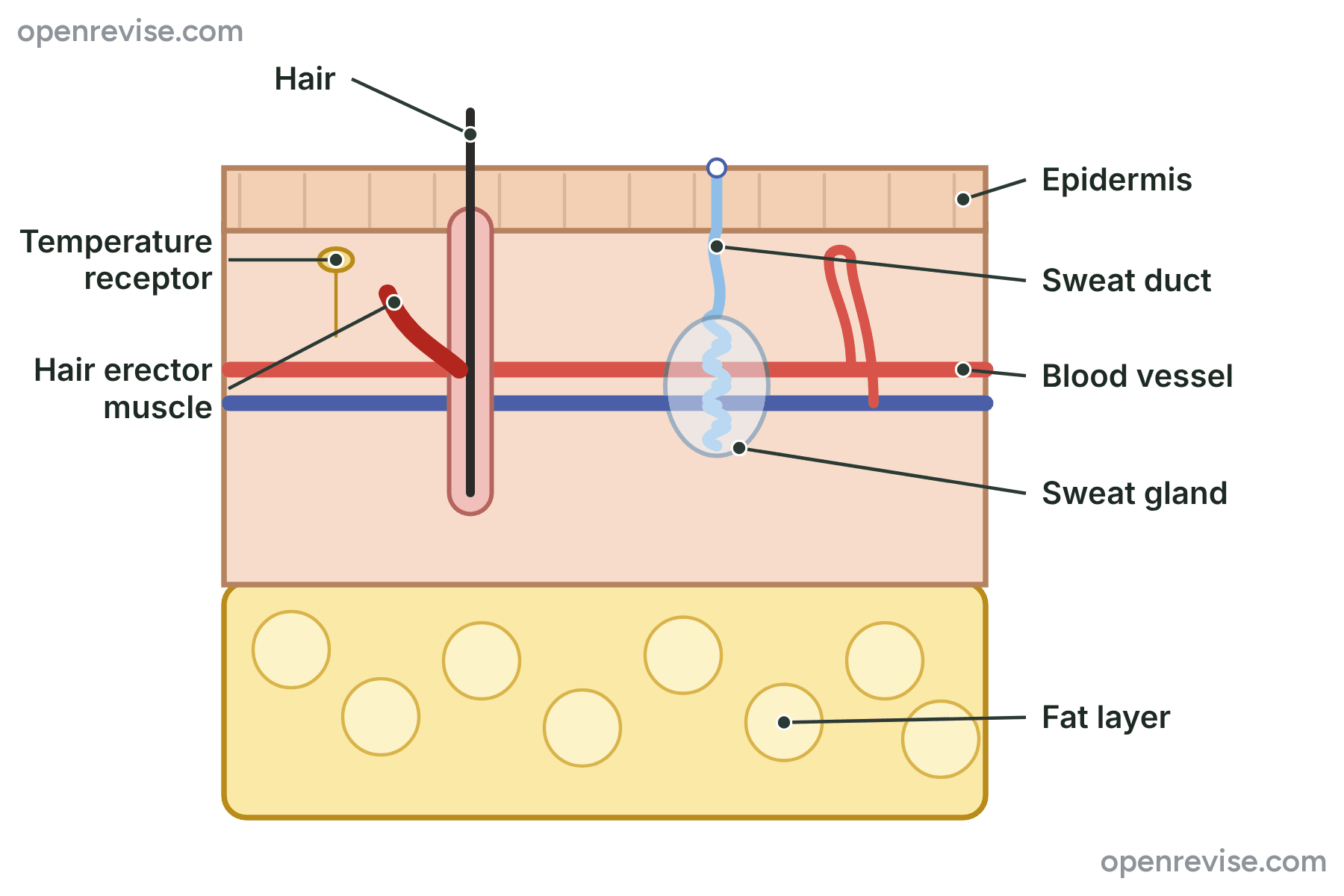
The skin has an epidermis, a dermis and a layer of fat, and the dermis contains the sweat glands and blood vessels.
The role of the hypothalamus
The hypothalamus is a small part of the brain that acts as the body's thermostat.
-
Receptors
It has receptors that monitor the temperature of the blood that flows through the brain. Temperature receptors in the skin send impulses to it about the temperature of the surroundings.
-
Coordination centre
It compares the temperature with the normal level, and decides which responses are needed.
-
Impulses to the effectors
It sends nerve impulses to the effectors, which are the sweat glands, the muscles and the blood vessels in the skin.
-
Negative feedback
The responses reverse the change in temperature, so the temperature returns to about 37 °C, and the hypothalamus stops sending the signals.
When the body is too hot
The effectors in the skin respond to cool the body.
-
Sweating
The sweat glands in the dermis release more sweat, which leaves the surface of the skin through the pores. As the sweat evaporates, it takes heat from the skin, which cools the body.
-
Hairs
The hair erector muscles relax, so the hairs lie flat, which stops air being trapped, so heat can be lost.
-
Blood vessels
The blood vessels in the skin widen, so more heat is lost from the skin. This is vasodilation, which is covered in the next lesson at Higher tier.
When the body is too cold
The effectors respond to warm the body, and to prevent heat loss.
-
Shivering
The skeletal muscles contract and relax very quickly, without being controlled. Respiration in the muscle cells releases heat energy, and this warms the blood.
-
Sweating
The sweat glands release little or no sweat, so less heat is lost by evaporation.
-
Hairs
The hair erector muscles contract, so the hairs stand up, which traps a layer of air that insulates the skin.
-
Blood vessels
The blood vessels in the skin narrow, so less heat is lost from the skin. This is vasoconstriction, which is covered in the next lesson at Higher tier.
Too hot and too cold
Too hot
- Sweat glands release more sweat
- Sweat evaporates, cooling the skin
- Hairs lie flat
- Muscles do not shiver
Too cold
- Sweat glands release little sweat
- Muscles shiver, releasing heat from respiration
- Hairs stand up, trapping air
- Fat layer insulates the body
Describing a thermoregulation response
A person walks out of a warm house into very cold air. Describe how the skin and the hypothalamus bring about a response that keeps the body temperature steady.
Show the solutionHide the solution
- 1 Detection The temperature receptors in the skin detect the drop in temperature of the surroundings, and the hypothalamus detects that the blood is cooler.
- 2 Coordination The hypothalamus decides that the body needs to be warmed, and sends impulses to the effectors.
- 3 Response The muscles shiver, which releases heat from respiration, and less sweat is released from the sweat glands.
- 4 Feedback The body temperature rises towards 37 °C, so the signals from the hypothalamus are reduced. This is negative feedback.
AnswerTemperature receptors in the skin detect the cold, and send impulses to the hypothalamus, which sends impulses to the muscles, so they shiver, and to the sweat glands, so they release less sweat.
Case study
Hypothermia and heat stroke
If the thermoregulation system is overwhelmed, the results can be serious. In hypothermia, the body temperature falls below about 35 °C, for example after a long time in cold water. The enzymes in the body slow down, and the person may become confused and sleepy, and the heart can stop. In heat stroke, the body temperature rises above about 40 °C, for example in a very hot place with little water. The sweating can fail, and the enzymes can be denatured. Both conditions need urgent medical treatment, to bring the temperature back to normal.
Summary and exam focus
- The epidermis is the outer barrier, and the dermis contains the sweat glands and receptors.
- The hypothalamus monitors the temperature of the blood and receives information from the skin.
- Sweat evaporates and cools the body when it is hot.
- Shivering releases heat from respiration when it is cold.
- Thermoregulation works by negative feedback.
Exam focus
Describe how the body responds when it is too cold, and when it is too hot, including the roles of the skin and the hypothalamus. (6 marks) (6 marks)
Start with the hypothalamus detecting the temperature and sending impulses. Then give one response for each case that you can explain in full: sweating and evaporation for too hot, and shivering with heat from respiration for too cold.
Key terms
The words this lesson expects you to use. Each one is linked from the first place it appears above.
- Epidermis
- The thin outer layer of the skin.
- Dermis
- The layer of the skin below the epidermis, which contains sweat glands, blood vessels and receptors.
- Hypothalamus
- The part of the brain that monitors body temperature and coordinates the response.
- Sweat gland
- A gland in the dermis that releases sweat.
- Evaporation
- The change of a liquid into a gas, which takes in heat from the surroundings.
- Shivering
- Rapid, uncontrolled contractions of the muscles, which release heat.
- Hair erector muscle
- A muscle in the dermis that moves a hair.
- Thermoregulation
- The control of body temperature.
- Temperature receptor
- A cell in the skin that detects temperature.
You've finished the notes
Check your understanding
Test yourself while it is fresh. Start with the flashcards, then try the exam questions.
Something here looks wrong?
Tell us what and we will go and look. It goes to whoever writes these pages, nobody else, and we do not ask who you are — so there is nothing to sign and nothing comes back to you.