Biology · Homeostasis
Vasoconstriction and Vasodilation (Higher tier)
The skin of a hot, tired runner is red and flushed, while the fingers of a person in the snow turn white. This lesson is for separate Biology only, and for the Higher tier only: Combined Science and Foundation students do not need it. It explains how vasodilation and vasoconstriction of the blood vessels in the skin control the loss of heat from the body.
Learning Objectives
- 1(Higher tier) Describe vasodilation and vasoconstriction of the blood vessels in the skin.
- 2(Higher tier) Explain how vasodilation increases heat loss, and how vasoconstriction reduces heat loss.
- 3(Higher tier) Describe the role of the hypothalamus in these responses.
- 4(Higher tier) Explain how all the responses work together as a negative feedback system.
Retrieval practice
-
1
Which part of the brain monitors body temperature?
Show answerHide answer
The hypothalamus.
-
2
What does the dermis contain?
Show answerHide answer
Sweat glands, hair follicles, blood vessels and receptors.
-
3
How does shivering warm the body?
Show answerHide answer
Respiration in the muscles releases heat.
-
4
What is negative feedback?
Show answerHide answer
A response that reverses a change, and returns a condition to normal.
Blood vessels in the skin
The dermis contains a network of blood vessels. Blood carries heat from the warm parts of the body, such as the liver and the muscles, to the skin. If the blood flows close to the surface of the skin, heat can be lost from it to the surroundings. If the blood is kept away from the surface, less heat is lost. The body controls the heat loss by changing the diameter of the blood vessels, which supply the skin, and this is how the skin can lose a lot of heat, or very little, without changing the temperature of the blood in the centre of the body.
Vasodilation
Vasodilation happens when the body is too hot.
-
The change
The hypothalamus detects that the blood is too warm, and sends impulses to the muscles in the walls of the blood vessels in the dermis. These muscles relax, so the vessels get wider.
-
The effect
More blood flows through the vessels that are close to the surface of the skin.
-
Heat loss
More heat is transferred from the blood to the surroundings, mainly by radiation, so the skin is warmer, and often redder.
-
Result
The body temperature falls back towards 37 °C.
Vasoconstriction
Vasoconstriction happens when the body is too cold.
-
The change
The hypothalamus detects that the blood is too cool, and sends impulses to the muscles in the walls of the blood vessels in the dermis. These muscles contract, so the vessels get narrower.
-
The effect
Less blood flows through the vessels that are close to the surface of the skin. More blood is kept deeper in the body.
-
Heat loss
Less heat is transferred to the surroundings, so the skin is cooler, and often paler.
-
Result
The body temperature rises back towards 37 °C.
Blood vessels in the skin
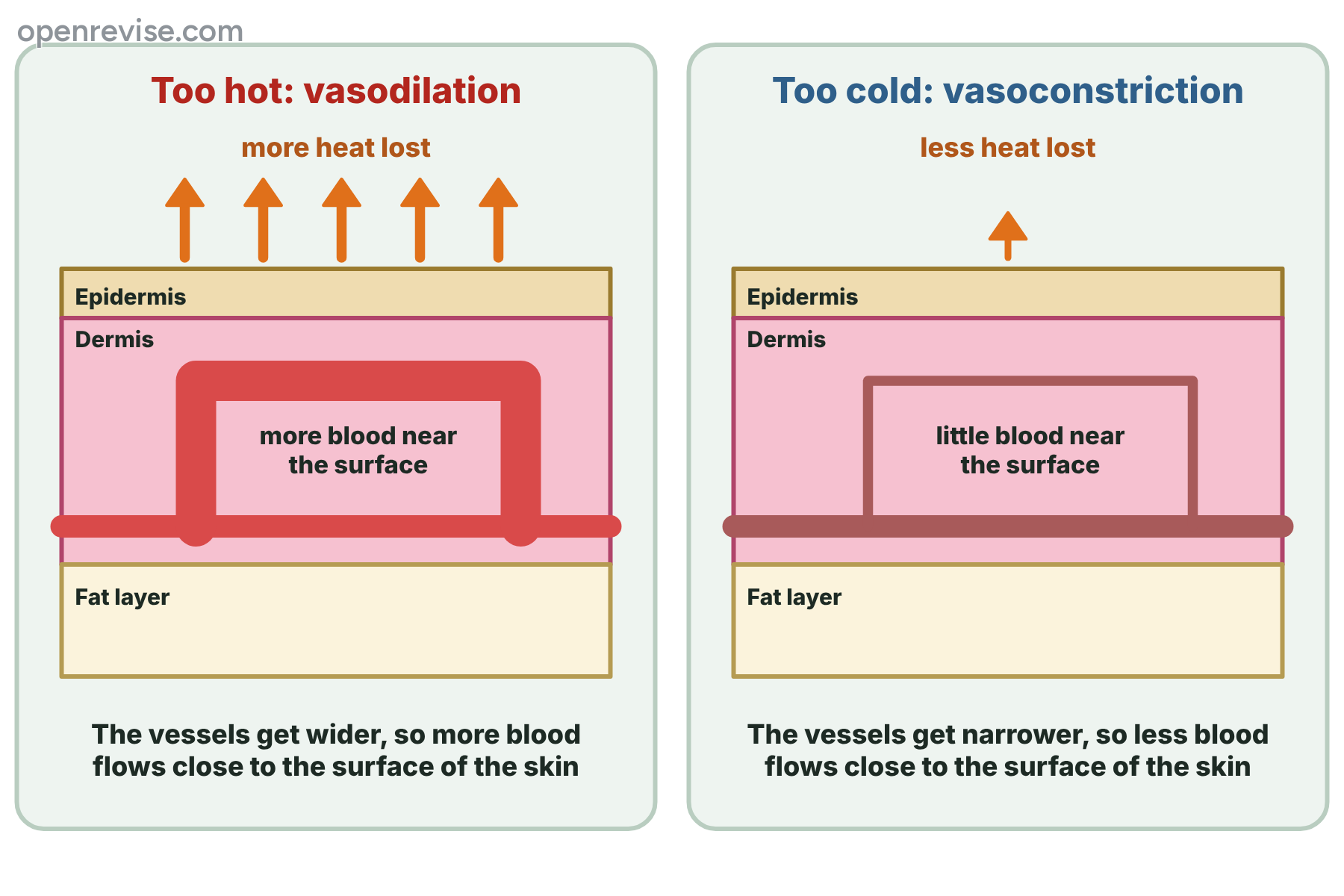
In vasodilation the vessels widen and more heat is lost, and in vasoconstriction they narrow and less heat is lost.
The hypothalamus controls the response
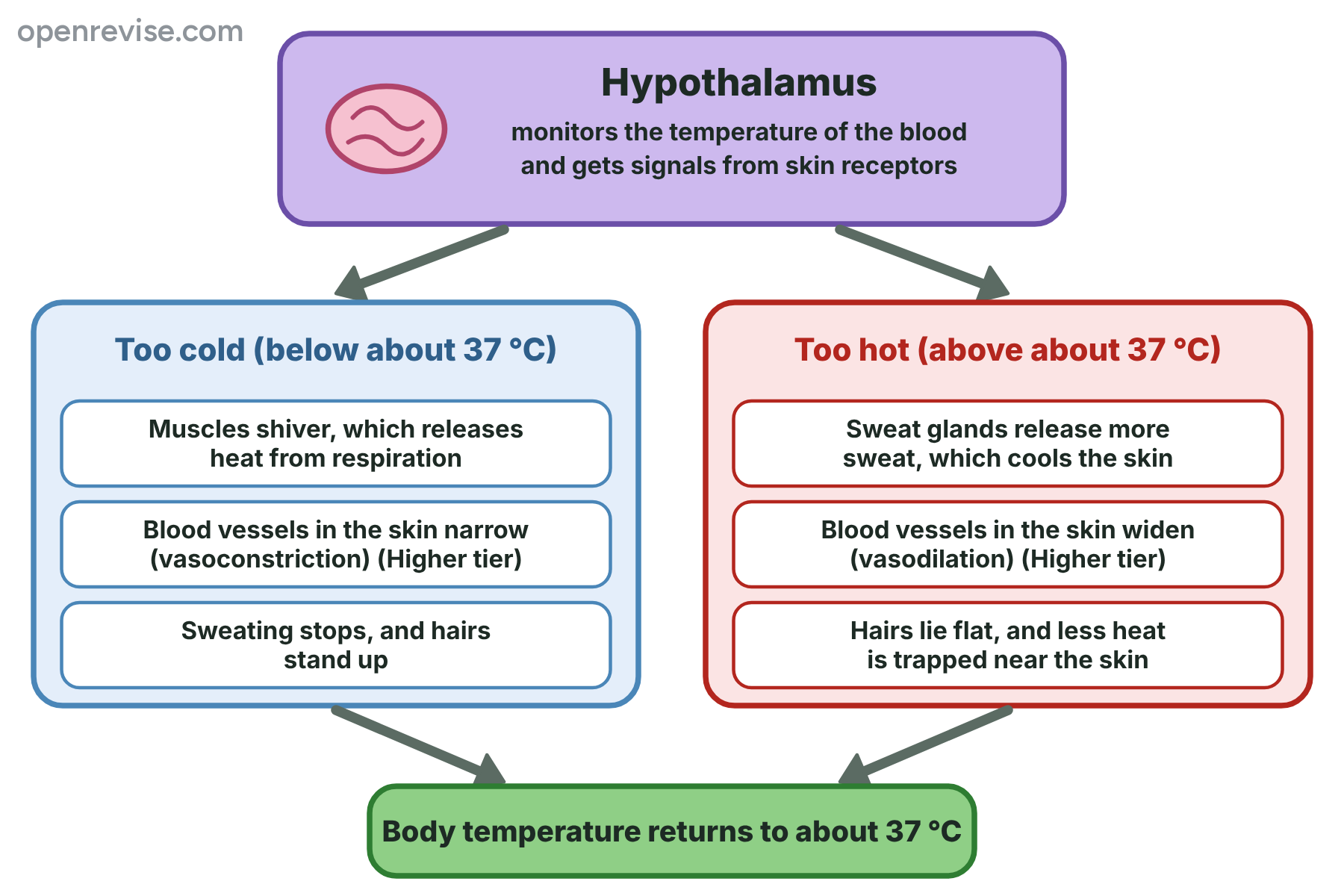
The hypothalamus coordinates the responses that return the body temperature to about 37 °C.
Vasodilation and vasoconstriction
Vasodilation (too hot)
- Muscles in the vessel walls relax
- Vessels get wider
- More blood near the skin surface
- More heat lost, so the body cools
Vasoconstriction (too cold)
- Muscles in the vessel walls contract
- Vessels get narrower
- Less blood near the skin surface
- Less heat lost, so the body stays warm
Explaining skin colour
A person who has been running has a red, flushed face. Explain why, and say what will happen to the skin when the person has cooled down.
Show the solutionHide the solution
- 1 Cause Running warms the body, and the hypothalamus detects the warmer blood.
- 2 Response Impulses cause the vessels in the dermis to widen, which is vasodilation.
- 3 Effect More blood flows near the surface, so the skin looks red, and more heat is lost to the surroundings.
- 4 Feedback When the temperature has fallen, the signals stop, and the vessels narrow again.
AnswerThe blood vessels in the skin have widened by vasodilation, so more blood flows near the surface, and more heat is lost. When the body has cooled, the vessels narrow again, and the skin returns to a normal colour.
Common errors
These are the mistakes that most often lose marks.
-
Moving vessels
Blood vessels do not move up and down in the skin. The vessels widen or narrow, and the blood flows more or less close to the surface.
-
Wrong words
Say vasodilation or vasoconstriction with the effect. Do not say that the vessels open or close.
-
Heat lost
The heat is lost from the blood to the surroundings, not from the skin cells. More blood near the surface means more heat is lost.
-
Shivering
It warms the body, because the muscles release heat from respiration.
Case study
Why fingers go white in the cold
In the cold, the hands and feet are often the first parts of the body to get cold. The hypothalamus causes vasoconstriction in the blood vessels of the skin, so that less blood flows to the fingers, and less heat is lost. This keeps the blood in the core of the body warm, which protects the organs, but the fingers become pale, and cold, and can be painful. In severe cold, the supply of blood to the fingers can be so low that the cells are damaged, which is called frostbite. This is one reason why people wear gloves.
Summary and exam focus
- Vasodilation widens the vessels in the skin, so more heat is lost.
- Vasoconstriction narrows the vessels, so less heat is lost.
- The hypothalamus sends impulses to muscles in the vessel walls.
- The vessels widen when it is hot, and narrow when it is cold.
- This is part of a negative feedback system.
Exam focus
Explain how vasoconstriction and vasodilation help to control the temperature of the body. (4 marks) (4 marks)
Link each term to the diameter of the vessels, the amount of blood near the skin surface, and the heat lost, in that order. Say which one happens when the body is too hot, and which when it is too cold.
Key terms
The words this lesson expects you to use. Each one is linked from the first place it appears above.
- Vasodilation
- The widening of the blood vessels in the skin, so that more heat is lost.
- Vasoconstriction
- The narrowing of the blood vessels in the skin, so that less heat is lost.
- Radiation
- The transfer of heat from a warm object to its cooler surroundings.
- Dermis
- The layer of the skin that contains the blood vessels and the sweat glands.
- Hypothalamus
- The part of the brain that coordinates the control of body temperature.
- Core temperature
- The temperature of the organs deep inside the body.
- Negative feedback
- A response that reverses a change.
- Effector
- A muscle or a gland that carries out a response.
- Thermoregulation
- The control of body temperature.
You've finished the notes
Check your understanding
Test yourself while it is fresh. Start with the flashcards, then try the exam questions.
Something here looks wrong?
Tell us what and we will go and look. It goes to whoever writes these pages, nobody else, and we do not ask who you are — so there is nothing to sign and nothing comes back to you.